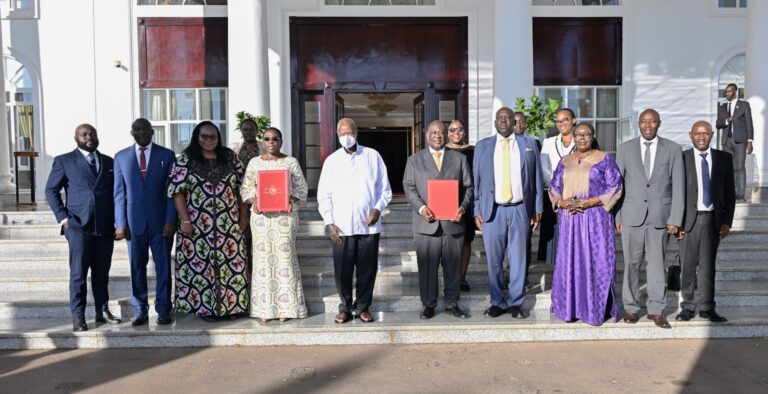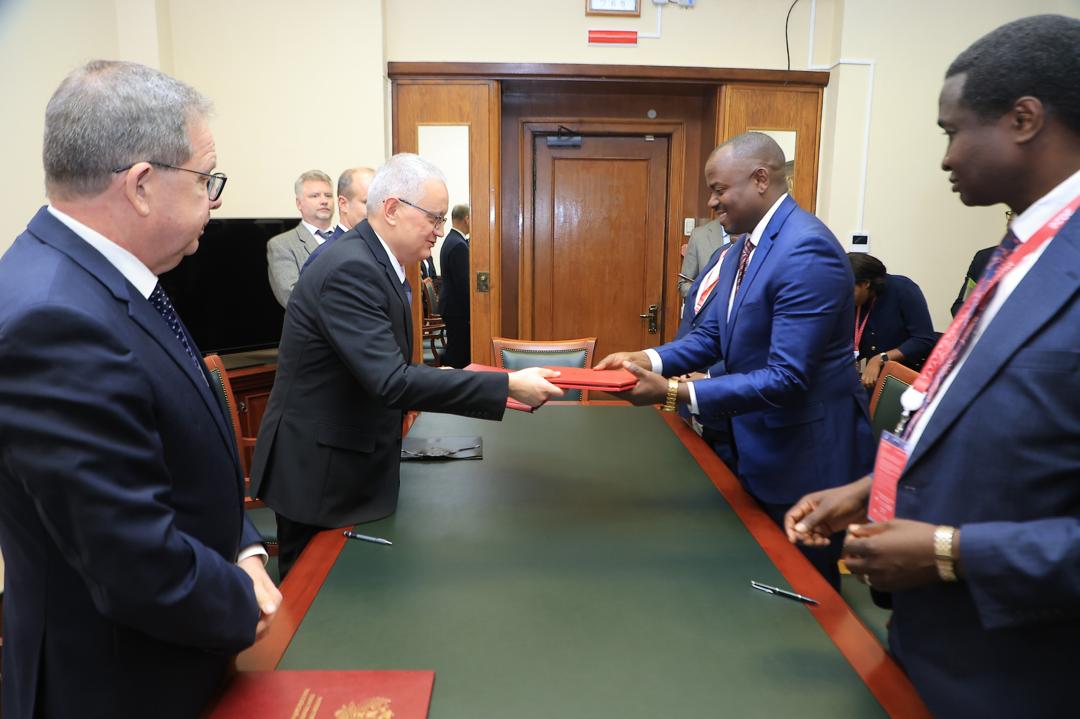
MOSCOW, RUSSIA | Uganda and the Russian Federation have signed a reciprocal visa-waiver agreement for holders of diplomatic and service passports, marking a step towards strengthening official engagement and expanding bilateral cooperation in trade, investment, education and technology.

The agreement was signed in Moscow on 28 October 2026 by Hon. Haruna Kyeyune Kasolo, Uganda’s Minister of State for Foreign Affairs in charge of Regional Affairs, and Mr. Georgy Borisenko, Russia’s Deputy Minister of Foreign Affairs, on the sidelines of the Third Russia–Africa Summit. The signing was confirmed by the Russian Foreign Ministry.
The agreement is intended to facilitate official travel between the two countries by removing visa requirements for eligible diplomatic and service passport holders. It does not constitute a general visa-free arrangement for ordinary passport holders. Under the announced provisions, the agreement will enter into force 30 days after both governments complete their respective domestic procedures and notify each other through diplomatic channels.
The agreement comes as Kampala and Moscow seek to translate longstanding diplomatic relations into practical economic outcomes. Easier official travel can reduce administrative barriers for government delegations, diplomatic consultations, technical exchanges and negotiations on bilateral cooperation.Its broader significance will depend on how effectively both governments use the arrangement to advance specific projects and institutional partnerships.
Discussions accompanying the signing covered trade, agricultural exports, investment, information and communication technology, and educational cooperation. Russia expressed interest in improving the visibility and market access of Ugandan coffee and other agricultural products, while Uganda invited Russian investors to explore opportunities in agro-industrialisation, mineral and energy development, infrastructure and manufacturing. These priorities align with Uganda’s wider ambition to expand production, strengthen value addition and access international markets through regional and continental integration.
Trade statistics point to opportunities for diversification
Available trade data demonstrate an existing commercial relationship with considerable scope for expansion. According to UN Comtrade data presented by Trading Economics, Uganda exported approximately US$39.3 million worth of goods to Russia in 2024. Coffee, tea, spices and related products accounted for approximately US$35.18 million, representing nearly 90 per cent of the recorded exports. This concentration highlights both an established Ugandan export strength and the opportunity to diversify trade into processed agricultural products, food manufacturing and other competitive sectors.
Uganda’s coffee industry is particularly relevant. The country exported approximately US$1.55 billion in coffee in 2024, according to World Bank World Integrated Trade Solution data based on UN Comtrade. Russia therefore represents one of several international markets in which Ugandan producers and exporters can pursue greater commercial opportunities. For Uganda, the strategic objective should extend beyond increasing export volumes to promoting domestic processing, packaging, product certification and stronger connections between producers and international buyers. Such measures can increase the share of export value retained within the domestic economy.
Education remains another established area of cooperation. According to the information provided by Ugandan officials, approximately 50 government-funded university scholarships are available to Ugandan students annually, alongside opportunities financed privately. Expanding academic exchanges could strengthen skills development in science, engineering, information technology, agriculture and other fields relevant to Uganda’s development priorities. Cooperation in information and communication technology could similarly support knowledge exchange, digital capacity-building and institutional modernisation. However, progress in these areas will require clearly defined projects, implementation timelines and measurable outcomes.
Uganda’s participation in the East African Community (EAC), comprising eight partner states, and the African Continental Free Trade Area (AfCFTA), which brings together 54 African Union member states that have signed the agreement, also offers potential investors access to wider regional and continental markets, subject to applicable trade rules and market-access requirements.
Addressing African and Russian foreign ministers in Moscow, Minister Kasolo called for stronger economic partnerships supported by agreed targets, effective implementation and regular reviews. He reaffirmed Uganda’s readiness to work with Russia, the African Union and other African countries.
The visa-waiver agreement provides a practical instrument for facilitating official engagement, but its economic impact will ultimately depend on the agreements, investments and partnerships that follow.Priorities include improving market access for Ugandan exports, supporting business-to-business connections, expanding scholarships, strengthening technical cooperation and ensuring that bilateral discussions produce tangible benefits for enterprises and communities.
As Uganda and Russia deepen their engagement, the agreement represents an opportunity to connect diplomatic mobility with commercial diplomacy and development cooperation. Its long-term value will be measured not simply by easier official travel, but by the extent to which both countries convert stronger institutional contact into sustainable trade, investment, skills development and mutually beneficial economic growth.