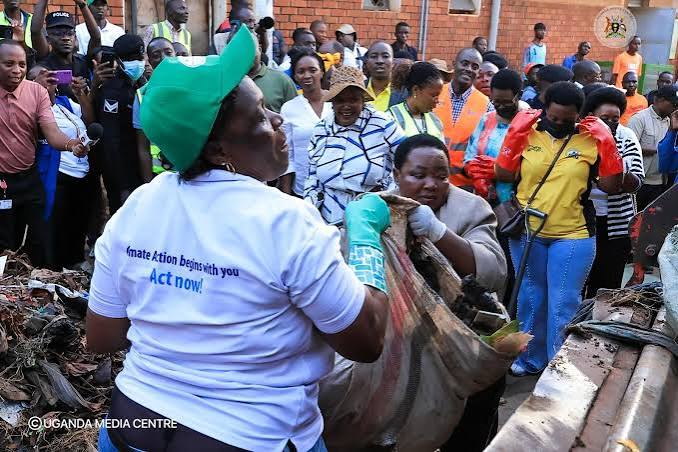
On the last Saturday of every month, Uganda will now pause for three hours not for celebration, politics, or commerce, but for a shared act of civic responsibility. From 7:00 a.m. to 10:00 a.m., communities across the country are expected to clean homes, markets, roads, drainage channels, schools, health centres and public spaces under the newly launched National Cleaning Days Initiative, a Cabinet-approved programme operating under the theme, “A Clean Uganda is Everybody’s Responsibility.” The initiative seeks to improve sanitation, reduce preventable diseases and restore a culture of collective responsibility.
The launch attracted widespread public participation, across Kampala and other towns, residents, local leaders, security agencies, religious institutions and businesses joined government officials in sweeping streets, clearing blocked drainage channels and collecting solid waste. It was a rare moment when public service became visibly communal rather than institutional. Yet, beneath the enthusiasm of the inaugural exercise lies a deeper policy question.
Can a monthly clean-up transform urban sanitation without equally transforming waste management systems? The Success and the Warning. One of the most striking observations from the first National Cleaning Day was not simply the number of people carrying brooms and wheelbarrows. It was the enormous piles of garbage left along roadsides after the exercise.
In many locations, communities successfully collected waste from drainage channels and neighbourhoods, but disposal systems struggled to keep pace. The sight of accumulated rubbish awaiting collection revealed an uncomfortable truth: public participation alone cannot compensate for inadequate waste management infrastructure.
Ironically, the exercise exposed both Uganda’s greatest strength and one of its biggest institutional gaps. The strength was unmistakab, thousands of Ugandans willingly participated once they were given a clear national call to action. Contrary to perceptions that civic engagement is declining, the exercise demonstrated that communities remain willing to contribute voluntarily when they understand the purpose and see collective participation. The weakness, however, was equally visible, cleaning campaigns cannot succeed sustainably if waste collection, recycling systems, landfill capacity and municipal logistics are not strengthened simultaneously.
For many Ugandans, the initiative also carried a sense of familiarity, Community cleaning is not new. Older generations remember Bulungi Bwansi, a community self-help tradition that encouraged neighbours to work together in maintaining roads, drainage systems and public spaces. Over time, however, urbanisation, changing lifestyles and weakening community structures gradually diminished that culture.

The National Cleaning Days initiative can therefore be viewed not simply as a new government programme but as an attempt to revive civic values that once defined local governance. Across Africa, similar models already exist, Rwanda’s Umuganda, held on the last Saturday of each month, has become internationally recognised for combining community service with national development. Other African countries have introduced periodic sanitation campaigns with varying degrees of success.
The lesson from across the continent is clear: sustainability depends less on the launch than on consistency. Clean Cities Require More Than Clean-Up Days, Public health experts consistently argue that sanitation is one of the most cost-effective investments governments can make.
Uganda’s Ministry of Health estimates that nearly 75 percent of the country’s disease burden is preventable, with poor sanitation contributing significantly to illnesses such as malaria, diarrhoeal diseases and typhoid. Yet cleaner cities require more than monthly mobilisation.
They require reliable waste collection, accessible public bins, effective drainage systems, recycling industries, environmental education, enforcement against illegal dumping and stronger municipal planning. Without these complementary investments, communities risk cleaning the same waste month after month.
The significance of Uganda’s National Cleaning Days extends beyond sanitation. It offers an opportunity to rebuild civic responsibility at a time when many African cities face rapid urbanisation, rising waste generation and increasing pressure on public infrastructure.
Development is often measured through roads, buildings and economic growth, but equally important is the relationship between citizens and public spaces.
Clean streets, functioning drainage systems and orderly neighborhoods are indicators not only of municipal efficiency but also of civic culture. If citizens continue participating and public institutions consistently fulfil their responsibilities, the initiative could evolve into something much larger than a monthly clean-up. It could become a national culture.
The first National Cleaning Day was always going to be symbolic. The second will measure commitment. The sixth will test consistency. The twelfth will reveal whether Uganda is witnessing the beginning of a lasting behavioral shift or another well-intentioned campaign that gradually fades from public memory.
For Africa, the message is equally relevant. Building cleaner cities is not simply about removing rubbish. It is about strengthening the partnership between government, communities and citizens in shaping healthier, more resilient and more liveable societies. The broom may clear today’s streets but Only sustained civic responsibility and effective public systems will keep them clean tomorrow.