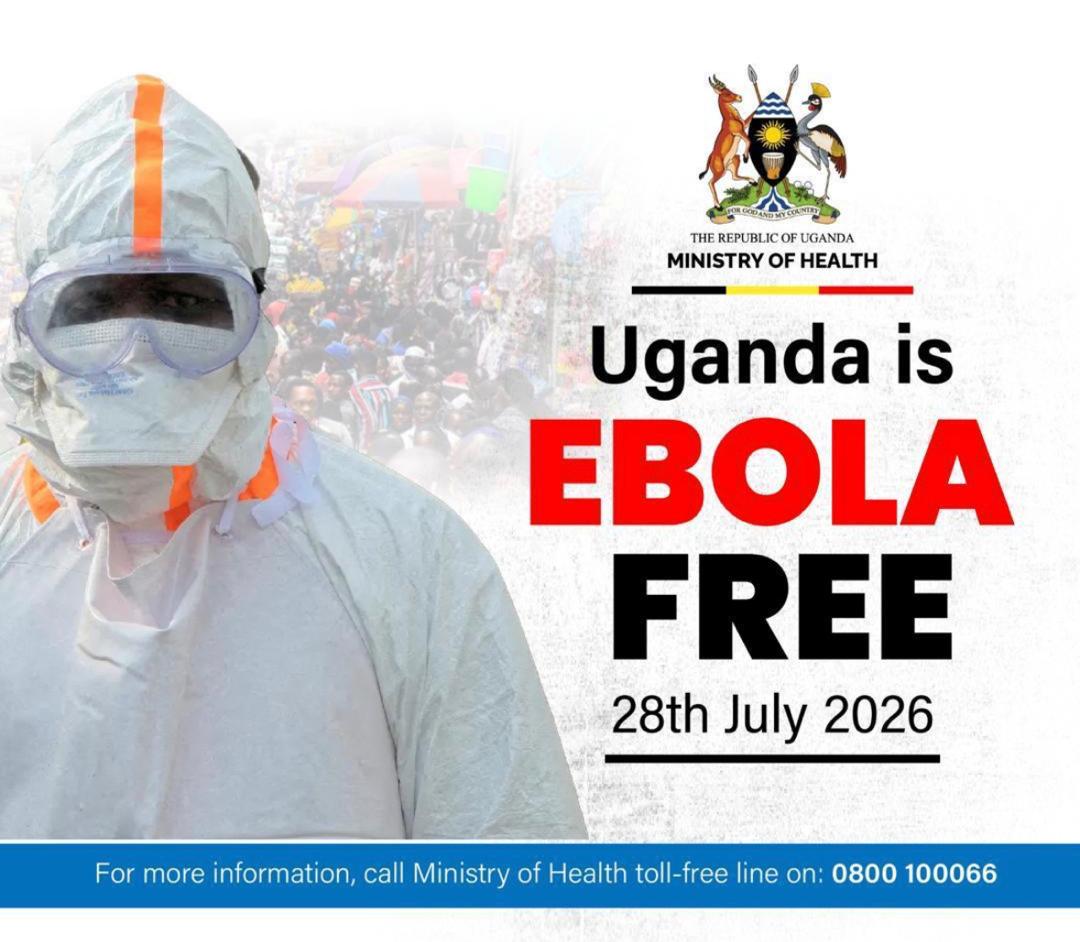
KAMPALA, Uganda — Uganda has officially declared the end of its 2026 Ebola Disease outbreak, marking another significant milestone in Africa’s expanding capacity to detect, contain, and manage complex public health emergencies. The announcement, made by the Ministry of Health on 28 July 2026, follows the successful completion of the internationally recognized 42-day monitoring period after the discharge of the country’s last locally transmitted patient on 16 June 2026, with no additional cases detected. Beyond representing a national public health achievement, Uganda’s declaration contributes to a broader continental conversation about Africa’s growing scientific capabilities, regional health diplomacy, and the evolution of international outbreak response frameworks.
Uganda’s 2026 Ebola outbreak presented an epidemiological profile distinct from many previous outbreaks experienced across Africa. According to the Ministry of Health, the outbreak originated from a fully documented importation event involving cases from the Democratic Republic of the Congo (DRC). Public health authorities were able to identify the source of infection, reconstruct every transmission chain, quarantine all identified contacts, and complete comprehensive surveillance without detecting unexplained community transmission.
The outbreak resulted in:
- 20 confirmed cases
- 18 recoveries
- 2 fatalities
- 15 imported infections from DRC
- 5 locally infected Ugandan healthcare and care workers
The ability to characterize every confirmed case provided an unusually complete epidemiological picture, allowing authorities to manage the outbreak with exceptional precision. Rather than relying solely on conventional surveillance methods, Uganda deployed rapid molecular diagnostics, genome sequencing, digital surveillance systems, real-time contact tracing, and strengthened incident management structures tools that increasingly define modern epidemic response. The Ministry further revealed that genomic studies identified the circulating virus as a distinct Bundibugyo ebolavirus variant, contributing valuable scientific knowledge to the global understanding of Ebola virus evolution.
Africa’s Health Systems Are Quietly Transforming
For decades, international narratives often portrayed African health systems primarily through the lens of vulnerability. The Ugandan experience tells a more nuanced story, Across the continent, investments in laboratory infrastructure, disease surveillance, emergency operations centres, genomic sequencing, community health networks, and cross-border collaboration have significantly strengthened preparedness against infectious disease threats. Uganda’s response reflects years of sustained investment rather than an emergency effort assembled during crisis.
Rapid diagnosis, decentralized laboratory capacity, trained surveillance teams, integrated digital reporting systems, and coordinated national leadership enabled authorities to interrupt transmission before widespread community spread occurred. The outcome demonstrates how institutional preparedness not simply emergency reaction has become one of Africa’s strongest public health assets. The outbreak also illustrates how health has increasingly become an important pillar of diplomacy. Recognizing that infectious diseases ignore political borders, Uganda and the Democratic Republic of the Congo established a Joint Cross-Border Ebola Response through a bilateral Memorandum of Understanding. Rather than waiting for infections to cross national frontiers, Uganda extended technical support into eastern DRC by establishing:
- Two mobile diagnostic laboratories
- An 80-bed Ebola Treatment Unit in Aru and Kasenyi
- Joint surveillance and rapid response mechanisms
This approach reflects an emerging doctrine within African health diplomacy: containing disease at its source protects the entire region. Such cooperative models increasingly complement the work of continental institutions including the Africa Centres for Disease Control and Prevention (Africa CDC), reinforcing the African Union’s broader agenda for collective health security.
Should International Outbreak Guidelines Evolve?
One of the most consequential aspects of Uganda’s declaration extends beyond national borders.
While respecting the internationally accepted 42-day declaration criterion, the Ministry of Health suggested that advances in epidemiological science may warrant broader discussion within global health governance. Historically, the 42-day period has served as the gold standard for declaring an Ebola outbreak over because it covers two maximum incubation cycles. Uganda argues that where an outbreak results from a fully characterized importation event and where complete genomic, epidemiological, and surveillance evidence demonstrates interruption of transmission scientific evidence may increasingly complement fixed timelines in determining when an outbreak has ended.
The proposal does not challenge existing safeguards, rather, it invites evidence-based discussion about whether advances in molecular epidemiology, genomic sequencing, and digital surveillance should play a greater role in future international guidance. As disease surveillance technology evolves, global health governance may similarly need to evolve alongside scientific capability.
Protecting Economic Confidence
Public health declarations carry economic implications well beyond the health sector.
During disease outbreaks, perceptions often influence tourism, trade, aviation, foreign investment, and international mobility as much as epidemiological realities. By formally declaring the outbreak over, Uganda has sought to reassure international partners that the country remains open and prepared. The Ministry emphasized that Uganda is safe for visitors, investors, and businesses while maintaining heightened surveillance, particularly along border districts where risks associated with the continuing outbreak in eastern DRC remain. This balance between vigilance and economic continuity has become increasingly important for countries seeking to safeguard both public health and economic resilience.
Although Uganda has successfully interrupted transmission within its borders, officials caution against complacency. The outbreak in neighbouring eastern DRC continues to evolve, meaning regional preparedness remains indispensable.
Uganda has therefore maintained:
- Enhanced surveillance at border crossings
- Rapid response teams across high-risk districts
- Continuous laboratory readiness
- Community-based disease monitoring
- Cross-border information sharing
These measures recognize that epidemic preparedness is no longer episodic but must become a permanent feature of national security and regional cooperation.
Uganda’s declaration should be understood not simply as the end of an outbreak but as part of Africa’s broader public health transformation. The continent increasingly possesses sophisticated diagnostic laboratories, world-class epidemiologists, genomic surveillance capacity, and rapidly improving emergency response systems capable of addressing complex infectious disease threats. Equally important, African countries are demonstrating that health security depends not only on national investment but also on regional solidarity. Uganda’s experience reinforces a lesson with implications far beyond its borders: resilient health systems, scientific innovation, and cross-border cooperation are becoming central pillars of Africa’s development, diplomacy, and international standing. As global health challenges grow increasingly interconnected, the continent’s expanding capacity to lead outbreak response may become one of its most consequential contributions to international public health.
The declaration of the end of Uganda’s 2026 Ebola outbreak represents an important public health milestone. At the same time, vigilance remains essential as neighbouring regions continue to respond to active transmission. Daily Thinkers recognizes the efforts of frontline health workers, researchers, communities, regional partners, and institutions whose collaboration demonstrates the importance of science-based policy, transparent communication, and international cooperation in safeguarding public health.