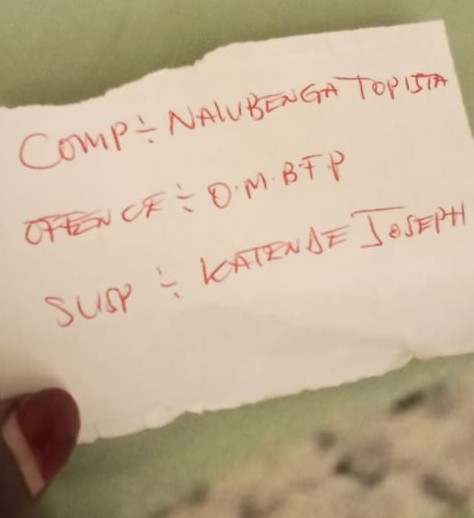
KYEGEGWA, UGANDA — For a Ugandan seeking a government job, Sh18 million was allegedly presented as the price of an opportunity that never materialised. What followed was a police complaint, an arrest, bank records showing at least Sh13 million entering an account bearing the name of the man identified by police as the suspect, and a written repayment acknowledgement but one question remains unanswered: What happened to the criminal investigation?
The case involving Nalubega Teopista, a staff member at St Edward’s Bukumi in Kakumiro District, raises a question beyond one disputed employment transaction: when money allegedly changes hands in connection with access to public employment, does repayment bring the matter to an end or should investigators still establish what happened, who was involved and whether an offence occurred?
Daily Thinkers seen bank records, police documentation and a written repayment acknowledgement and spoke to people familiar with the circumstances. The evidence does not establish guilt. It does establish a trail that can be investigated.
THE MONEY TRAIL
Two financial records seen by Daily Thinkers account for Sh13 million of the alleged payment. A Centenary Bank deposit slip records a cash deposit of Sh10 million on 13 March 2026 at the bank’s Mubende Branch into an account bearing the name Joseph Katende. A second Centenary Bank agent receipt records another Sh3 million payment on 26 March 2026 into an account associated with Katende. Together, the documents account for Sh13 million.
People familiar with the matter told Daily Thinkers that a further Sh5 million was allegedly sent through mobile money. That transaction has not been independently verified by Daily Thinkers and is therefore not presented as established fact.
The distinction is important, the available documents support a Sh13 million financial trail. The larger Sh18 million figure remains an allegation requiring further verification. The crucial investigative question is therefore straightforward: What happened to the Sh13 million after it entered the account? Banking records, subject to lawful investigative procedures, should provide part of that answer.
THE POLICE FILE
When the promised employment reportedly failed to materialise, Nalubega reported the matter to Kyegegwa Police Station. Police documentation seen by Daily Thinkers records:
Complainant: Nalubega Teopista
Suspect: Joseph Katende
Offence: Obtaining Money by False Pretenses Police Station: Kyegegwa Police Station
Reference: SD/67/21/03/2026
Information gathered by Daily Thinkers indicates that Katende was subsequently arrested but the publication has not established what happened to the investigation after the arrest. That leaves a series of questions:
- Was the Sh10 million transaction verified?
- Was the Sh3 million payment traced?
- Was the account examined to establish where the money went?
- Was the alleged Sh5 million mobile-money transaction investigated?
- Were the people involved in introducing Nalubega to Katende interviewed?
- Was the alleged government vacancy verified?
- Was Katende found to have any official role in recruitment?
- Was the police file submitted to prosecutors?
- Was anyone charged?
- Does the investigation remain open?
They are questions about whether the evidence was followed. A written acknowledgement dated 23 August 2026, seen by Daily Thinkers, records repayment of Sh13 million to Nalubega by Lubowa Dafula, described in the document as acting on behalf of Katende. The same document records a further Sh5 million as outstanding.
Daily Thinkers has not independently established whether that amount was subsequently paid or why Lubowa became responsible for the repayment.
That creates another investigative question: What was Lubowa’s connection to the original transaction, and what was the source and purpose of the repayment? But the larger legal point is equally important.
A repayment does not, by itself, establish whether a criminal offence occurred. It does not determine whether the original promise was false, who made it, whether there was an intention to defraud, whether the money was connected to a government recruitment process, or whether other people were involved. Those are matters for evidence and lawful investigation.
Perhaps the simplest question in the entire case has yet to be answered: Did the government job actually exist? Daily Thinkers has not independently established the alleged vacancy. The relevant authorities can Investigators and the responsible public institution should be able to establish:
- Which institution was recruiting;
- What position was allegedly available;
- Whether the position was part of an approved establishment;
- Whether the vacancy was advertised;
- What recruitment procedure applied;
- Whether Nalubega applied;
- Whether she was shortlisted;
- Whether an interview was conducted;
- Who had authority to appoint;
- Whether Katende had any official role in the process; and
- Whether any official recruitment records correspond with the alleged promise.
If the vacancy existed, recruitment records should provide evidence of the process. If it did not exist, that would also be significant either way, the question is capable of being tested against official records.
THE PEOPLE BEHIND THE PAPER TRAIL
According to information gathered by Daily Thinkers, Nalubega was introduced to Patrick, a colleague at St Edward’s Bukumi. Patrick allegedly told her that he knew someone who could assist her in obtaining government employment. She was subsequently connected to Katende.
A school administrator who spoke to Daily Thinkers on condition of anonymity confirmed that Nalubega and Patrick are employees of St Edward’s Bukumi. The administrator said the school had received reports concerning the two staff members and had advised them to seek legal redress. The administrator also said conduct of that nature was inconsistent with the school’s values. The administrator’s account does not establish that any offence occurred. It does, however, identify another potential line of inquiry. Investigators could establish:
- What exactly was Nalubega told?
- What did Patrick know about the alleged job?
- Who introduced Katende?
- Was money discussed before the introduction?
- Did Patrick receive any money or other benefit?
- What communications exist between the people involved?
Daily Thinkers has not established that Patrick committed any offence. Those questions require evidence, not assumption.
A NATIONAL WARNING SIGN
The Kyegegwa case cannot be viewed entirely in isolation, Uganda’s Inspectorate of Government has documented a substantial recruitment-corruption problem involving public-sector recruitment and District Service Commissions. Its research covering 2018–2022 estimated that job seekers paid approximately UGX29 billion in recruitment-related bribes, while the cumulative value of bribes demanded was estimated at approximately UGX78 billion.
The Inspectorate reported that the health sector recorded the highest estimated value of actual bribes paid, at approximately UGX12.9 billion. Those national figures do not establish that the Kyegegwa allegation forms part of the same pattern but they provide important context. Nalubega was reportedly seeking employment in the health sector. That makes the alleged transaction particularly relevant to questions about the integrity of public recruitment.
Uganda’s recent experience also shows that recruitment allegations are not confined to one district. Complaints and investigations concerning local-government recruitment have emerged in other districts, including Zombo, Kisoro and Butaleja.
The public-interest question is therefore broader than whether one alleged transaction occurred. It is whether institutions are capable of identifying patterns, preserving evidence and following recruitment complaints through to a documented conclusion.
Daily Thinkers contacted the Kyegegwa OC CID by telephone. The officer referred the reporter to the police spokesperson for further details concerning the case registered at the station.
During that conversation, the OC CID did not provide Daily Thinkers with the substantive investigative history of the file. The publication therefore puts a straightforward question to the Uganda Police Force: What is the current status of SD/67/21/03/2026? The public does not need investigators to prejudge the case. It needs to know whether the evidence was followed.
Uganda’s constitutional framework gives the Director of Public Prosecutions authority to direct police investigations and to institute and undertake criminal proceedings in accordance with the law. That creates another traceable question: Was the Kyegegwa file submitted for prosecutorial review?
- If it was, what decision followed?
- If it was not, why?
Daily Thinkers is not calling for prosecution on the basis of a newspaper investigation. The publication is asking whether a documented criminal complaint, accompanied by identifiable financial evidence and followed by an arrest, received the appropriate investigative and prosecutorial assessment.
WHAT THE AUTHORITIES CAN NOW ESTABLISH
The case does not require speculation.
There are several identifiable lines of inquiry.
Police can establish:
- Whether the Sh10 million and Sh3 million transactions occurred as documented;
- What happened to the funds after entering the account;
- Whether the alleged Sh5 million mobile-money transaction occurred;
- Who communicated with whom concerning the alleged employment;
- Who introduced Nalubega to Katende;
- Whether other people were involved;
- Whether other complaints exist;
- Whether the alleged vacancy existed; and
- The current status of the police file.
Kyegegwa and relevant local-government authorities can establish:
- Whether the alleged position existed;
- Which institution had authority to recruit;
- Whether the position was advertised;
- Whether Nalubega applied or was shortlisted;
- What recruitment procedure applied; and
- Whether Katende had any legitimate role in the process.
Prosecutors can establish:
- Whether the police file was submitted for prosecutorial review;
- Whether the available evidence met the applicable threshold for further action; and
- What decision, if any, was made?
Anti-corruption authorities can establish:
- Whether similar complaints exist;
- Whether the same individuals, positions or methods appear in other complaints; and
- Whether the circumstances justify a wider inquiry.
None of these steps requires anyone to be declared guilty.
They require the evidence to be tested.
Daily Thinkers has seen:
- A bank document recording Sh10 million deposited into an account bearing Katende’s name;
- A second bank-agent document recording Sh3 million paid into an account associated with Katende;
- Police documentation identifying Nalubega as complainant and Katende as suspect;
- A police reference, SD/67/21/03/2026;
- A written acknowledgement recording repayment of Sh13 million;
- Accounts from people familiar with aspects of the circumstances; and
- Information indicating that Katende was arrested.
These documents and accounts do not establish criminal guilt.
They establish why further questions are reasonable.
WHAT WE DO NOT KNOW
Daily Thinkers has not established:
- That Joseph Katende committed a criminal offence;
- That Patrick committed an offence;
- That Lubowa Dafula committed an offence;
- That a government official participated in the alleged transaction;
- That the alleged Sh5 million mobile-money payment occurred;
- That the alleged government vacancy existed;
- That other victims exist;
- What happened to all of the money after the documented payments;
- Whether the remaining Sh5 million was subsequently paid;
- Whether the police investigation was completed;
- Whether the file was submitted to the ODPP; or
- What final decision, if any, was made on the complaint?
These gaps are not weaknesses in the investigation. They are the questions the investigation now needs to answer.
The alleged Sh18 million payment began, according to the complainant’s account, as a job seeker’s search for a future. It has become a test of something larger: Can an allegation involving public employment be followed from complaint, to evidence, to investigation, and finally to a documented institutional outcome? Uganda’s Inspectorate of Government has already documented the scale of recruitment-related bribery reported by job seekers. The Kyegegwa case presents a much smaller but measurable test.
- There is a complainant.
- There are bank records.
- There is a police reference.
- There was reportedly an arrest.
- There is a written repayment acknowledgement.
- What remains unclear is what the justice system did with the evidence.
- That is the question Daily Thinkers is putting to the authorities:
- Where did the money go?
- Where is the file?
- Was the alleged government job real?
- What did the investigation establish?
A refund can return money. Only a proper investigation can establish what happened.
Daily Thinkers recognises the right of all persons named in this investigation to respond. Joseph Katende has not been convicted of obtaining money by false pretences. Daily Thinkers has not established that Patrick or Lubowa Dafula committed any offence, nor that a government official participated in the alleged transaction.
The Uganda Police Force, Kyegegwa District authorities, Office of the Director of Public Prosecutions, Inspectorate of Government, St Edward’s Bukumi and all individuals named in this investigation are invited to provide substantive responses or documentary evidence that materially clarifies the issues raised. Daily Thinkers will publish substantive responses and update this investigation where new evidence materially changes the facts established.
This investigation is based on documentary evidence seen by Daily Thinkers, including bank transaction records, police documentation and a written repayment acknowledge ement, together with interviews and information obtained from people familiar with the matter. The publication has independently established the existence of documents accounting for Sh13 million of the alleged payment. The alleged additional Sh5 million has not been independently verified and is therefore presented as an allegation rather than a confirmed transaction.
Daily Thinkers contacted the Kyegegwa OC CID concerning the status of the police case and sought information about the investigation. The publication has deliberately separated documented facts, attributed allegations, information from sources and unresolved questions.
The investigation does not determine criminal liability. That responsibility belongs to the competent investigative, prosecutorial and judicial authorities. Its purpose is narrower and fundamental: to follow the evidence and ask whether the institutions responsible for acting on it have done so.
THE QUESTION THAT REMAINS
The story began with an alleged promise of a government job. It now rests on a set of documents that can be examined, a police file that can be traced and a recruitment process that can be verified. The public-interest question is no longer simply whether someone lost money. It is whether the institutions entrusted with public employment and criminal justice can explain, transparently and lawfully, what happened next. Daily Thinkers — Thinking Beyond the Headlines.