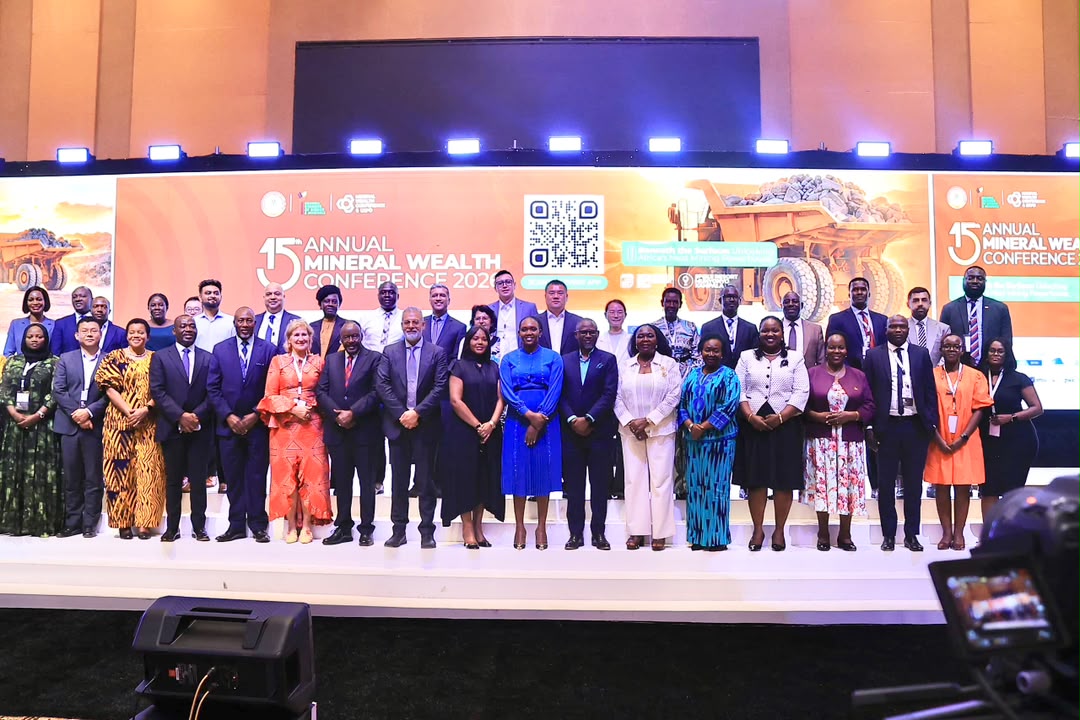
KAMPALA,— Uganda’s 15th Annual Mineral Wealth Conference has concluded with a renewed focus on turning the country’s mineral resources into greater industrial value, investment, jobs and regional economic opportunities. Speaking at the close of the conference, Hon. Phiona Nyamutooro, Minister of State for Mineral Development, thanked delegates and stakeholders for their participation and outlined government priorities for transforming the mining sector.
Minerals currently account for about 2.2% of Uganda’s GDP, according to figures highlighted at the conference. The sector’s wider economic significance is also reflected in the country’s mineral production and export ambitions, particularly as Uganda seeks to strengthen geological information, formalise artisanal and small-scale mining, expand value addition and attract responsible investment.
- The numbers tell part of the story: • 2.2% — minerals’ contribution to Uganda’s GDP, as cited at the conference.
- 4% — Uganda’s estimated overall GDP growth in FY2025/26, according to UBOS.
- UGX 68.7 billion — reported value of mineral production in Q3 FY2024/25, representing a 13.8% quarterly increase.
- US$4.2 billion — the 2026/27 national indicator framework target for the value of refined gold exports, highlighting the scale of ambition around mineral exports and value chains.
- 1% — increase in the reported aggregate value of mineral production in the latest statistical series presented by UBOS, underscoring significant movement in mineral activity.
At the conference, Minister Nyamutooro emphasised government efforts around licensing, access to financing, formalisation of artisanal and small-scale mining, environmental compliance and mineral value addition.
She also reaffirmed the role of the Uganda National Mining Company in strengthening commercial participation, value addition and partnerships with investors.
Importantly, the Ministry will treat the conference recommendations as a working agenda, with progress expected to be reported at the next edition. Priorities include stronger geological data, improved analytical laboratories, greater Ugandan participation across mineral value chains and responsible mine closure.
Uganda’s High Commissioner to Tanzania, Amb. (Rtd) Col. Fred Mwesigye, commended the Uganda Chamber of Energy and Minerals for convening a platform bringing together stakeholders from Africa and beyond.
Drawing on Uganda–Tanzania experiences, he called for deeper regional cooperation, technology transfer, value addition and shared infrastructure so that Africa’s mineral resources translate into investment, industrialisation and opportunities for its growing youth population.
The central message emerging from the conference is increasingly economic: the question is not simply how much mineral wealth Uganda possesses, but how much value can be retained, processed and multiplied within Uganda and the wider African market.