Mubende, Uganda – Stakeholders in Mubende District have called for stronger coordination, transparency and measurable results as the Uganda Climate Smart Agricultural Transformation Project (UCSATP) moves into implementation, with particular emphasis on ensuring that the new intervention delivers lasting value chains rather than repeating challenges associated with previous agricultural support programmes.
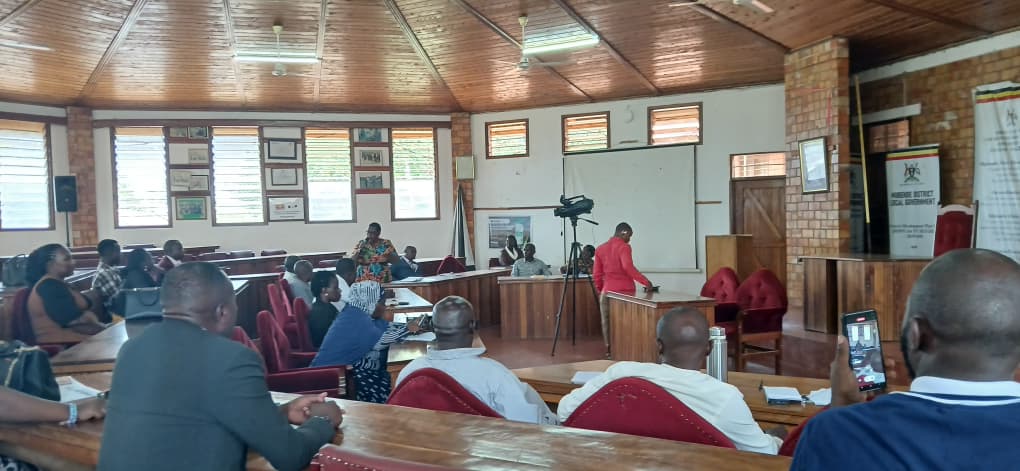
The call was made during a UCSATP stakeholders’ engagement meeting held at the Mubende District Council Chambers on Monday, 21 September 2026. The engagement brought together district officials and other stakeholders to discuss the implementation modalities of the project, including farmer mobilisation, access to agricultural inputs, infrastructure development, monitoring, supervision and oversight.
During the meeting, Daily Thinkers sought clarification on how lessons from previous interventions, including programmes implemented under the National Agricultural Advisory Services (NAADS), Operation Wealth Creation (OWC) and other input-distribution initiatives, had been incorporated into UCSATP’s new Electronic Voucher Management System (EVMS). Daily Thinkers also asked how the district would demonstrate that UCSATP was building sustainable value chains in coffee, livestock, beneficial insects and aquaculture, particularly through aggregation, processing, finance and reliable markets after project support ends.
The questions further focused on how UCSATP would be integrated with existing government programmes such as the Parish Development Model (PDM) and the wider agro-industrialisation agenda, rather than creating parallel farmer groups, infrastructure and reporting systems. A central question put to the stakeholders was: “At the end of UCSATP, what will be different in Mubende that was not achieved by the programmes that came before it, and what evidence will the district use to prove that difference?”
Responding to the issues raised, Fred Kisakye, the District Production and Marketing Officer for Mubende District, outlined the strategic framework through which UCSATP is expected to improve agricultural production, market access and resilience. “The Project Development Objective is to increase productivity, market access and resilience of selected value chains and to respond promptly and effectively to emergencies,” Kisakye said. He explained that the project was not limited to distributing agricultural inputs but was designed to support farmers organised in groups while developing infrastructure necessary to strengthen production and market systems.
Under UCSATP, Mubende is implementing interventions across four major value-chain areas: coffee in ten lower local governments; dairy production in five lower local governments; beef in four lower local governments; beneficial insects, including apiary and black soldier flies; and aquaculture fisheries. The project is also supporting infrastructure and enabling systems, including road improvements, community water points, irrigation facilities, laboratories and weather stations.
Kisakye said the overall objective was to increase production and productivity while improving market access and addressing the effects of climate change. He emphasised that the project also seeks to increase processing capacity so that Mubende can move beyond supplying raw agricultural commodities. “The long-term goal is to move from simple production to value-added processing involving both the public and private sectors,” Kisakye noted. He linked the transformation of the value chains to wider economic outcomes, including export growth, increased household incomes and employment opportunities.
Kisakye, however, acknowledged that increased production alone would not guarantee access to high-value markets. “There is a critical need to meet high-quality standards to compete effectively in the market,” he said. He observed that some suppliers and farmers continue to face difficulties maintaining the standards required by large-scale and high-value buyers. “A gap exists between current farmer output and the requirements of large-scale buyers,” Kisakye explained.
This places emphasis on strengthening the entire chain from production and farmer organisation to quality control, aggregation, processing and marketing.The district production officer also identified the scaling of processing capacity between public and private stakeholders and ensuring that farmers meet rigorous market standards as issues requiring sustained attention.
A major change in the delivery of critical agricultural inputs under UCSATP is the use of the Electronic Voucher Management System (EVMS). The system was launched in Mubende on 24 June 2026 in an event presided over by the Resident District Commissioner. The electronic system is intended to improve the manner in which farmers access critical inputs while strengthening transparency and accountability in the distribution process.
Kisakye said that with the project committees now fully constituted, stakeholders needed to understand the implementation arrangements, including farmer mobilisation, monitoring, supervision and oversight. The shift to an electronic mechanism also provides an opportunity to address concerns historically associated with untimely input delivery, beneficiary identification and accountability in agricultural support programmes.
Mr. Birungi Abubaker, the Deputy Resident District Commissioner (DRDC) for Mubende, stressed the importance of timely delivery of agricultural inputs and transparency regarding any contribution expected from beneficiaries. He directed attention to the practical questions that farmers need answered before implementation progresses. “The District Production Officer should ensure all products are timely,” Birungi said. He also called for clarity where beneficiaries are expected to contribute towards project activities. “If it is co-funding, how much does an individual have to contribute to this programme? Let us make it clear,” he said. His remarks placed emphasis on ensuring that farmers understand the financial obligations, if any, attached to project-supported interventions before they participate.
Beatrice Katsigazi, the Resident District Commissioner (RDC) for Mubende, emphasised the importance of communicating government programmes effectively to citizens. “All government programmes should be well communicated very well to the general public,” Katsigazi said. She added that the security leadership’s responsibility was to ensure that government programmes were implemented in accordance with established standards and government priorities. “Our work as security is to ensure all these programmes follow the available standards and the NRM Manifesto,” she said. Her intervention highlighted the role of communication and public oversight in ensuring that intended beneficiaries understand government interventions and that implementation remains within established frameworks.
The engagement also touched on the wider development conditions affecting communities. Charles Kawuma, the District Health Educator and District HIV/AIDS Focal Person, raised concern about Mubende’s performance in immunisation. “Mubende District is poorly performing in immunisation,” Kawuma said, urging residents and stakeholders to support the forthcoming immunisation campaign. His appeal reflected the interconnected nature of agricultural transformation and broader community development, where improved household welfare depends not only on production and incomes but also on access to essential social services.
The UCSATP engagement ultimately placed the question of measurable transformation at the centre of Mubende’s agricultural agenda. For the district, the challenge will be to demonstrate that interventions in coffee, dairy and beef, beneficial insects and aquaculture translate into functioning value chains capable of connecting organised farmers to infrastructure, finance, processing facilities and dependable markets.
The test of the project will therefore extend beyond the number of farmers registered, inputs distributed or facilities constructed. It will increasingly be reflected in whether farmers can produce consistently to market standards, aggregate commercially viable volumes, access processing and financing, withstand climate-related shocks and maintain market relationships beyond the period of direct project support.
For Mubende, UCSATP provides another opportunity to strengthen its position as an agricultural production and commercial hub. The stakeholder engagement demonstrated that expectations are now extending beyond project implementation to a more fundamental question: whether the investment can convert agricultural support into durable economic systems that continue delivering value after the project cycle ends.