A border is more than a line separating two countries, for millions of Africans, it is a route to employment, trade, education, investment, family connections and access to essential services but when the administrative cost of crossing or operating beyond that border becomes complicated, unpredictable or excessively expensive, the consequences can extend far beyond the individual traveller.

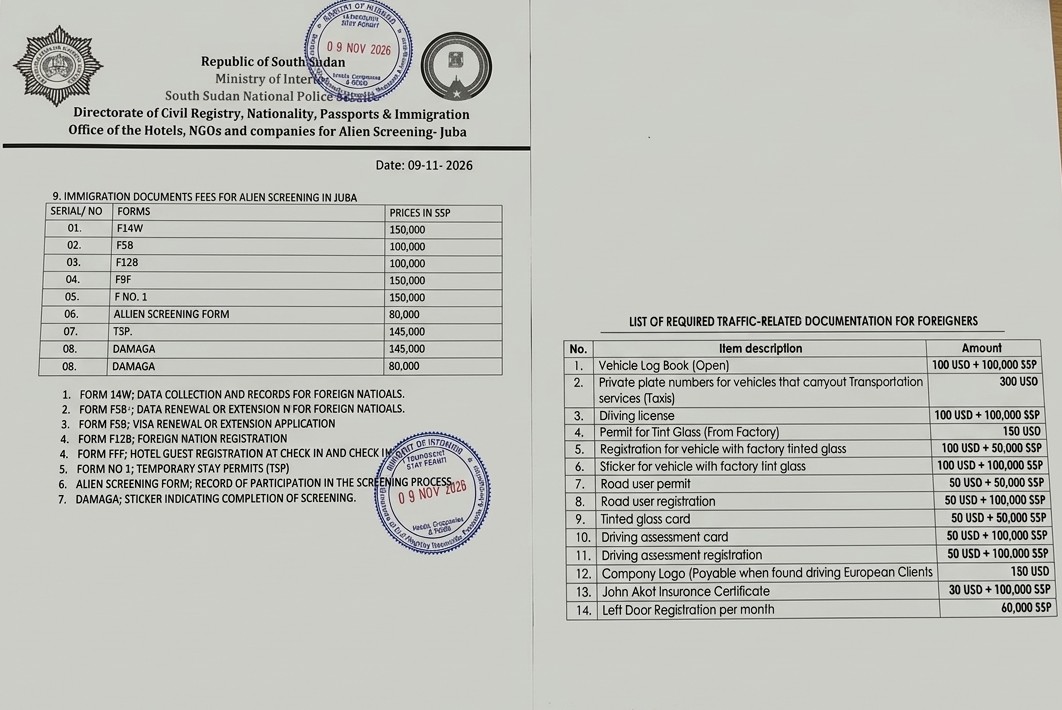
A fee schedule dated 9 November 2026, from the South Sudan’s Ministry of Interior and the National Police Service Directorate of Civil Registry, Nationality, Passports and Immigration, has outlined charges for foreign-national screening and traffic-related documentation in Juba raises wider policy question: Are Africa’s immigration systems making regional mobility easier, or are administrative requirements becoming another obstacle to integration?
The document lists eight immigration-related forms and screening requirements. These include Form 14W for foreign-national data collection and records at 150,000 South Sudanese pounds (SSP), Form F5B for visa renewal or extension at 100,000 SSP, Form F12B for foreign-national registration at 100,000 SSP, and Form F9F for hotel guest registration at 150,000 SSP. The Alien Screening Form is listed at 80,000 SSP, while the temporary stay permit is priced at 100,000 SSP. Two additional entries, TSP and Damaga, are listed at 145,000 SSP and 80,000 SSP respectively. Taken together, the eight listed charges amount to 905,000 SSP if an applicant were required to pay for every item. This is an arithmetic total, not an indication that every foreign national must obtain all eight documents. Their applicability would depend on the individual’s immigration status and circumstances.
The second schedule introduces another layer of costs for foreign nationals operating vehicles. A vehicle logbook is listed at US$100 plus 100,000 SSP, while private taxi registration plates attract US$300. A driving licence is listed at US$100 plus 100,000 SSP. Other charges cover factory-tinted glass permits, vehicle registration, stickers, road-user permits, registration, driving assessment documentation and insurance certification. Across the 13 traffic-related entries, the listed dollar-denominated amounts add up to US$1,230, while the additional local-currency components total 850,000 SSP, if every listed item were applicable and paid. Again, this is a combined calculation of the schedule, not a mandatory charge imposed on every foreign driver.
The use of two currencies is particularly important in an economy experiencing significant monetary and exchange-rate pressures, charges denominated in both US dollars and South Sudanese pounds can complicate compliance for businesses, transport operators and individual residents. The World Bank’s 2026 assessment of South Sudan reported severe economic pressures, including food inflation of 234 per cent in FY2025 and substantial depreciation of the official exchange rate. Such conditions make transparent fee publication, clear payment channels and predictable administrative procedures especially important.
South Sudan’s situation is relevant to a much wider African conversation because mobility is already central to the continent’s economic life. According to the Institute for Security Studies’ African Futures analysis, approximately 52.5 million African-born international migrants were living outside their countries of birth in 2025. Of these, approximately 26.9 million were living in another African country, while 25.6 million lived outside the continent. This means that movement within Africa is not a marginal phenomenon. It is an established economic and social reality involving traders, professionals, construction workers, transport operators, entrepreneurs, students and families. Immigration systems consequently influence the daily functioning of regional markets.
The commercial stakes are equally significant, Intra-African trade reached an estimated US$220.3 billion in 2024, representing a 12.4% increase from 2023, according to figures reported by Afreximbank’s African Trade Report. The growth demonstrates the opportunities emerging from stronger continental commercial connections, but also highlights the importance of removing avoidable barriers to trade.
The African Continental Free Trade Area (AfCFTA) is intended to create a more integrated market by reducing tariffs and addressing non-tariff barriers. However, the movement of goods depends heavily on the movement of people: drivers, customs agents, technicians, logistics managers, business owners and investors must be able to operate within predictable regulatory environments.
An entrepreneur transporting goods across a border may benefit from reduced tariffs but still encounter substantial costs arising from vehicle documentation, licensing, immigration registration and administrative delays. Where requirements are unclear or duplicated, the cost of doing business rises, potentially weakening the commercial benefits that trade agreements are designed to deliver.
For East Africa and the wider Horn of Africa, these concerns are particularly relevant. South Sudan is a member of the East African Community, alongside Burundi, the Democratic Republic of the Congo, Kenya, Rwanda, Somalia, Tanzania and Uganda. The regional integration agenda places importance on cooperation in trade, transport, labour mobility and the movement of people.
This does not mean that regional membership removes a state’s authority to regulate immigration, screen foreign nationals or enforce road-safety requirements. Governments retain legitimate responsibilities to protect national security, maintain accurate immigration records, regulate commercial transport and safeguard public order. The issue is whether such requirements are administered transparently, proportionately and consistently with applicable regional commitments. Clear schedules should identify the legal authority for each charge, the service being provided, the categories of people required to pay, available exemptions, payment procedures and the mechanism for challenging incorrect assessments.
The distinction between legitimate regulation and unnecessary administrative burden is fundamental. Screening can strengthen national security, while predictable and properly administered registration systems can improve accountability. However, unclear charges, multiple payment points or unexplained foreign-currency requirements can expose businesses and individuals to uncertainty and create opportunities for informal payments.
For African governments, the lesson is not to abandon immigration controls. It is to modernise them. Digital registration, interoperable border systems, harmonised documentation, published fee schedules and coordinated customs and immigration procedures can make regulation more efficient without compromising sovereignty.
South Sudan’s published schedule should prompt a broader discussion among African states about the relationship between national administrative systems and continental integration. The AfCFTA cannot achieve its full potential through tariff reductions alone. It also requires efficient borders, predictable regulations, reliable transport systems and the confidence of those who invest, work and trade across national boundaries.
For South Sudan, the immediate priority should be to clarify the legal basis and implementation of the published charges, communicate which documents apply to each category of foreign national, and ensure that the dual-currency requirements are transparent and consistently administered.
For the wider continent, the question is more consequential: can Africa build a genuinely integrated economic space while the administrative experience of crossing its borders remains fragmented? The future of African integration will not be determined only in summit declarations or trade agreements. It will also be shaped at immigration counters, border posts, vehicle registration offices and the everyday points where citizens and businesses encounter the state. A connected Africa requires regulated borders, but regulation must facilitate legitimate movement rather than make mobility an increasingly expensive privilege.