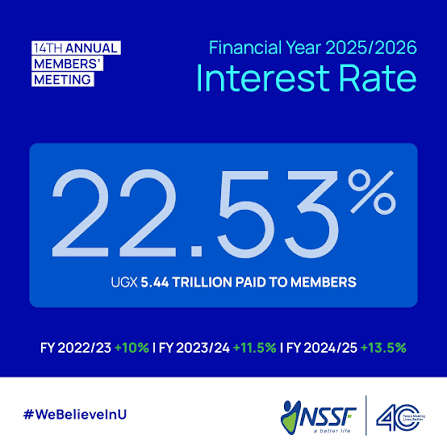
Kampala, Uganda –Uganda’s National Social Security Fund (NSSF) has declared a 22.53 per cent interest rate for members for the financial year 2025/26, the highest rate announced in the Fund’s 40-year history. The declaration places renewed attention on a question extending beyond retirement savings: how Uganda can increasingly use its growing pool of domestic institutional capital to support economic transformation while safeguarding the interests of savers.
The rate, announced by Minister of Finance, Planning and Economic Development Henry Musasizi at NSSF’s 14th Annual Members’ Meeting, will see approximately Shs5.44 trillion credited to members’ accounts. This compares with an interest allocation of about Shs2.5 trillion associated with the 13.5 per cent rate declared for 2024/25.
The scale of the latest distribution reflects the expansion of NSSF itself. The Fund reported strong growth in income during the financial year, while assets under management increased from approximately Shs26 trillion to Shs32 trillion. Member contributions also continued to rise, demonstrating the growing volume of long-term savings being mobilised through the formal social security system.
For Uganda, the significance of this growth extends beyond the balance sheets of individual savers. A large pension fund creates a substantial pool of patient capital that can potentially participate in government securities, equities, infrastructure, private enterprise and other long-term investments.
NSSF reported investing approximately Shs4.32 trillion in Uganda’s economy during the financial year. Government securities accounted for about 76 per cent of this investment, while approximately 18 per cent was invested in equities, including listed companies.
The investment pattern illustrates the dual role of a large pension institution. NSSF must generate competitive and sustainable returns for members, while its investment activities also have wider effects on the availability of capital within the economy. This is where the development question becomes important.
Uganda requires substantial long-term financing for infrastructure, industrialisation, agriculture, housing, energy and private-sector development. Domestic institutional investors can potentially complement government revenues, commercial bank lending and external development financing.
However, pension assets are ultimately members’ savings. Their deployment therefore has to remain consistent with the Fund’s legal mandate, investment rules and responsibility to generate appropriate returns.
The issue is consequently not whether NSSF should simply invest more in development projects, but which investments can simultaneously meet sound financial requirements and contribute to Uganda’s productive capacity.
The discussion at the annual meeting pointed to major infrastructure projects, including the proposed Kampala–Jinja Expressway, as potential areas for NSSF participation. Such projects illustrate the potential connection between pension capital and national infrastructure development. Where commercially viable structures exist, institutional investors can provide long-term financing that complements public resources.
NSSF Board Chairman David Ogong, however, noted that the Fund’s investment activities remain subject to the legal framework governing its operations. This is significant because the availability of capital does not by itself determine where pension funds can be invested.
For policymakers, the challenge is therefore to create investment structures in which commercially sound projects can attract institutional capital without converting pension savings into instruments of policy financing that expose members to inappropriate risks.
NSSF’s role is also becoming increasingly regional. The Fund has invested more than Shs10 trillion in Kenya, Tanzania and Rwanda as part of its diversification strategy. This gives the Fund an additional relevance to Uganda’s economic and commercial diplomacy.
Regional integration is often discussed in terms of trade, customs, infrastructure and movement of people. Yet capital is another important component of regional economic integration. When Ugandan institutional investors participate in neighbouring markets, they become part of the financial architecture supporting the wider East African economy. Such investments can also provide portfolio diversification while exposing Ugandan institutional capital to businesses and financial markets beyond the domestic economy.
The regional dimension therefore presents an intersection between investment strategy and economic diplomacy: Uganda’s institutions are not only seeking opportunities abroad but are also participating in the development of interconnected East African markets.
The Fund’s long-term strategy gives this trend an even larger potential scale. NSSF currently has approximately 3.6 million registered members, with about 2.7 million having balances. During the first year of its new strategy, the Fund targeted 300,000 new savers and reported enrolling approximately 311,000.
Its longer-term ambition is to reach 15 million savers and grow assets to Shs80 trillion by 2035, after revising an earlier Shs50 trillion target. If achieved, such growth would substantially expand Uganda’s domestic pool of long-term capital.
It would also make questions surrounding capital allocation increasingly important. The larger the Fund becomes, the greater the potential economic consequences of its investment decisions not only for individual savers but also for capital markets, government financing, infrastructure and private investment.
For Uganda’s economic diplomacy, NSSF provides an example of how domestic financial institutions can become part of a broader strategy for economic transformation. A stronger domestic savings base can reduce exclusive dependence on external sources of long-term finance. At the same time, regional investment allows Ugandan institutions to participate in markets across East Africa.
This does not mean that pension funds should replace foreign investment or development finance. Rather, domestic institutional capital can potentially work alongside these sources of financing, particularly where investment opportunities are structured around commercially viable projects. The growing size of NSSF also creates a platform for greater engagement between financial institutions, government agencies, businesses and Uganda’s economic missions abroad. Identifying viable investment opportunities, understanding regional markets and supporting Ugandan institutional investors are increasingly interconnected aspects of economic diplomacy.
The 22.53 per cent interest rate is therefore an important headline, but it is not the only measure of NSSF’s significance. The deeper issue is what happens as the Fund continues to grow. The immediate benefit is the higher amount credited to members. The longer-term significance lies in whether Uganda can build an investment ecosystem capable of converting growing domestic savings into productive capital while maintaining prudent risk management and sustainable returns.
With assets of approximately Shs32 trillion, millions of members and an expanding regional investment portfolio, NSSF occupies an increasingly important position within Uganda’s financial and economic architecture. Its next phase will consequently be measured not only by the size of annual interest declarations, but also by the quality of the capital allocation decisions behind them how effectively pension savings are protected, diversified and channelled into investments capable of generating lasting economic value.
For Uganda’s economic diplomacy, the emerging opportunity is clear in structural terms: a growing domestic savings base can become an important source of long-term capital for Uganda and the wider East African economy, provided that development objectives and the fiduciary interests of savers remain properly aligned.