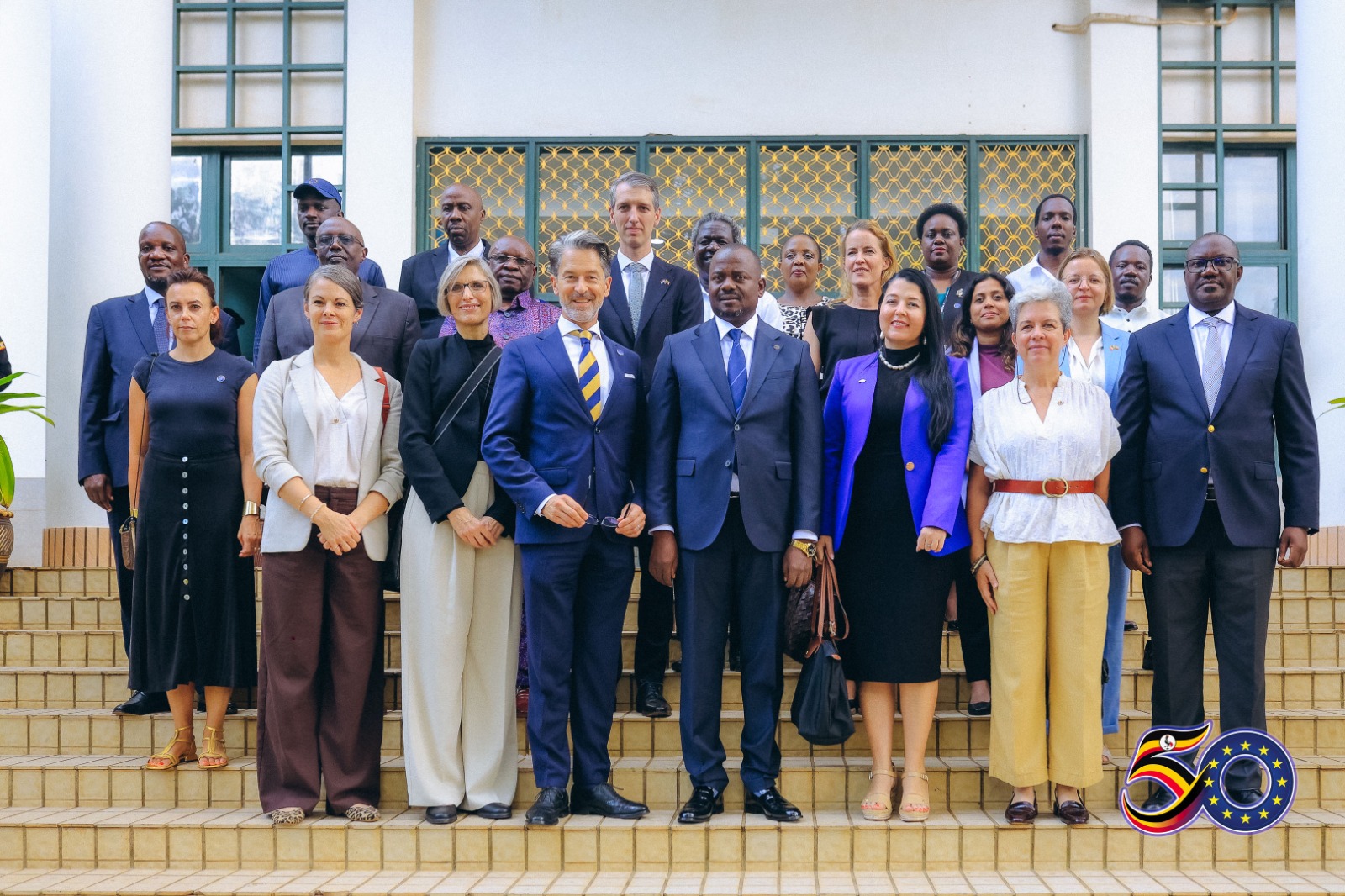
Kampala,— Uganda and the European Union marked five decades of partnership with a special photographic exhibition at the Ministry of Foreign Affairs Headquarters in Kampala, using the stories of Ugandans to reflect on the evolution of a relationship that has expanded from development cooperation into trade, investment, education, climate action, security and humanitarian cooperation.
Held under the theme “Together, Tukola, Built by Uganda, Backed by the European Union,” the exhibition brought together Government representatives, the European Union Delegation and Heads of Mission from EU Member States. The exhibition featured 12 Ugandan “icons” whose experiences illustrated the human dimension of the partnership, including entrepreneurs, farmers, health workers, creatives, engineers and refugees.
Representing the Government of Uganda, the Minister of State for Foreign Affairs in charge of Regional Cooperation, Hon. Haruna Kyeyune Kasolo, described the anniversary as an opportunity to reflect on the evolution of the relationship and its future direction. “For 50 years, the Uganda-EU partnership has been part of Uganda’s development story. From rebuilding infrastructure and expanding essential services to supporting education, livelihoods, innovation and sustainable growth, this cooperation has touched the lives of many Ugandans across generations,” Hon. Kasolo said.
The partnership dates back to May 1976, when the European Community opened its delegation in Kampala. At the time, the European Community had nine member states; today, the European Union comprises 27 Member States. Over the intervening five decades, the relationship has expanded considerably. According to the EU Delegation, the EU and its Member States, working as Team Europe, have provided more than €5 billion in development support to Uganda over the past five decades, alongside substantial European private investment.
The economic relationship has also become increasingly significant. EU trade data show that in 2024, EU imports from Uganda were valued at €1.077 billion, while EU exports to Uganda stood at €739 million, bringing total merchandise trade to approximately €1.82 billion. EU imports from Uganda were dominated by agricultural products, which accounted for about €1 billion, highlighting the importance of agriculture and value addition to Uganda’s commercial engagement with the European market.
The shift towards a more commercially oriented relationship was also highlighted by Mr. Vincent Waiswa Bagiire, Permanent Secretary of the Ministry of Foreign Affairs, who noted that the partnership was entering a phase in which trade and investment would play a greater role alongside established development cooperation. The transition, he observed, provided an opportunity to build on previous achievements while aligning cooperation more closely with Uganda’s long-term economic priorities.
EU Ambassador to Uganda H.E. Jan Sadek said the photographic exhibition was intended to place people at the centre of the Golden Jubilee story. “A partnership is ultimately measured not only in years, but in lives changed. These twelve stories remind us that behind every programme, investment or policy, there are Ugandans whose determination, talent and enterprise are helping shape the country’s future,” Ambassador Sadek said.
The exhibition reflected cooperation across renewable energy, education, health, gender equality, human rights, agriculture, infrastructure, environmental conservation and the creative economy. Earlier in 2026, Ambassador Sadek noted that the partnership had evolved into a broad relationship encompassing trade and investment, energy and climate action, education and health, humanitarian support and regional stability.
Looking towards the next 50 years, Hon. Kasolo emphasised the importance of cooperation that responds to Uganda’s changing economic priorities. He highlighted climate finance, value-added trade, education, innovation and stronger connections between universities and enterprises as areas for deeper engagement. He also pointed to opportunities in infrastructure and energy, health and education, agricultural processing, construction and services, while emphasising the importance of increasing the value of Ugandan exports through improved certification, storage, post-harvest systems, engineering and processing.
Agriculture remains central to this agenda. Coffee, fish, flowers and fruits are among Uganda’s export interests in European markets, while the scale of EU imports from Uganda in 2024 demonstrated the continuing importance of agricultural commodities in the relationship.
The partnership also carries an important humanitarian dimension. Uganda hosts more than two million refugees and has continued to work with international partners on refugee protection, livelihoods and social and economic inclusion. The Golden Jubilee exhibition therefore presented the Uganda-EU relationship not simply as a record of five decades of official cooperation, but as an evolving partnership expressed through institutions, businesses, communities and individual lives.
As Uganda and the European Union look beyond the 50-year milestone, the emphasis is increasingly on converting established cooperation into expanded trade, investment, skills, innovation and sustainable economic opportunities, while preserving the dialogue and institutional relationships that have sustained the partnership since 1976.