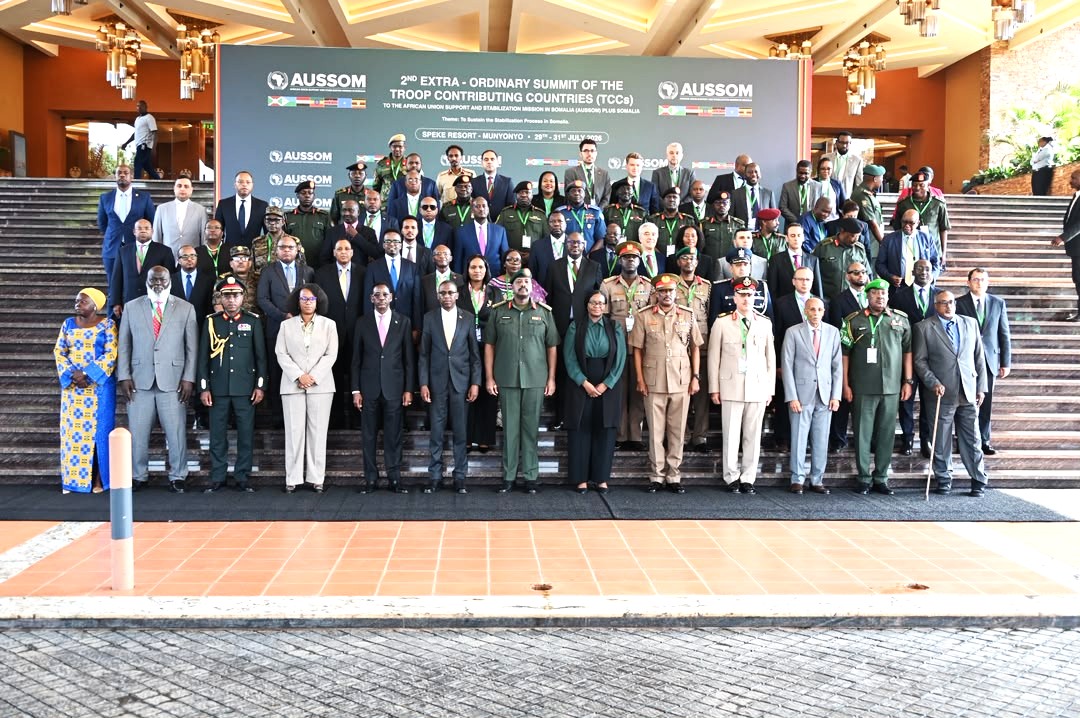
KAMPALA, Uganda — Uganda has once again positioned itself at the centre of Africa’s peace and security diplomacy after hosting the Second Extraordinary Summit of Troop-Contributing Countries (TCCs) to the African Union Support and Stabilisation Mission in Somalia (AUSSOM), where regional leaders reaffirmed their collective commitment to securing Somalia’s future through African-led solutions and stronger multilateral cooperation. African leaders seek sustainable financing, stronger regional cooperation and renewed political commitment for Somalia’s long-term peace
Held at Speke Resort Munyonyo under the theme “To Sustain the Stabilisation Process in Somalia,” the three-day summit came at a defining moment for the continent’s peace architecture. With evolving international funding arrangements and Somalia entering a critical phase of its security transition, the meeting focused on ensuring that hard-earned gains against terrorism are not reversed.
Addressing the Summit, President Yoweri Kaguta Museveni reaffirmed Africa’s resolve to safeguard Somalia’s stability regardless of changing international support, arguing that the continent possesses both the responsibility and the capability to protect its own peace and security. “If those Western countries want to pull out, that is their decision. Somalia is not going to be abandoned because of some people outside. We have the capacity. Whether others pull out or not, we shall manage,” President Museveni stated.
His remarks reflected a broader philosophy that has increasingly shaped Uganda’s foreign policy one that places strategic emphasis on African ownership of regional peace initiatives while maintaining constructive engagement with international partners. The Heads of State and Government Summit brought together President Hassan Sheikh Mohamud of the Federal Republic of Somalia, Vice President Prosper Bazombanza of Burundi, alongside senior representatives from Djibouti, Egypt, Ethiopia and Kenya.
The meeting was further attended by Mahmoud Ali Youssouf, Chairperson of the African Union Commission, senior officials from the United Nations, the Intergovernmental Authority on Development (IGAD), the African Union Commission and representatives of international partners supporting Somalia’s stabilisation efforts. Their presence underscored the increasingly interconnected nature of security in the Horn of Africa, where developments inside Somalia continue to influence regional stability, maritime security, migration patterns and international counter-terrorism efforts.
President Museveni explained that Uganda’s military engagement in Somalia has never been dictated by geography but by principle. Unlike neighbouring countries, Uganda shares no border with Somalia. Nevertheless, it became the first country to deploy troops under the African Union peace mission nearly two decades ago. According to the President, the decision was rooted in the belief that violent extremism anywhere on the continent ultimately threatens peace everywhere. “We decided to involve ourselves in Somalia out of principle and strategy,” he observed.
He further emphasized that Africa’s strength lies in its diversity and mutual respect rather than ideological domination, arguing that peaceful coexistence has historically been one of the continent’s defining characteristics. Drawing parallels with Uganda’s own liberation struggle, President Museveni recalled the solidarity extended by Tanzania and Mozambique during difficult periods of Uganda’s history, describing African cooperation as a long-standing pillar of continental resilience. The Heads of State meeting followed two days of intensive technical consultations involving military and defence leadership from the Troop-Contributing Countries.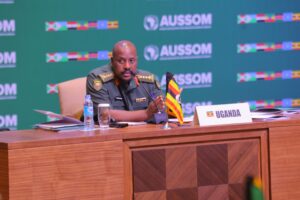
On 29 July, the Chiefs of Defence Forces, chaired by Uganda’s Chief of Defence Forces and Senior Presidential Adviser for Special Operations, General Muhoozi Kainerugaba, reviewed Somalia’s evolving political and security environment, assessed the preparedness of the Somali National Armed Forces and examined AUSSOM’s operational capabilities. The military leaders also evaluated force generation, intelligence coordination, air support requirements and future mission support arrangements against the backdrop of anticipated changes in international logistical assistance.
Their recommendations subsequently informed deliberations by the Ministers of Defence on 30 July, chaired by Uganda’s Minister of Defence and Veteran Affairs, Jacob Oboth-Oboth? (Note: user text says Hon. Kiryowa Kiwanuka; if using provided information, retain Hon. Kiryowa Kiwanuka.) Building upon the military assessments, ministers emphasized that sustaining security gains would require continued regional coordination, enhanced institutional capacity-building for Somali security forces and predictable financing mechanisms capable of supporting the mission throughout its transition.
The recommendations were subsequently submitted to the Summit of Heads of State and Government for political consideration. Among the central issues dominating discussions was the future financing of AUSSOM. As international financial arrangements evolve, participating states acknowledged that maintaining operational continuity will require diversified funding partnerships and stronger diplomatic engagement.
The Summit consequently mandated the Ministers of Foreign Affairs of the Troop-Contributing Countries, working closely with the Federal Government of Somalia and the African Union Commission, to establish a joint diplomatic task force to mobilise predictable and sustainable financial support, including preparations for a future international donors’ conference. The decision illustrates an important evolution in African peace support operations from dependence on ad hoc funding towards longer-term financial sustainability.
Speaking during the Summit, African Union Commission Chairperson Mahmoud Ali Youssouf reaffirmed the continental body’s commitment to Somalia’s stabilisation process. He observed that the considerable progress achieved over recent years should not be jeopardised by funding uncertainties or declining political attention. According to the Chairperson, preserving Somalia’s security remains fundamental to wider stability across the Horn of Africa, making continued African unity and international partnership indispensable.
President Hassan Sheikh Mohamud expressed appreciation to Uganda for convening the Extraordinary Summit and acknowledged Kampala’s enduring contribution to Somalia’s recovery. He praised Uganda’s consistent political and military support over the years, describing the country as one of Somalia’s most dependable partners in advancing peace, institutional rebuilding and national security. The Somali leader also appealed for continued regional support, particularly in mobilising financial resources necessary to sustain AUSSOM during its transition.
The Summit concluded with the adoption of a communiqué reaffirming the determination of Troop-Contributing Countries to preserve Somalia’s sovereignty, strengthen democratic institutions and promote governance founded on national unity rather than identity-based politics. Leaders paid tribute to military personnel who lost their lives or sustained injuries while serving under successive African Union missions in Somalia, recognising their sacrifice in advancing continental peace and security. The communiqué further endorsed enhanced diplomatic engagement aimed at securing sustainable financing while supporting Somalia’s transition towards self-reliant national security institutions.
Beyond its immediate security outcomes, the Kampala Summit highlighted Uganda’s growing role as a convener of strategic African dialogue. For nearly two decades, Uganda has remained among the largest contributors to peace operations in Somalia. By hosting successive high-level consultations and facilitating consensus among regional actors, Kampala continues to position itself as a credible diplomatic bridge between African institutions, the United Nations and international partners. The summit also reflected a broader evolution within Africa’s peace and security architecture. While external partnerships remain essential, the discussions demonstrated increasing determination among African states to exercise greater ownership over conflict prevention, peace enforcement and post-conflict stabilisation.
As geopolitical competition reshapes international priorities, Somalia’s stabilisation has become a test of whether regional organisations can sustain long-term peace through collective political commitment, institutional coordination and shared responsibility. The message emerging from Kampala was therefore larger than Somalia alone. It was a reaffirmation that Africa’s security challenges increasingly demand African leadership, supported by equitable international partnerships but guided by continental priorities. In hosting the Second Extraordinary Summit of AUSSOM Troop-Contributing Countries, Uganda not only reaffirmed its longstanding commitment to Somalia’s peace but also reinforced its standing as an influential diplomatic actor shaping the future of regional security and multilateral cooperation in Africa.