Mbale, Uganda– In the eastern highlands of Uganda, where the fertile slopes of Mount Elgon descend into valleys of coffee farms, waterfalls and ancient footpaths, lives one of East Africa’s most culturally distinctive communities the Bagisu, also known as the Bamasaaba. While Uganda is home to more than 65 indigenous communities, the Bagisu have earned international recognition for preserving one of Africa’s most enduring rites of passage: Imbalu, the traditional public circumcision ceremony that has become both a symbol of identity and an expression of living cultural heritage. Yet to define the Bagisu solely through Imbalu would be to overlook the richness of a people whose history, landscapes, traditions and resilience have shaped one of Uganda’s most remarkable cultural regions.
The Bagisu primarily inhabit Bugisu, a sub-region in Uganda’s Eastern Region comprising Mbale City, Mbale, Bududa, Bulambuli, Manafwa, Namisindwa and Sironko districts. According to Uganda’s 2024 National Population and Housing Census, the region is home to more than 1.8 million people, making it one of the country’s most densely populated cultural landscapes.
Their homeland stretches across the western slopes of Mount Elgon, one of Africa’s oldest extinct volcanoes whose fertile volcanic soils have sustained generations of farming communities. Here, agriculture remains both an economic activity and a cultural inheritance, with families cultivating Arabica coffee, bananas, beans, maize and millet on carefully terraced hillsides. For centuries, the mountain has been more than geography. It is a source of identity, spirituality and oral history, reflected in the community’s traditions, folklore and relationship with nature.
Members of the community refer to themselves as Bamasaaba, while an individual is known as Omumasaaba or Mugisu. They speak Lumasaba, a Bantu language closely related to Bukusu, spoken across the border in western Kenya, illustrating the deep historical and cultural connections that transcend modern national boundaries. Like many African societies, the Bamasaaba preserve their history primarily through oral tradition, clan systems and community ceremonies. Their social organisation continues to emphasise family, respect for elders, communal responsibility and cultural continuity.
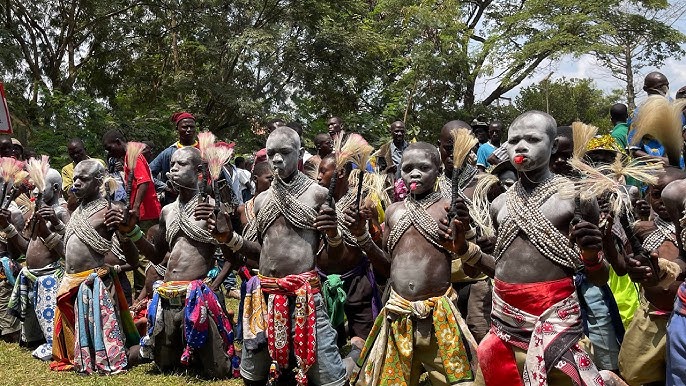
No cultural practice is more closely associated with the Bamasaaba than Imbalu, the traditional male circumcision ceremony held every even-numbered year. Unlike clinical procedures performed privately elsewhere, Imbalu unfolds publicly through music, dance, family gatherings and community participation. Young initiates move through weeks of preparation before undergoing circumcision without anaesthesia, demonstrating courage, discipline and readiness for adulthood according to cultural expectations.
For the Bamasaaba, Imbalu is far more than a physical ritual. It represents social responsibility, continuity between generations and the reaffirmation of collective identity. The ceremony has attracted researchers, cultural practitioners and international visitors seeking to understand one of Africa’s best-preserved rites of passage. It has also been recognised internationally as a living cultural tradition requiring preservation and respectful documentation.
Although Imbalu often dominates public conversations about the Bagisu, Bugisu possesses a remarkable concentration of cultural and natural heritage sites that remain relatively unknown outside Uganda. Across the region are sacred cultural grounds, historical caves, ceremonial forests, waterfalls, mountains and ancestral meeting places that continue to shape community memory. Among the notable attractions are:
• Mutoto Cultural Grounds, regarded as the spiritual home of the Imbalu tradition and the seat of the Bamasaaba Cultural Institution.
• Wanale Ridge, overlooking Mbale City with spectacular panoramic views and volcanic formations.
• Sisiyi Falls, one of the highest waterfalls in the region, surrounded by local traditions and breathtaking scenery.
• Biritanyi Gorge, an unusual landscape where flowing water crosses directly over a roadway before descending into the valley below.
• Ancient caves such as Nakoko, Zebubu and Namisindwa, which preserve stories of settlement, refuge and traditional livelihoods.
• Historic sites associated with Semei Kakungulu, whose legacy remains intertwined with the political history of eastern Uganda.
Together, these places reveal Bugisu as a destination where cultural heritage, environmental conservation and historical memory intersect.
The global reputation of Mount Elgon Arabica Coffee has made Bugisu one of Uganda’s leading coffee-producing regions. For generations, coffee cultivation has supported household incomes while strengthening cooperative movements such as the historic Bugisu Cooperative Union, established in 1954. Today, coffee remains central to both the local economy and Uganda’s broader agricultural exports, linking mountain communities to international markets. The landscape itself tells the story rolling coffee gardens framed by waterfalls, forests and volcanic ridges that have sustained communities for centuries.
Like many heritage regions across Africa, Bugisu faces modern challenges, Population growth, urbanisation, environmental degradation and recurring landslides on Mount Elgon’s slopes continue to threaten both communities and heritage sites. Climate change has intensified concerns over ecosystem conservation, while the gradual disappearance of oral history raises questions about preserving cultural knowledge for future generations.
Institutions such as the Mt. Elgon Culture and History Museum, together with cultural leaders, researchers and local communities, have intensified efforts to document historical sites, promote heritage education and encourage responsible cultural tourism. Their work reflects a wider continental movement recognising that cultural heritage is not merely about preserving the past it is an investment in identity, education and sustainable development.
The story of the Bagisu is ultimately one of continuity, it is the story of mountain farmers whose coffee reaches global markets; of communities that continue to celebrate ancient traditions while embracing modern education; of sacred landscapes that coexist with expanding towns; and of a people who have maintained a distinct cultural identity amid changing political, economic and social realities. For visitors, Bugisu offers more than scenery, it offers an opportunity to experience one of East Africa’s most vibrant living cultures, where every dance, mountain trail, coffee garden and ancestral site contributes to a deeper understanding of Uganda’s extraordinary cultural diversity.
As global interest in authentic cultural experiences continues to grow, the Bagisu remind us that heritage is not confined to museums or monuments. It lives in communities, languages, ceremonies and landscapes passed from one generation to the next, shaping both memory and the future. Daily Thinkers believes that telling such stories responsibly contributes to a broader appreciation of Africa’s cultural wealth, while encouraging dialogue, preservation and sustainable cultural tourism across the continent.