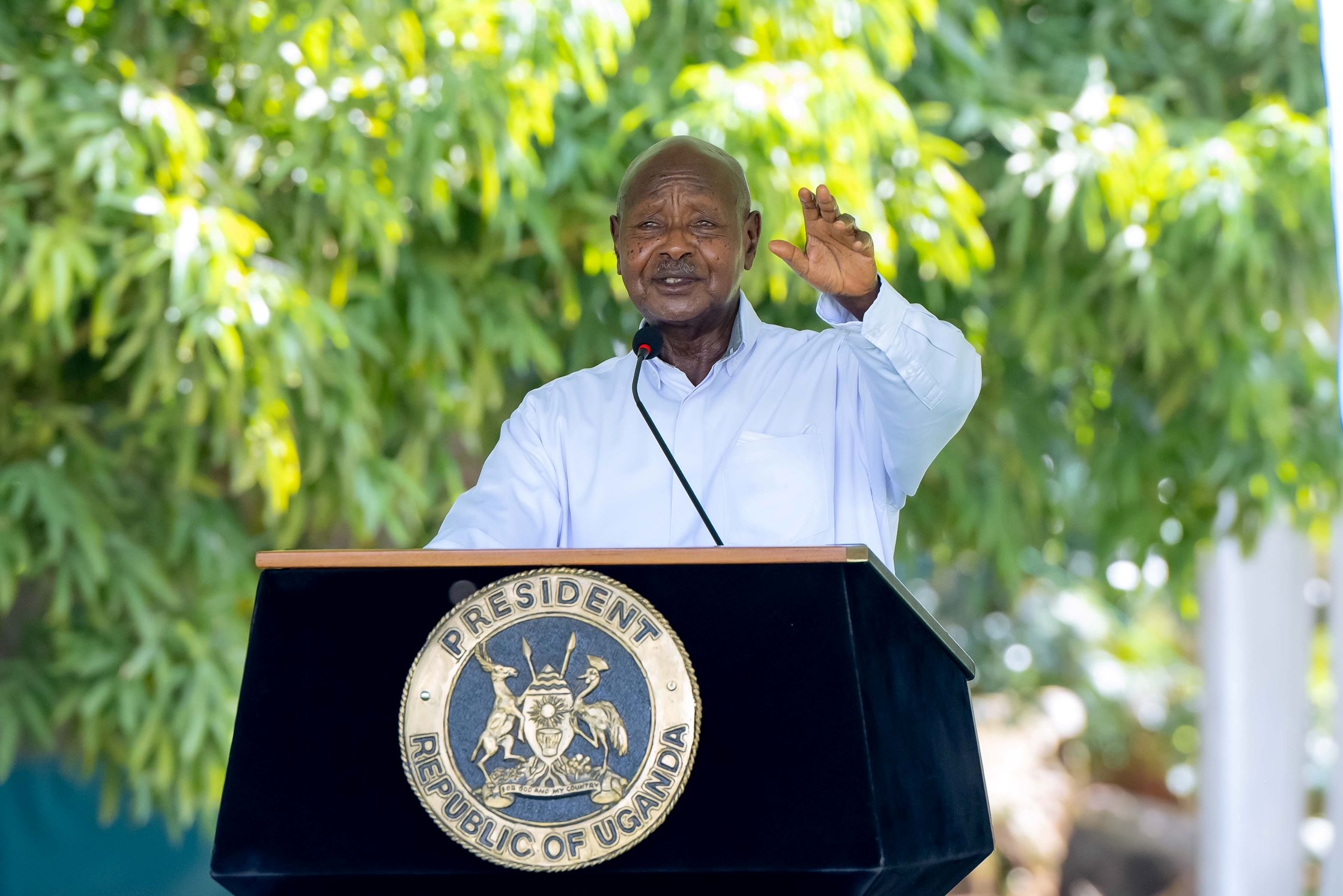
KAMPALA — Uganda’s debate over public-sector accountability has entered another phase after President Yoweri Kaguta Museveni called for renewed action against corruption, absenteeism in public health facilities, medicine shortages and alleged misuse of government programmes. President Museven told NRM legislators that public service must be measured by delivery, while urging MPs to confront corruption, absenteeism and misuse of public resources
Addressing members of the National Resistance Movement (NRM) Parliamentary Caucus at Speke Resort Munyonyo in Kampala on Friday, August 7, President Museveni said concerns raised by citizens during his recent countrywide engagements pointed to persistent weaknesses in public service delivery.
His message was direct: government programmes can only translate into development when institutions function, public resources reach their intended beneficiaries and officials remain accountable for the responsibilities entrusted to them. The intervention placed health services, corruption, the Parish Development Model (PDM), local government recruitment, crime and the rising burden of non-communicable diseases among issues requiring renewed attention from government and Parliament.
Health service delivery emerged as one of the strongest concerns in the President’s address. President Museveni questioned reports that some public health facilities lack essential medicines while patients are directed to private pharmacies and drug shops to obtain treatment. He said the government must establish whether reported shortages are caused by inadequate supply, administrative failures or diversion of medicines. The President said he intends to follow up on the matter, including allegations of possible theft of medicines from public facilities.
The concern goes beyond the availability of drugs. It touches the larger question of whether public investment in health is translating into services that citizens can actually access when they need them. For many African countries, health-system resilience remains closely connected to governance. Medicines, staffing, infrastructure, procurement and accountability are not isolated administrative questions; together they determine whether public health institutions can fulfil their social mandate.
Museveni also raised concern about absenteeism among health workers, particularly professionals employed by government who are allegedly not consistently present at their designated stations. He argued that Uganda should not retain public employees who repeatedly fail to perform their duties when qualified young professionals are available to enter the workforce. The President said government could eventually replace non-performing workers with younger professionals.
The statement places a difficult but important question before Uganda’s public-service system: how can government simultaneously protect institutional professionalism, enforce accountability and create meaningful opportunities for a growing generation of qualified professionals? The answer will require more than disciplinary measures. It will also depend on transparent recruitment, effective supervision, fair deployment, adequate working conditions and reliable performance-management systems.
The President also drew attention to the increasing burden of cancer and diabetes, describing non-communicable diseases as an emerging challenge requiring greater government attention. Uganda has made substantial progress against several infectious diseases, but the changing disease profile presents a different policy challenge.
Cancer, diabetes, cardiovascular conditions and other non-communicable diseases place pressure not only on hospitals but also on households, workplaces and national productivity. Museveni questioned why increasing numbers of Ugandans are seeking treatment abroad, particularly in India, and called for greater attention to prevention and the underlying causes of disease.
His remarks point toward a broader policy conversation: Uganda’s health strategy must increasingly balance treatment with prevention, early diagnosis, public awareness, research and environmental and lifestyle factors. For a country seeking to transform its economy, the health of its population is also an economic question. Illness removes people from productive activity, increases household expenditure and places additional pressure on public resources.
The President’s concerns over the Parish Development Model placed local governance and household economic transformation at the centre of the discussion. PDM was designed to support households in moving into the money economy through organised parish-level interventions. Its effectiveness, however, depends heavily on whether resources reach intended beneficiaries and whether local institutions can account for them.
Museveni cited allegations of theft and misuse of PDM resources in several areas, including Pakwach, Maracha, Iganga and Buwambo, while identifying Kasese as an area where he had received reports of comparatively positive implementation. The allegations require proper investigation and evidence-based follow-up rather than assumptions of guilt. But politically, the President’s intervention underscores an important reality: large-scale development programmes can lose public legitimacy when citizens perceive that benefits are being captured by intermediaries.
The President instructed Prime Minister Robinah Nabbanja to have the relevant authorities investigate reported cases. For Parliament and local governments, the implication is equally significant. Oversight cannot end with the allocation of money. It must extend to procurement, beneficiary selection, implementation, monitoring and measurable household outcomes.
The President also criticised alleged corruption in local government recruitment, citing information that a government position in Kibale was allegedly being offered for Shs10 million. Such allegations, if substantiated, would raise serious questions about merit-based recruitment and the integrity of Uganda’s public-service institutions. Employment in government is not a private commodity. Recruitment processes determine who occupies positions responsible for administering public resources and delivering services to citizens.
A credible response therefore requires more than political condemnation. It requires transparent recruitment systems, independent oversight, accessible complaint mechanisms and consequences for proven misconduct. The President also urged MPs to become more vocal in exposing corruption within their constituencies. His appeal for legislators to become “durable” rather than “seasonal” leaders carries a broader democratic message: elected representatives are most valuable when they maintain contact with citizens beyond electoral campaigns.
Another theme in the President’s address was the tension between expanding administrative structures and investing in productive capacity. Museveni criticised what he described as excessive political attention to the creation of new districts, cities and leadership positions, arguing that government should concentrate on infrastructure and interventions capable of increasing household incomes.
He singled out irrigation as a critical tool in Uganda’s effort to reduce poverty and strengthen agricultural productivity. The argument reflects a longstanding development question across Africa: should scarce public resources be directed primarily towards expanding administrative structures, or towards infrastructure and productive sectors capable of generating employment, incomes and resilience?
Uganda’s answer will inevitably require balancing both. Administrative units can improve access to public services and representation, but they also carry recurring costs. Infrastructure such as irrigation, roads, railways, schools and health facilities, meanwhile, can create longer-term productive capacity. The policy challenge is therefore not simply whether new administrative units should be created, but whether each public investment can demonstrate measurable value to citizens.
Museveni’s appeal to NRM legislators to speak out against corruption also places Parliament’s oversight role under renewed scrutiny. The effectiveness of parliamentary representation is ultimately measured not only by participation in legislation but also by the ability to question implementation, demand accountability and communicate citizens’ concerns to government.
For ruling-party legislators, however, this responsibility can involve a delicate balance between supporting government programmes and scrutinising their implementation. A mature governance system requires both, supporting national development priorities does not have to mean abandoning oversight. Equally, criticism does not have to become political obstruction. The stronger model is constructive accountability: identify problems, establish facts, demand corrective action and protect programmes that demonstrably serve the public interest.
Following the President’s address, the NRM Parliamentary Caucus adopted 11 resolutions presented by Government Chief Whip Dr Jane Ruth Aceng. The resolutions included continued support for government priorities in defence and security, roads, railways, irrigation, health and education, alongside renewed commitments to fighting corruption. The caucus also resolved to strengthen discipline and integrity during electoral processes and support ongoing and forthcoming local council and women’s council elections.
On PDM, MPs pledged to support implementation, improve visibility and follow up allegations involving diversion, theft and corruption. The caucus also resolved to examine challenges surrounding school fees in public schools and develop proposals for government consideration. Other resolutions covered value addition, domestic markets and regional integration.
The caucus further endorsed continued financial contributions agreed by the NRM Central Executive Committee, including monthly contributions from MPs to the party and parliamentary caucus. The resolutions also welcomed independent MPs aligned with the NRM into the parliamentary caucus. Among the foreign-policy matters contained in the resolutions was support for Ambassador Olara Otunnu’s candidature for Secretary-General of the United Nations.
Taken together, the President’s remarks and the caucus resolutions point to a wider challenge confronting Uganda: translating political commitments and public expenditure into visible improvements in everyday life. Medicine shortages, absenteeism, corruption, PDM accountability, local government recruitment, school fees and household incomes may appear to belong to different policy areas. In practice, they are connected by one institutional question whether public systems can consistently deliver what citizens are promised.
That question is particularly important as Uganda pursues economic transformation and deeper regional integration. Africa’s development story is increasingly being shaped by the quality of its institutions. Roads, hospitals, irrigation schemes, digital systems and investment programmes matter, but so do the rules governing how public resources are allocated and monitored. Uganda’s next phase of development will therefore require both investment and institutional discipline.
The President’s call for stronger action against corruption and poor service delivery may resonate with citizens who encounter these challenges directly. But the lasting test will not be the strength of the political language used to condemn misconduct. It will be whether investigations are completed, evidence is acted upon, public resources are protected, health facilities receive medicines, workers report for duty, beneficiaries receive programme support and citizens can see measurable improvements in their communities.
For Daily Thinkers, that is where the story ultimately lies, Beyond the headlines is the harder question of implementation and in Uganda’s development journey, implementation not intention will determine whether public policy becomes public value.