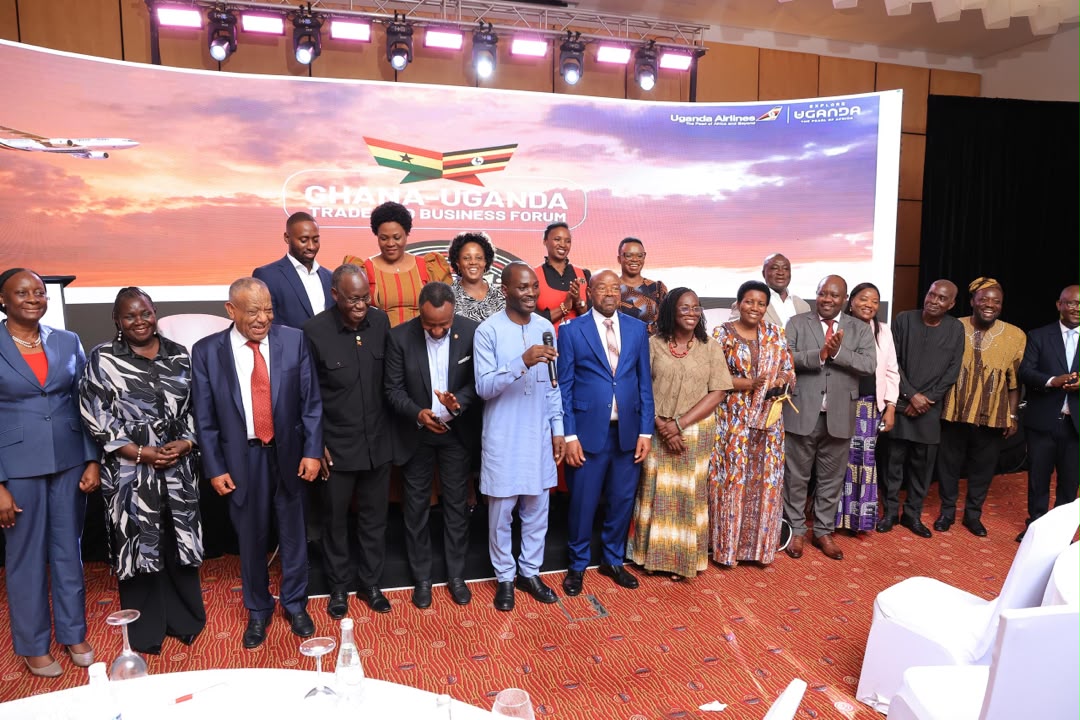
Accra, Ghana | Uganda and Ghana have renewed their commitment to strengthening intra-African trade, tourism and investment following a joint business forum in Accra, held to mark the launch of Uganda Airlines’ new Entebbe–Accra service via Lagos.

The forum, held on 28 October 2026 at the Accra Marriott Hotel under the theme “Leveraging Air Connectivity for Trade, Tourism, Investment and Economic Cooperation,” brought together government officials, business executives, investors and tourism representatives from both countries to explore commercial partnerships and opportunities under the African Continental Free Trade Area (AfCFTA).
The launch of the four-times-weekly service on 27 October marked a new phase in connectivity between East and West Africa, with the two governments and their business communities encouraged to translate improved transport links into measurable economic outcomes. The engagement reflects a wider continental priority: reducing the practical barriers that prevent African businesses from accessing markets, building partnerships and participating more effectively in regional and continental value chains.
Addressing the forum, Uganda Airlines’ Acting Chief Executive Officer, Mr. Girma Wake, described the Accra route as a strategic bridge between East and West Africa, designed to facilitate trade, tourism, investment and business partnerships. He thanked the Government of Uganda for its continued support of the national carrier, which was revived in 2019, and highlighted the importance of passenger and cargo services in supporting commercial activity. According to Mr. Wake, the airline’s cargo freighter capability, with a capacity exceeding 30 tonnes, offers additional potential to serve exporters, importers and traders seeking more efficient connections between the two regions.
Improved connectivity can reduce the logistical obstacles associated with long-distance business travel, enable companies to maintain closer relationships with partners and create opportunities for tourism operators to develop cross-border products. Cargo capacity can also support the movement of eligible goods, subject to operational schedules, freight arrangements and applicable customs and regulatory requirements. For Uganda and Ghana, the commercial opportunity lies in using the route to facilitate sustained business engagement rather than treating it solely as a passenger transport service.
Uganda’s Minister of State for Finance and Economic Development urged the participating business communities and the respective ministries, departments and agencies to implement the decisions reached during the forum for the mutual benefit of both countries. The emphasis on implementation is significant. Business forums can establish contacts and identify opportunities, but their long-term value depends on whether discussions lead to commercial agreements, investment commitments, market access and functioning partnerships.
Uganda’s Minister of State for Works and Transport, Hon. Fred Byamukama, encouraged Ugandan businesses to take advantage of the new route and the favourable travel arrangements between the two countries. He noted that Ghana permits visa-free travel for Ugandans under the applicable arrangements, making it easier for eligible travellers to explore business and investment opportunities. For companies considering expansion into West African markets, direct air connectivity can make preliminary visits, negotiations and follow-up engagements more practical. However, visa-free entry does not automatically remove business registration, work authorisation, customs or other regulatory requirements that may apply to particular activities.
In her keynote address, Ghana’s Minister of Tourism, Culture and Creative Arts, Hon. Abla Dzifa Gomashie, called for cooperation frameworks in creative industries, particularly film, music and fashion. She highlighted the potential for collaboration to generate employment and facilitate skills transfer among young people in both countries.
The creative economy offers a complementary dimension to conventional trade and investment cooperation. Joint productions, cultural festivals, fashion showcases and professional exchanges could create opportunities for artists, designers, filmmakers and entrepreneurs while strengthening people-to-people relations. Such initiatives could also support tourism promotion by presenting Uganda and Ghana as destinations with distinctive cultural identities, heritage and creative talent.
The new route comes as African countries continue implementing the AfCFTA, which seeks to establish a single continental market for goods and services, facilitate investment and deepen economic integration. The World Bank estimated in its 2020 assessment that successful implementation of the AfCFTA could increase African incomes by 7 per cent, or approximately US$450 billion, by 2035, compared with its baseline projections. The report also estimated that the agreement could help lift 30 million people out of extreme poverty and 68 million out of moderate poverty. These figures are projections, not realised outcomes, and depend on implementation, trade facilitation, infrastructure, investment and complementary domestic reforms.
Against this background, stronger air links between Uganda and Ghana can contribute to the practical infrastructure required for businesses to identify suppliers, reach customers and establish partnerships across regional markets. The two countries could build on the forum by identifying priority export products, facilitating business-to-business matchmaking, sharing market intelligence and establishing follow-up mechanisms to track commercial commitments.
The forum concluded with a dinner gala attended by more than 400 guests. The programme included a cake-cutting ceremony and a Uganda Airlines-sponsored raffle, through which three attendees won air tickets. Beyond the ceremonial activities, the launch presents an opportunity for both countries to connect diplomacy with enterprise, infrastructure with market access, and cultural cooperation with employment creation. The ultimate measure of the Entebbe–Accra route will be its contribution to sustained passenger demand, cargo movement, tourism growth, commercial partnerships and investment flows.
For Uganda and Ghana, the next step is to ensure that the new air link becomes a practical platform for expanding bilateral commerce and strengthening African economic integration. As the continent advances the AfCFTA agenda, the partnership demonstrates how connectivity, coordinated public policy and private-sector participation can work together to bring African markets closer and create opportunities for shared prosperity.