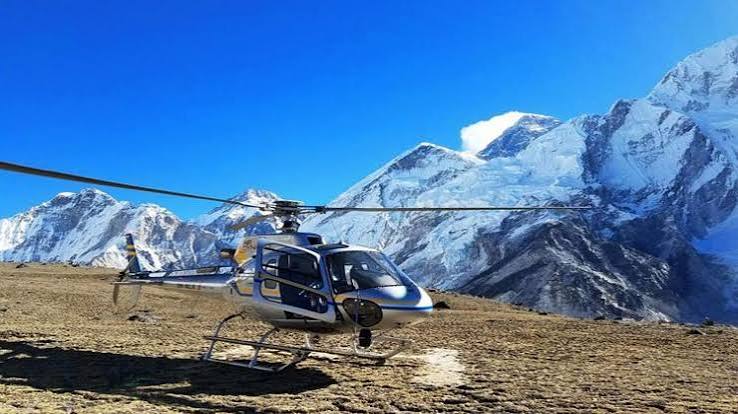
KATHMANDU, Nepal | The collision of two helicopters preparing to land in Nepal’s Mount Everest region has renewed attention on aviation safety, emergency response and the growing demands placed on mountain tourism infrastructure, following an accident that claimed the life of an Indian tourist and left two other people injured.

The incident occurred on Tuesday morning at Pheriche village in Solukhumbu district, approximately 4,200 metres above sea level, as the aircraft approached a landing site along one of the world’s most recognised trekking routes. Authorities identified the deceased as a 47-year-old Indian national. A New Zealand passenger sustained injuries and was evacuated to Kathmandu for medical attention, while a Nepali pilot was also injured and received treatment locally.
The helicopters were operated by Fishtail Air and Air Dynasty. According to information provided by the Civil Aviation Authority of Nepal, one aircraft was undertaking a cargo flight from Lukla, while the other was carrying foreign passengers from the Everest region. The precise circumstances surrounding the collision remain subject to investigation. Preliminary accounts have pointed to possible communication difficulties between pilots, although no definitive cause has been established.
The accident occurred during Nepal’s autumn trekking season, when improved weather conditions attract climbers, trekkers and adventure travellers to the Himalayan region. Helicopters have become an important component of this tourism and emergency-response network, particularly in locations where difficult terrain and the absence of road infrastructure make conventional transport challenging.
Nepal’s tourism industry is an important contributor to employment, foreign exchange earnings and international visibility. According to Nepal Tourism Board figures, the country welcomed 1,158,459 international visitors in 2025, compared with 1,147,548 in 2024. Indian nationals accounted for 292,438 arrivals, making India Nepal’s largest source market that year. The figures demonstrate the importance of maintaining visitor confidence in the safety and reliability of the country’s tourism infrastructure.
The Everest region occupies a particularly important place in this industry. Mount Everest, at 8,848.86 metres, is the world’s highest mountain above sea level, while the surrounding Sagarmatha National Park is recognised as a UNESCO World Heritage Site. Its international appeal extends beyond mountaineering to include trekking, environmental tourism, scientific interest and cultural encounters with local communities.
However, the growth of adventure tourism also creates operational pressures. Helicopters transport supplies, support rescue missions and evacuate visitors experiencing altitude-related illness or exhaustion. At high elevations, aircraft operations are affected by changing weather, reduced air density, restricted landing areas and complex mountain geography. These conditions demand rigorous flight coordination, competent ground operations and strict adherence to safety procedures.
The risks are not new. Reporting by The Kathmandu Post indicates that Nepal has recorded at least 22 fatal helicopter crashes since the Civil Aviation Authority began maintaining records in 1966. The figure places Tuesday’s accident within a wider national aviation-safety challenge rather than treating it as an isolated incident.
The incident presents an opportunity for Nepal’s aviation authorities and tourism stakeholders to examine how helicopter traffic is coordinated around busy trekking destinations. Priorities include reviewing landing-site management, communication protocols between aircraft, flight scheduling, weather assessment, pilot training and emergency-response arrangements.
The investigation will also need to establish whether existing procedures were followed and whether additional safeguards are necessary where multiple aircraft operate within confined mountain landing zones. Any recommendations should be guided by evidence and implemented in consultation with operators, local authorities, pilots, tourism businesses and communities.
There is also a wider environmental and social dimension. Communities around Everest have previously raised concerns about increasing helicopter activity, including noise, pressure on the fragile mountain ecosystem and the distribution of tourism-related economic benefits. Balancing commercial access, emergency services, conservation and local livelihoods remains essential to sustainable destination management.
For international travellers, the tragedy is a reminder that adventure tourism requires more than attractive destinations and efficient transport. It depends on transparent safety standards, accountable operators and emergency systems capable of responding to the realities of high-altitude environments.
As Nepal investigates the circumstances of the collision, the priority remains support for the injured, respect for the life lost and a credible assessment of the operational failures, if any, that contributed to the accident. The long-term measure of the response will not simply be the restoration of helicopter services. It will be whether lessons from the tragedy translate into stronger aviation oversight, safer tourism operations and renewed confidence in one of the world’s most important mountain destinations.