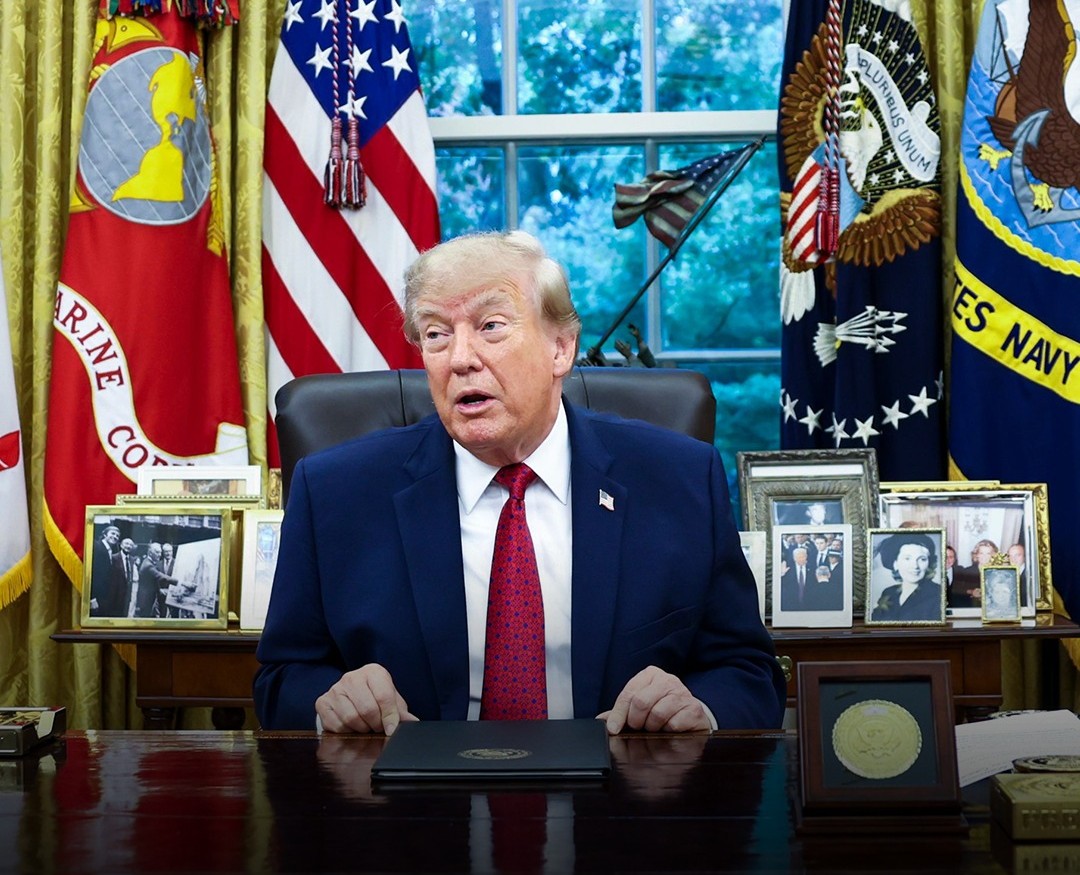
The office of the President of the United States has always communicated more than the authority of the person occupying it. Its architecture, portraits, furniture and ceremonial arrangements represent an institution built around the history, political traditions and global influence of the American presidency. Yet, since returning to the White House in January 2025, President Donald Trump has introduced a distinctive visual identity to one of the world’s most recognisable political spaces: the Oval Office.

Gold has become a defining feature of the room. Decorative gold accents, gilded ornaments, elaborate frames, statuettes and additional portraits have transformed the appearance of the presidential workspace. The changes reflect Trump’s longstanding preference for gold-toned interiors, a design language also visible in some of his privately owned properties. But when applied to the Oval Office, the transformation carries a significance that extends beyond personal taste. It places the president’s individual style inside a room that has traditionally served as a visual representation of the American state.
The Oval Office is not simply an executive workplace. It is where American presidents address the nation, receive foreign leaders, make major announcements and conduct some of the country’s most consequential diplomatic engagements. Images from the room circulate internationally, shaping how audiences understand the personality and priorities of the American presidency.
Trump’s changes have been particularly visible. In March 2025, CNN reported that the number of paintings displayed in the office had tripled within approximately eight weeks of his return. New decorative pieces included gold ornaments on the mantel, gilded mirrors, gold eagles and elaborate features around the doors and fireplace. Subsequent additions further extended the gold decoration across the room’s walls and furnishings.
The changes have also included portraits of prominent American figures, busts and a copy of the Declaration of Independence. The result is an office in which historical references, national symbols and the president’s preferred decorative style occupy the same space. The White House’s most recognisable room has therefore become a subject of international media attention, not only because of the decisions made inside it, but also because of what its appearance communicates.
American presidents have historically left physical marks on the White House. Renovations, changes in furnishings, portraits and alterations to ceremonial spaces have reflected different administrations and periods in American history. The present transformation, however, has attracted particular attention because of the scale and visual character of the changes. In August 2026, Reuters reported on Trump’s wider remaking of Washington, including changes to the Oval Office, the Rose Garden and other parts of the White House grounds. The Rose Garden, traditionally associated with outdoor presidential ceremonies and events, was converted from a grass lawn into a stone patio with umbrella-covered tables. These developments have generated debate about presidential discretion, historical preservation and the relationship between public buildings and the personal preferences of elected leaders.
Supporters of renovation can argue that presidents should have room to modernise the environments in which they work and host international visitors. Critics, meanwhile, have raised concerns about the preservation of historic spaces and the extent to which an institution’s appearance should reflect the preferences of one administration. The distinction matters because the White House is both a working residence and a national historical site. Its public meaning extends beyond the political party or individual occupying it at any particular moment.
On 5 November 2026, Trump introduced another dimension to the debate by signing a proclamation intended to designate the Oval Office and Cabinet Room as a national monument. Reuters reported that he described the move as a way of protecting the historic spaces from major future modifications, suggesting that substantial changes would require congressional approval.
The announcement was striking because it came after his own administration had undertaken extensive alterations to the Oval Office. It raises a broader institutional question: how should a president balance the authority to adapt an official workplace with the responsibility to preserve a space that belongs to the historical memory of the nation? The legal implications of the proclamation and the extent of protection it could provide remain important considerations. The Associated Press noted that the action cannot necessarily prevent a future president from redecorating or rescinding the designation. In other words, the announcement has opened a further debate rather than conclusively settling the future of the office.
For international audiences, the Oval Office is also a diplomatic stage. Heads of state, prime ministers, ambassadors and international organisations encounter the American presidency through its public ceremonies, official photographs and televised meetings. The room’s transformation therefore contributes to the wider image of American leadership. Its gold decoration may be interpreted by some as a statement of prestige and personal identity, while others may see it as a departure from the restrained institutional appearance associated with earlier administrations. These are interpretations, rather than evidence of a change in American foreign policy.
That distinction is essential. The design of a presidential office does not, by itself, determine the direction of diplomacy, trade negotiations, security partnerships or international commitments. Those are shaped by policy decisions, institutions, strategic interests and the changing balance of global power. Nevertheless, political symbolism matters. In international relations, the presentation of leadership can influence perceptions, reinforce national narratives and shape the atmosphere in which diplomatic engagements take place.
Trump’s Oval Office makeover illustrates a recurring tension in democratic governance: the relationship between individual leadership and institutional continuity. Presidents are elected to exercise authority, introduce their priorities and leave a record of their administrations. Yet, the institutions they occupy have histories that precede them and will continue after their departure.
The question is not simply whether gold belongs on the walls of the Oval Office. It is whether a historic national institution can accommodate the personal expression of its temporary occupant while preserving an identity that belongs to the wider American public.
As the United States approaches the 250th anniversary of its independence in 2026, the debate carries additional historical weight. The Oval Office remains a powerful symbol of American government, but its evolving appearance reminds the world that national symbols are continually interpreted, contested and reshaped.
For now, the gold remains a visible signature of Trump’s second presidency. Its lasting significance, however, will depend not only on the decorations themselves, but on how future administrations, historians and the American public judge this particular chapter in the history of the White House. The Oval Office may belong to the sitting president for a time, but its place in American history belongs to generations.