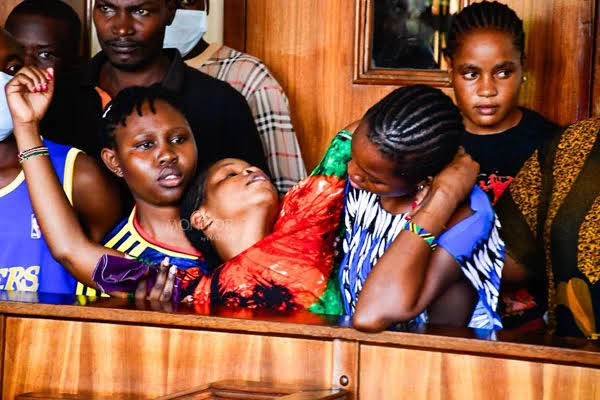
A courtroom in Kampala has become the latest stage in Uganda’s growing debate over environmental protection, oil development and the constitutional rights of citizens to question decisions concerning national resources. The collapse of environmental activist Dorothy Asio during proceedings at Buganda Road Chief Magistrate’s Court has brought renewed attention to the treatment of environmental defenders, the administration of justice and the relationship between economic development and civic freedoms.

Asio, a member of the youth-led environmental movement Rooted in Resistance, reportedly collapsed in the dock while participating in a hunger strike described as a protest against prolonged pre-trial detention. The court subsequently ordered prison authorities to provide a formal medical report on her condition. Magistrate Rophine Achayo suspended proceedings and directed that the case return on November 16 for a further bail hearing.
The incident follows the arrest of ten environmental activists on August 31, 2026, while attempting to march to Parliament to deliver a petition seeking reforms in Uganda’s oil sector. On September 1, they were charged with causing nuisance on a public road under Section 67(1)(c) of the Roads Act. They have denied the charge. According to their defence lawyers, the activists’ continued detention and repeated court adjournments have raised concerns about access to bail, speedy trial rights and their physical welfare. The significance of this case extends beyond the individuals appearing before the court. It raises a fundamental question for Uganda: how should a country balance its ambitions for petroleum-led economic transformation with the constitutional rights of citizens to question the environmental, social and economic implications of major development projects?
Uganda’s experience is part of a wider continental conversation. Global Witness documented at least 124 killings of land and environmental defenders worldwide in 2025, bringing its recorded total since 2012 to 2,375. Its September 2026 findings identified three killings in Africa during 2025: two in Tanzania and one in the Democratic Republic of Congo. These numbers should not be interpreted as proof that Africa is safer. The organisation warns that restricted access to information, intimidation and difficulties verifying incidents contribute to underreporting, particularly across Africa and Asia.
The 2024 report had documented nine killings in Africa, representing approximately six per cent of the 146 defenders killed or disappeared globally that year. Across the continent, defenders face risks associated with land disputes, extractive industries, conservation, agriculture and infrastructure development. The figures tell only part of the story. Environmental defenders do not face violence exclusively through physical attacks. Arrests, prolonged detention, intimidation, threats and legal proceedings can also restrict the ability of individuals and communities to participate in decisions affecting their environment.
Global Witness identifies criminalisation as an increasingly common tactic used to silence environmental defenders. Its 2025 reporting specifically highlights concerns about the use of legal systems against defenders in Uganda, Kenya and Tanzania. This makes the Kampala proceedings relevant to a wider regional discussion about the protection of civic space.
Uganda’s petroleum development represents a major national economic undertaking. The government has defended oil investment as an opportunity to expand production, create employment, develop infrastructure and support the country’s ambition to grow its economy towards US$500 billion. The East African Crude Oil Pipeline, stretching approximately 1,443 kilometres through Uganda and Tanzania to the Tanzanian coast, is central to this strategy. Government reporting has placed construction progress above 90 per cent, with first oil targeted for 2027.
For government, petroleum development is linked to national revenue, energy security and industrialisation. For environmental organisations, the debate concerns the project’s environmental footprint, climate implications, land rights, community displacement and the long-term costs of dependence on fossil fuels.
These positions need not be treated as mutually exclusive. A country can pursue economic development while demanding strong environmental safeguards, transparent compensation arrangements, credible impact assessments and public accountability. Indeed, the larger the investment, the greater the need for effective oversight.
The right to question development policy should not automatically be interpreted as opposition to national development. Equally, peaceful activism does not place individuals above the law. The challenge for public institutions is to distinguish legitimate enforcement of the law from restrictions that could unnecessarily undermine constitutional freedoms.
Human rights activist David Musiri, speaking outside the court, criticised the handling of the case and called for greater judicial independence. He warned against what he described as a shift from the rule of law towards rule by law. These are his expressed concerns, not a judicial finding on the case. The distinction is important. The rule of law requires that laws be applied consistently, that accused persons receive fair hearings, that detention is subject to legal safeguards and that courts remain independent. It also requires accountability where environmental harm or violations of community rights are established.
For Uganda, the immediate priorities should be the timely medical assessment of detained activists, fair consideration of bail applications, expeditious proceedings and respect for the presumption of innocence. For the wider environmental debate, government, investors and civil society need credible channels through which concerns can be raised and addressed without intimidation or violence.
The collapse of an activist in court should not become an occasion for political spectacle. It should prompt institutional reflection. Uganda’s development ambitions will be judged not only by the infrastructure it builds, the oil it produces or the investment it attracts, but also by how it protects citizens, manages natural resources and handles disagreement. Across Africa, the transition towards sustainable development requires more than environmental policies written into national plans. It requires institutions capable of balancing economic interests, ecological protection and human rights.
Dorothy Asio’s case remains before the courts, and the allegations against the activists must be determined through due process. But the broader question is already before the country: can Africa pursue ambitious economic transformation while ensuring that those who question the environmental consequences of development are heard, protected and treated fairly? The strength of development is not measured only by what a country extracts from its land. It is also measured by the institutions it builds to protect that land, its people and their rights.