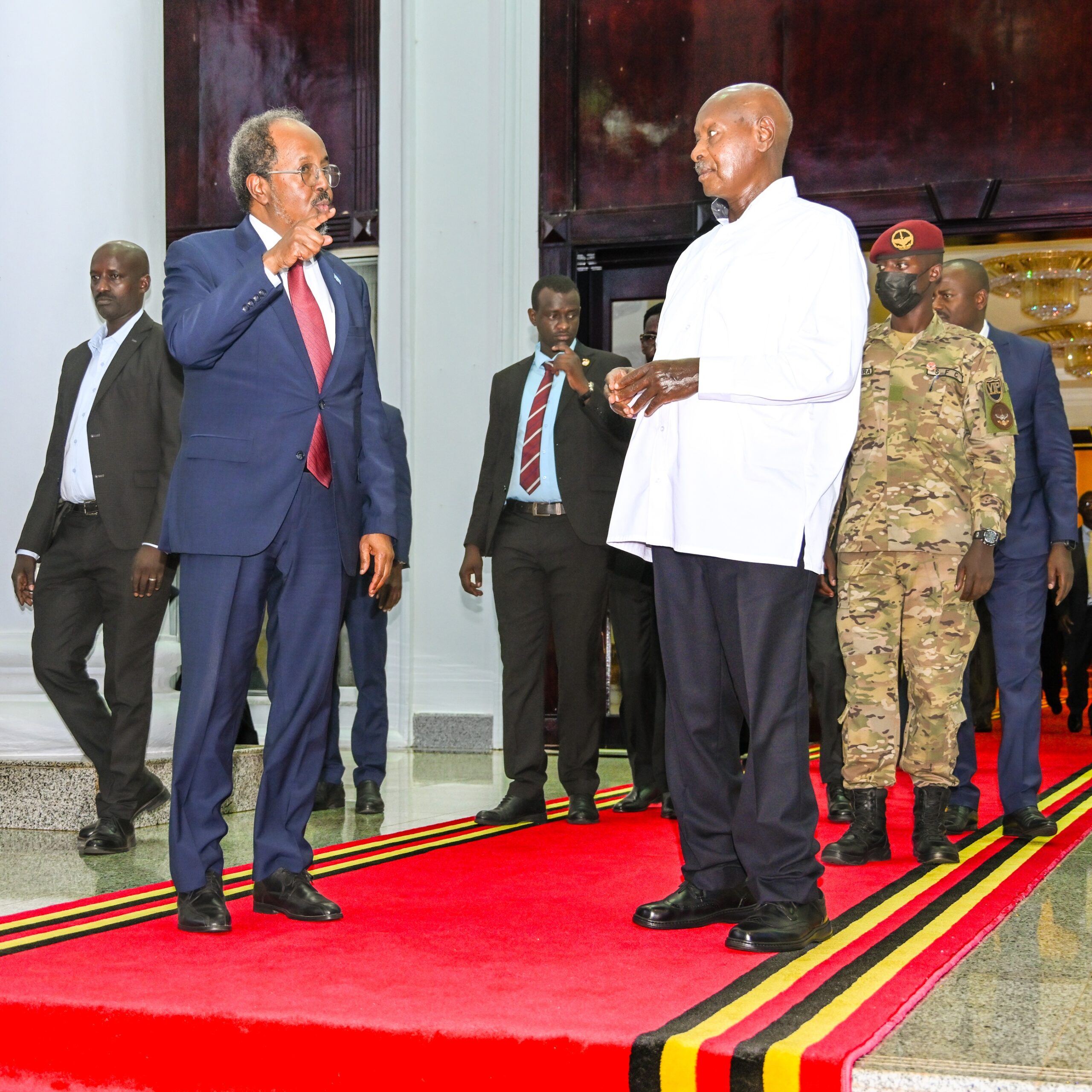
ENTEBBE, Uganda — Uganda and Somalia have reaffirmed their longstanding strategic partnership, with Presidents Yoweri Kaguta Museveni and Dr. Hassan Sheikh Mohamud pledging to deepen cooperation in promoting peace, regional security and sustainable development across the Horn of Africa.
The commitment emerged from high-level bilateral talks held at State House, Entebbe, where the two Heads of State reviewed progress in regional peace efforts, governance reforms and state-building, while exploring avenues for enhanced collaboration in addressing evolving security challenges. The meeting underscored the enduring relationship between Kampala and Mogadishu one that has been shaped by nearly two decades of Uganda’s contribution to Somalia’s stabilization efforts and a shared commitment to regional peace under African-led initiatives.
President Hassan Sheikh Mohamud commended Uganda for its continued support to Somalia, particularly through the deployment of the Uganda People’s Defence Forces (UPDF) under regional peace support operations. He noted that Uganda’s contribution has been instrumental in strengthening Somalia’s security architecture during one of the country’s most challenging periods. “We are grateful for the security support that Uganda has continued to extend to Somalia. We are in a much better position today than we were before, although challenges remain,” President Mohamud said.
The Somali leader also briefed President Museveni on his government’s ongoing political and constitutional reforms, highlighting efforts to restore universal suffrage after decades without direct elections. He described the reforms as a significant step toward strengthening democratic governance and ensuring that Somalia’s political future is shaped by its citizens through inclusive participation.
President Museveni welcomed Somalia’s progress, reaffirming Uganda’s unwavering commitment to supporting a peaceful, united and prosperous Somalia. “For the last 19 years, we have stood with Somalia because we believe in supporting just causes and protecting innocent people. Our interest has always been to see Somalia become peaceful, stable and prosperous,” President Museveni stated.
Reflecting on Uganda’s own post-conflict experience, President Museveni emphasized that durable peace is built through strong national institutions, inclusive governance and national cohesion rather than sectarian divisions. He observed that Somalia possesses the resilience and potential to overcome its remaining challenges through sustained dialogue, institutional strengthening and collective national purpose.
The Ugandan leader further reiterated Kampala’s readiness to continue working closely with Mogadishu in advancing regional security cooperation, governance reforms and economic integration within the Horn of Africa and the broader East African region.
For his part, President Mohamud described Uganda as a trusted and reliable partner whose support has extended beyond military cooperation to include broader political engagement and regional solidarity. He reaffirmed Somalia’s commitment to strengthening bilateral ties in pursuit of shared peace, stability and prosperity.
The discussions also highlighted the importance of sustained African cooperation in addressing transnational security threats, including terrorism, violent extremism and cross-border instability. Both leaders stressed that African-led solutions remain central to achieving lasting peace and sustainable development across the continent.
Uganda has remained one of Somalia’s most consistent security partners since deploying troops in 2007 under African Union peace support missions. Its continued engagement reflects a broader foreign policy approach that links regional stability with economic integration, political cooperation and collective security.
As the Horn of Africa continues to navigate complex security and governance challenges, the meeting between Presidents Museveni and Mohamud reaffirmed a shared conviction that sustainable peace requires not only security interventions but also stronger institutions, democratic governance and closer regional collaboration. For both Kampala and Mogadishu, the bilateral engagement signals continuity in a partnership that has become an important pillar of East Africa’s broader peace and security architecture.