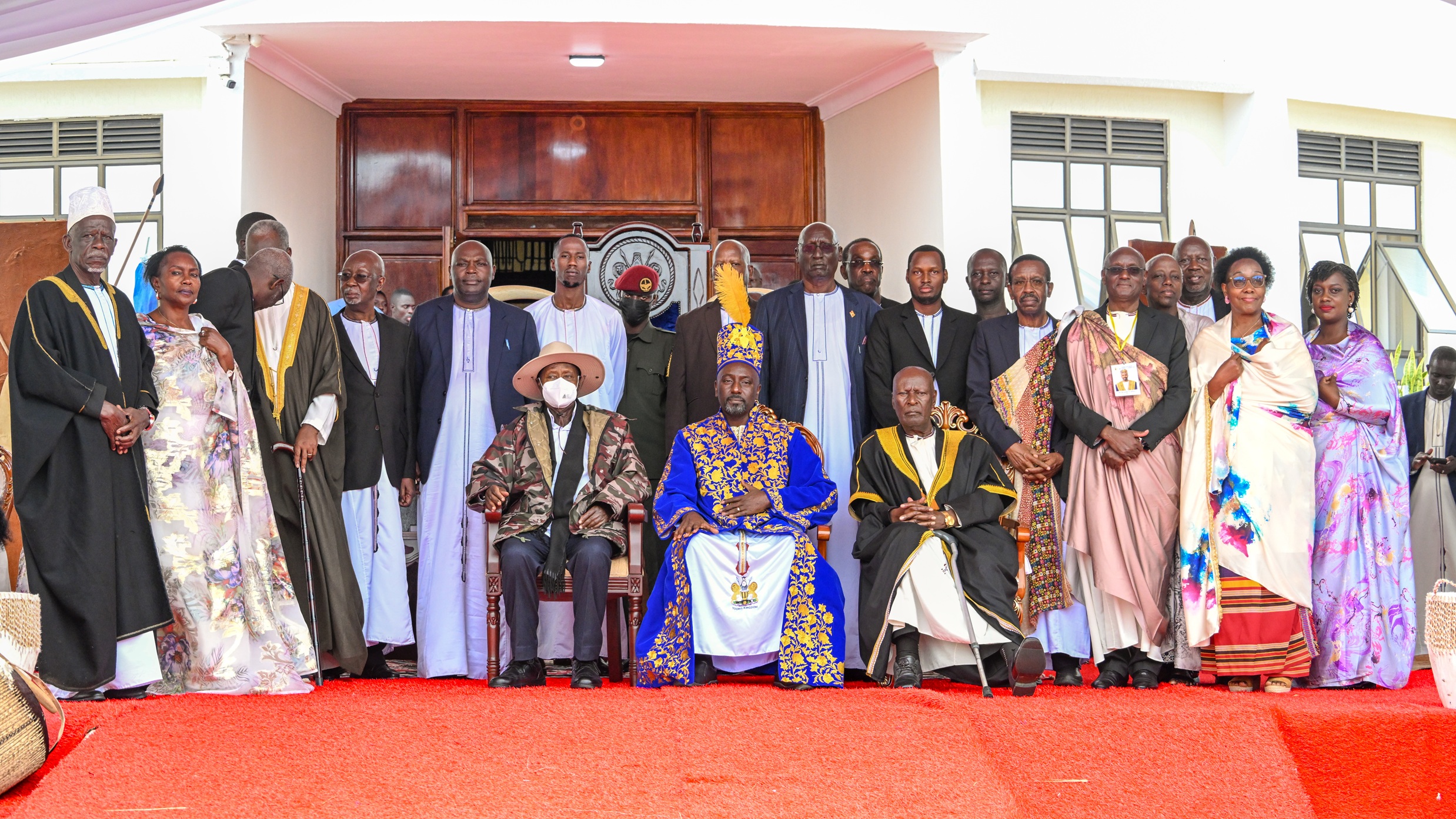
Fort Portal,— The royal drums of Tooro sounded once again at Karuziika Palace on Tuesday as President Yoweri Kaguta Museveni presided over the coronation of His Majesty Edward Rukidi Nyabongo I, marking the beginning of a new chapter for one of Uganda’s historic cultural institutions.The ceremony followed the death of Omukama Oyo Nyimba Kabamba Iguru Rukidi IV on August 27, 2026, bringing to a close a 31-year reign that began when Oyo inherited the throne at the age of three.
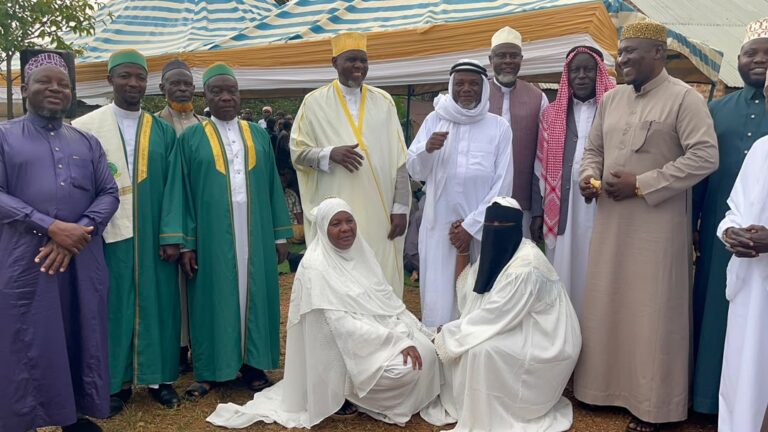
Thousands of Batooro, cultural leaders, religious leaders, government officials, diplomats and guests from across Uganda and beyond gathered at Karuziika Palace in Fort Portal to witness the transition. The coronation followed a thanksgiving service at St John’s Cathedral, led by Bishop Reuben Kisembo, before celebrations moved to the palace, where the return of the royal drums and unveiling of the lion statues symbolised the closing of the mourning period and the restoration of public royal ceremonies but beyond the colour and ceremony, the occasion represented something deeper: the continuity of Tooro’s cultural identity.
Tooro’s history reaches deep into the Great Lakes region and is preserved through royal genealogies, oral traditions, clan institutions, language, music, dance, dress and customary knowledge. According to the Uganda Media Centre, Tooro’s historical narrative traces its royal traditions through the ancient Batembuzi and Bachwezi traditions before the emergence of the Babiito dynasty. The independent Tooro Kingdom emerged around the 1830s under Prince Olimi I, who separated from Bunyoro and established a distinct royal institution. The kingdom later reaffirmed its independence in the nineteenth century under Omukama Kasagama.
The monarchy subsequently navigated the political transformations brought by British colonial rule and Uganda’s post-independence political changes. In 1967, Uganda abolished the traditional kingdoms as political institutions. The traditional institutions were restored in 1993, reopening a new era in which cultural kingdoms could contribute to cultural preservation and social development without exercising constitutional political authority. The Tooro institution therefore carries a history that predates the modern Ugandan state and has survived several major political transformations. The coronation of Nyabongo I becomes part of that longer story of continuity.
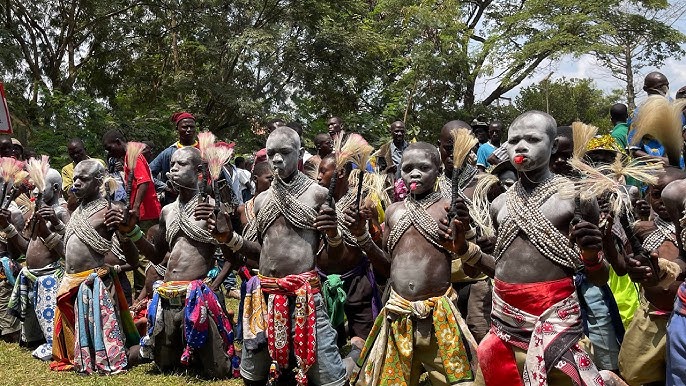
For the Batooro, heritage is not confined to royal buildings or ceremonial occasions. It lives in language, names, clan relationships, traditional music, dance, dress, oral history, food, crafts and systems of social organisation. At Karuziika, the sound of the royal drums, the amakondere, the vibrant mushana and busuuti worn by guests, the ululations and the ceremonial unveiling of the lion statues transformed the palace grounds into a living cultural archive. These traditions provide a connection between generations.
President Museveni used the occasion to call for greater protection of indigenous languages, cultural practices and indigenous knowledge. He argued that local languages contain concepts and expressions that may not always be fully captured when translated into English and urged cultural institutions to work with government to preserve them. He also highlighted indigenous science and traditional knowledge, citing the preservation of Ankole long-horned cattle as an example of heritage that can carry ecological, economic and cultural value. His wider message was that cultural heritage should not be treated merely as something belonging to the past, but as knowledge and identity capable of contributing to contemporary society.
The cultural significance of Tooro also intersects with Uganda’s rapidly expanding tourism economy. Uganda recorded 1,371,895 international tourist arrivals in 2024, an increase of 7.7 percent from 2023. Tourism earnings reached approximately US$1.28 billion, while the sector continued to recover strongly following the disruption caused by the COVID-19 pandemic.
The Ministry of Tourism, Wildlife and Antiquities subsequently reported that international arrivals rose further to 1.642 million in 2025, while tourism earnings reached UGX 5.83 trillion (US$1.62 billion). Domestic tourism participation was reported at 3.27 million Ugandans, demonstrating the increasing importance of tourism to Uganda’s economy and domestic cultural engagement.
Within this broader tourism landscape, western Uganda offers a distinctive combination of cultural and natural heritage. Tooro’s royal traditions are situated within a landscape associated with the Rwenzori Mountains, Kibale’s primate forests, Semuliki’s ecological diversity and Fort Portal’s cultural and historical identity. This creates an opportunity to connect cultural heritage, nature-based tourism, community enterprise and destination marketing rather than treating them as separate sectors.
The kingdom’s traditions can therefore contribute not only to cultural identity but also to intergenerational learning, creative industries, hospitality, crafts, gastronomy, heritage tourism and local enterprise.
President Museveni paid tribute to the late King Oyo, recalling their correspondence and acknowledging the contribution the late monarch made to Tooro and Uganda. He also congratulated Nyabongo I, recalling his earlier career as a news anchor and editor. “I was watching him on the news as a good news reader in English, so I am sure he will do a good job here,” the President said.
Museveni further used the occasion to argue that cultural institutions can complement the modern state by helping preserve indigenous languages, culture and knowledge. He particularly called upon cultural leaders to address family and marriage institutions and to promote responsible family life, while emphasising the importance of protecting indigenous knowledge, crafts and traditional practices.
In his maiden address as Omukama, Nyabongo I paid tribute to his predecessor and thanked the Babiito clan, the royal family, government and the people of Tooro for guiding the kingdom through the transition. He pledged an inclusive reign in which the kingdom would serve all people without discrimination while protecting the culture, traditions and ways of life of the Batooro. “We shall work together in unity, trusting that the Lord shall protect and bless the people of Tooro,” he said.
The new Omukama also pledged to work with religious leaders and elders to promote peace and wealth creation and encouraged the people of Tooro to work with the central government in advancing national development.
The transition also drew attention to the changing role of traditional institutions in contemporary Uganda. Minister of Gender, Labour and Social Development, Gen. Henry Tumukunde, said government recognised the contribution of the late King Oyo and welcomed the new royal couple.He emphasised the importance of maintaining clear institutional boundaries between cultural leadership and political authority while encouraging traditional institutions to strengthen their organisational capacity.
Minister of Tourism, Wildlife and Antiquities Hon. Tom Butime described the coronation as a historic occasion for Tooro and Uganda and commended the Batooro for maintaining unity during the transition.
The Omujwera Musuuga, Charles Kamurasi, also praised the people of Tooro for coming together to prepare for the coronation and formally handed authority to the new King.
As the afternoon progressed, Karuziika Palace became a theatre of cultural expression. Batooro in traditional mushana and busuuti filled the grounds. Royal drums that had remained silent during mourning once again reverberated through Fort Portal. Traditional dancers performed to the rhythm of amakondere, while ululations rose from the assembled crowds as the lion statues were unveiled. The imagery was unmistakable: mourning had given way to renewal.
For Tooro, the coronation was therefore more than the installation of a new monarch. It was a public reaffirmation of a cultural institution whose history stretches back generations and whose survival has depended on the transmission of language, memory, customs, knowledge and identity.
For Uganda, it offered another reminder that cultural heritage remains an important part of the country’s social fabric and, increasingly, an asset within the wider cultural and tourism economy. As Omukama Edward Rukidi Nyabongo I begins his reign, the challenge before the kingdom will be to carry the weight of its history while giving its heritage relevance to a new generation.
The royal drums have sounded again. A new reign has begun in Tooro, but the deeper story is one of continuity: a culture remembering where it came from while preparing for where it is going.