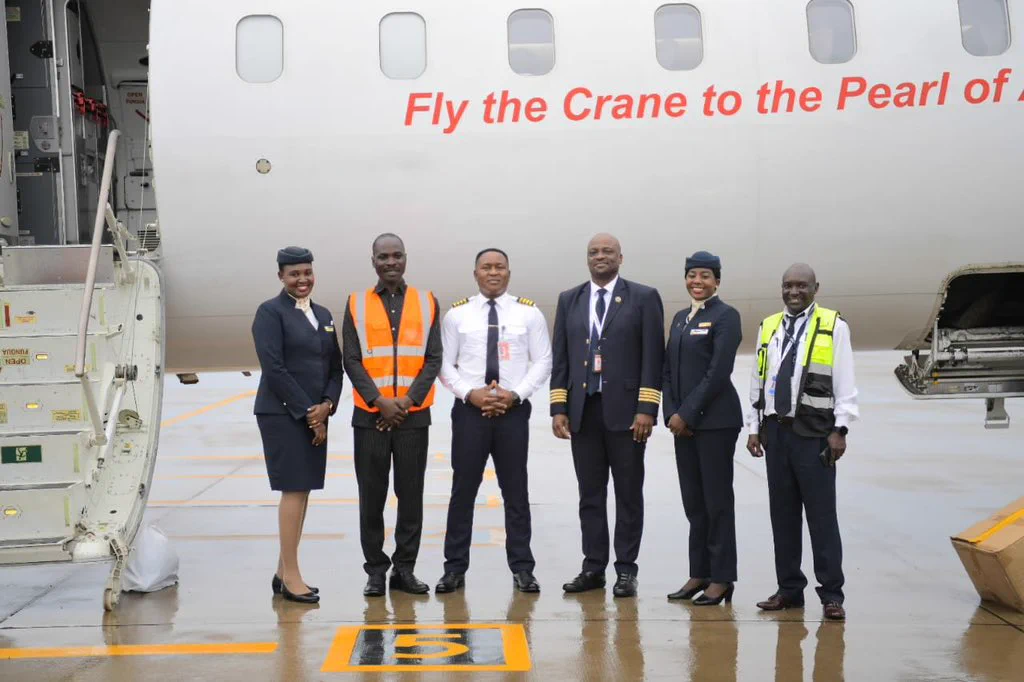
Hoima, Uganda — Kabalega International Airport has begun receiving passenger flights, marking an important step in Uganda’s efforts to connect the oil-producing region more directly with the rest of Uganda and the wider African economy.
The arrival of a Uganda Airlines Bombardier CRJ900 carrying CAF, FIFA and AFCON Local Organising Committee officials provides a particularly powerful symbol of what the airport is being positioned to support: energy, sport, tourism, trade and regional mobility converging around Hoima.
The development comes as Uganda prepares for two major milestones—its first oil production and the co-hosting of the 2027 Africa Cup of Nations (AFCON) with Kenya and Tanzania. AFCON 2027 is scheduled to begin on 19 June 2027, bringing one of Africa’s biggest sporting events to East Africa. Kabalega International Airport is being developed as a critical piece of the infrastructure supporting Hoima and the wider Bunyoro region.
Government has allocated Shs183.7 billion for the airport’s passenger terminal and related operationalisation, with the objective of opening the facility to commercial passenger traffic ahead of AFCON 2027. The airport is strategically located close to Hoima City Stadium, one of the venues being prepared for the continental tournament. Government has also been investing heavily in roads, accommodation and other infrastructure around Hoima and Masindi.
The convergence is significant.
- An airport brings people.
- A stadium brings audiences.
- Oil brings investment.
Tourism brings visitors and connectivity allows all four to interact.
For Africa, the development represents a broader question about how major infrastructure can transform regions beyond traditional capitals. Hoima is emerging as an important node in Uganda’s western economic landscape, while the airport has the potential to connect Bunyoro more efficiently with other African markets and international destinations.
Uganda’s oil sector is expected to create demand for aviation, logistics, accommodation, professional services, construction, food supply chains and other supporting industries. At the same time, AFCON 2027 will bring football teams, officials, media, supporters and commercial activity into the region. That creates an opportunity for sporting infrastructure to become economic infrastructure.
Uganda is now approximately nine months from the opening of AFCON 2027. The Local Organising Committee says the country is targeting completion of its three competition stadiums by the end of December 2026, while CAF continues to assess infrastructure and operational readiness.
Recent CAF engagements have also highlighted the importance of accommodation, visas and upcountry infrastructure, underscoring that hosting a continental tournament requires much more than stadiums. This is where Kabalega International Airport becomes strategically important. The question is no longer simply whether aircraft can land. The bigger question is what economic ecosystem will grow around every landing.
- Will local farmers supply hotels?
- Will young people find new skills and employment?
- Will tourism operators package Bunyoro for African and international visitors?
- Will local manufacturers and service providers enter the supply chains?
- Will the airport become a genuine commercial gateway rather than an event-driven facility?
Those are the questions that will determine the airport’s long-term legacy.
The arrival of passenger flights should therefore be viewed as the beginning of a longer journey. AFCON 2027 can provide the immediate catalyst. Oil can provide a major economic anchor. But the enduring objective should be to build a connected, productive and investment-ready Bunyoro whose infrastructure continues generating value long after the final whistle of the tournament.
Kabalega International Airport could ultimately become more than a transport facility. It could become a gateway through which Bunyoro connects its people, resources, businesses and opportunities to Uganda, East Africa and the wider African market and as the first passenger aircraft touches down, that future is no longer only being planned on paper—it is beginning to take flight.