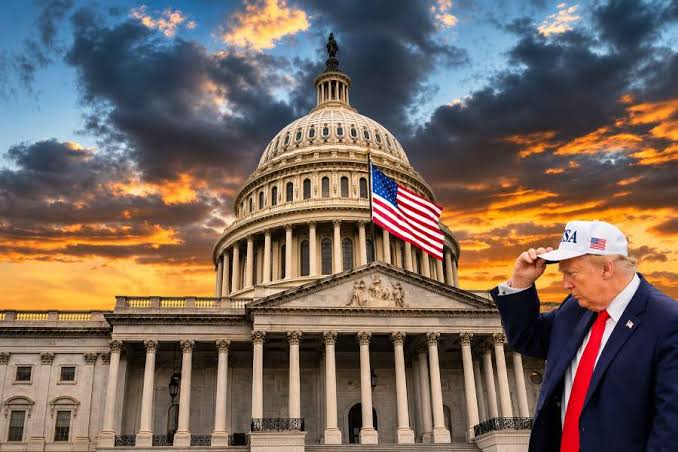
On 3 November 2026, American voters delivered a consequential verdict on President Donald Trump’s Republican administration, handing the Democratic Party control of both chambers of Congress. The result marks a return to divided government and creates a new political environment in which the White House must contend with an opposition-controlled legislature during the final two years of the presidential term.

The Associated Press called Democratic control of the Senate at 11:36 p.m. Eastern Time on election night, followed by the House at 1:24 a.m. on 4 November. As counting and projections continue to develop, the latest reported figures show Democrats leading with approximately 54 Senate seats, including independents who caucus with them, against 44 Republican seats. In the House, the Democratic tally has reached approximately 254 seats against 162 Republicans, with several races still awaiting final calls. The emerging Democratic advantage represents a substantial reversal of the Republican congressional position established in 2024. The significance is not simply that one party has gained seats. It is that voters have interrupted unified Republican control of Washington and given the opposition the institutional tools to challenge the administration’s domestic and international agenda.
Although foreign policy became an unusually prominent feature of this election, economic anxiety remained central to the voter verdict. Inflation, household purchasing power, healthcare affordability and the cost of living shaped the political atmosphere in which Americans cast their ballots.
CBS News exit-poll analysis reported that 89% of voters considered the cost of living a major or crucial factor in their decisions. Voters who described the economy negatively and those who said their financial circumstances had deteriorated over the previous two years leaned towards Democratic candidates. President Trump’s approval rating was reported at approximately 38% during the election period, reflecting the political pressure facing his administration. These figures point to an important electoral lesson: economic performance is not measured only through national growth indicators or financial-market performance. Voters judge governments through the cost of groceries, fuel, housing, healthcare and the security of household incomes.
The election therefore demonstrates how economic dissatisfaction can weaken a governing party even when it retains a substantial financial and organisational campaign infrastructure. The result is a warning to political administrations that electoral support cannot be sustained indefinitely through political messaging when everyday economic pressures remain unresolved.
The 2026 election also exposed the extraordinary concentration of financial resources in American politics. According to reporting based on Federal Election Commission filings, the 50 largest individual donors and donor groups contributed approximately US$2.77 billion during the election cycle.
Elon Musk emerged as the largest individual contributor, with approximately US$446 million directed mainly towards Republican-aligned political organisations. Elizabeth and Richard Uihlein contributed about US$150 million, while Jeff and Janine Yass contributed approximately US$110 million. Major Democratic-aligned contributors included George Soros and Michael Bloomberg.
Republican-leaning contributors accounted for approximately US$1.7 billion among the largest contributors tracked, compared with about US$832 million from Democratic-leaning donors. These figures should not be confused with total party campaign expenditure or the complete value of all political donations. Yet the electoral outcome offers a striking distinction between financial influence and political consent. Large donations can finance advertising, mobilisation, research and political organisation, but they cannot guarantee that voters will accept a candidate’s message or endorse an administration’s record. The 2026 result reinforces the principle that campaign capital may influence the political contest, but it cannot independently determine its conclusion.
One of the most significant features of this election was the role of the US military conflict with Iran. Traditionally, American midterm elections are dominated by domestic concerns. In 2026, however, an international conflict became closely connected to the daily economic experiences of American households.
The conflict, which began on 28 February 2026, contributed to pressure on energy markets and fuel prices. A Brown University Climate Solutions Lab tracker, using American Automobile Association fuel-price data, recorded an increase in average regular gasoline prices from approximately US$2.982 to US$4.069 per gallon, representing a rise of about 36.5% over the period it measured. The relationship between the conflict, global energy-market conditions and domestic fuel prices is complex. Nevertheless, the increase became a visible economic burden for households and a political vulnerability for the administration.
The International Institute for Strategic Studies reported that 55% of surveyed voters considered government corruption a crucial election issue, 49% identified the cost of living as crucial, and 34% identified the Iran conflict as crucial. The findings illustrate how domestic governance, economic performance and international security can converge in a single electoral contest. For Washington, the lesson is that foreign military decisions are not insulated from domestic accountability. Their consequences can travel through energy prices, inflation expectations, public confidence and ultimately the ballot box.
The incoming Democratic-controlled Congress will possess important constitutional powers, including legislative authority, control over congressional appropriations, committee oversight and the Senate’s role in confirming presidential appointments.
The administration will therefore face more difficult negotiations over federal spending, defence funding, foreign assistance and other major policy priorities. Congressional committees can hold hearings, request documents, issue subpoenas where authorised and scrutinise the conduct of government departments. However, it would be inaccurate to conclude that President Trump has lost 50% of his executive authority. The American constitutional system separates executive, legislative and judicial powers. The President remains head of the executive branch and retains significant authority over diplomacy, military command and the implementation of existing law. He also retains the power to veto legislation, although Congress can override a veto with the constitutionally required two-thirds majority in both chambers.
Impeachment is another possibility, but it should not be confused with automatic removal. The House can approve articles of impeachment by a simple majority. Conviction in the Senate requires the support of two-thirds of senators present. A Democratic majority of approximately 54 seats, therefore, does not by itself provide the votes necessary to remove the President. The more immediate consequence is likely to be sustained oversight, political confrontation and negotiations over legislation and funding.
The implications extend well beyond the United States. A Democratic-controlled Congress could intensify scrutiny of Washington’s policies towards Iran, Israel, Ukraine, China and its European allies. However, the extent of any change will depend on whether congressional pressure can translate into legislation, appropriations or bipartisan agreements.
For Europe, the election introduces another layer of uncertainty into transatlantic security and defence cooperation. European governments will be watching how Congress approaches Ukraine, NATO-related funding and the wider strategic relationship with Washington.
In the Middle East, congressional scrutiny of the Iran conflict and US military expenditure could increase pressure for clearer objectives, stronger oversight and a more sustainable diplomatic strategy. Yet the President retains considerable operational and diplomatic authority, meaning that a change in congressional control does not automatically produce a change in American foreign policy.
For Africa, the consequences may be felt through development assistance, trade, investment, security cooperation and diplomatic engagement. Congressional committees can influence funding for the State Department, foreign assistance programmes and international development institutions. Changes in budget priorities or political oversight may therefore affect the pace and predictability of some US-Africa programmes.
African governments should avoid assuming that a Democratic majority automatically means a new American approach to the continent. US policy towards Africa has historically involved both bipartisan interests and differences over implementation. Strategic competition, critical minerals, energy security, infrastructure, trade access, counterterrorism and democratic governance are likely to remain relevant regardless of which party controls Congress.
For Uganda and the wider East African region, the important consideration is how to maintain constructive engagement with Washington while strengthening economic partnerships, regional integration and diversified international cooperation. A more contested US political environment makes consistent diplomatic engagement and a clear articulation of national interests even more important.
The first and most likely scenario is legislative confrontation accompanied by selective cooperation. Democrats are expected to prioritise oversight, affordability and scrutiny of the administration, while Republicans and the White House defend presidential policy priorities. Nevertheless, areas such as national security, infrastructure and certain economic measures may still provide opportunities for bipartisan agreements.
The second scenario is greater reliance on executive action. Where legislative agreement proves difficult, the administration may increasingly depend on executive orders, existing statutory powers and agency-level decisions to pursue its priorities. This could deepen policy uncertainty for businesses, investors and international partners, particularly in areas such as tariffs, immigration and regulation.
The third scenario is an early contest over the political future beyond Trump. With the 2028 presidential election approaching, the midterm outcome is likely to influence party leadership, candidate positioning and the political narratives of both parties. Democrats will be under pressure to demonstrate that electoral victory can produce tangible policy improvements, while Republicans will need to rebuild their appeal among voters concerned about economic conditions and the administration’s direction. These are projections rather than certainties. Their development will depend on the final congressional composition, the administration’s response, economic conditions and international events.
The 2026 US midterms demonstrate that political power in a major global power is never permanently secured by electoral victory, financial resources or control of the executive branch. It must be continually sustained through public confidence, institutional accountability and the capacity to respond to changing national and international realities.
For President Trump, the results create a more difficult governing environment, but not the end of presidential authority. For Democrats, control of Congress offers an opportunity to scrutinise the administration and present an alternative governing agenda, but also places responsibility on them to convert electoral gains into credible policy outcomes.
For the international community, the central question is whether Washington’s new political balance will produce greater institutional restraint, sharper domestic confrontation or a recalibration of American global engagement.
The ballot boxes have changed the balance of power in Washington. The next test will be whether America’s political institutions can turn that change into effective governance—and whether the world’s most influential democracy can manage its domestic divisions without deepening uncertainty across an already unsettled international system.