The United Arab Emirates’ decision to lift the suspension on issuing new visas to Ugandan nationals marks an important development in Uganda’s diplomatic engagement with the Gulf region, restoring a significant channel for travel, education, business and people-to-people relations after months of Ebola-related precautionary restrictions.
Announced on Wednesday, 11 November 2026, by the UAE’s National Emergency Crisis and Disaster Management Authority (NCEMA), in coordination with the Ministry of Health and Prevention and the Federal Authority for Identity, Citizenship, Customs and Port Security, the revised measures allow Ugandans to apply for new visas and enter the UAE, provided at least 21 days have elapsed since their departure from Uganda. The decision follows the restrictions introduced in June 2026 in response to the Bundibugyo Ebola virus outbreak.
The revised framework also provides for the entry of Ugandan students who were enrolled in UAE educational institutions before June 2026, together with their family members, subject to approved health procedures. Administrative staff of Uganda’s Embassy in the UAE holding ordinary passports and their families are also covered. Holders of Ugandan diplomatic and special passports may enter under the applicable exemption procedures. Humanitarian and medical cases will continue to be assessed individually, with medical travellers required to provide approved reports identifying their diagnosis, receiving healthcare facility and scheduled treatment date.
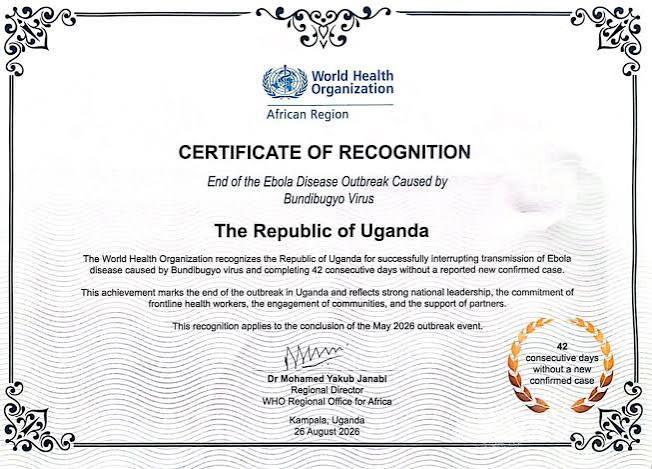
The decision is particularly significant when viewed against Uganda’s public-health response. The outbreak, declared on 15 May 2026, resulted in 20 confirmed cases and two deaths in Uganda. The World Health Organization and Africa Centres for Disease Control and Prevention subsequently announced its end on 27 August 2026, following 42 consecutive days without a new confirmed case after the last patient was discharged from care on 16 July. This internationally recognised monitoring period provided an important basis for reassessing the country’s epidemiological situation.
The UAE’s decision therefore reflects the relationship between public-health diplomacy and international mobility: travel restrictions may be necessary during an outbreak, but their continuation must remain responsive to changing scientific evidence and risk assessments. The retention of the 21-day condition demonstrates that the restoration of travel access is accompanied by continued precaution rather than an assumption that health risks have disappeared across the region.
For Uganda, the implications extend well beyond individual travel. The UAE is an important commercial and investment partner. In October 2025, Uganda’s Ministry of Foreign Affairs reported bilateral trade of approximately US$2.85 billion, while UAE investment in Uganda was estimated at US$3.5 billion across sectors including energy, infrastructure, agribusiness, oil and gas, manufacturing, real estate and tourism. The two countries also brought together more than 300 delegates at the Fourth Uganda–UAE Business Forum in Kampala, demonstrating the scale of their commercial engagement.
Restoring access to new visas can help sustain this relationship by facilitating business travel, investor engagement, educational mobility, official exchanges and family connections. It also supports Uganda’s broader Economic and Commercial Diplomacy agenda, which seeks to convert diplomatic relationships into trade, investment, tourism and employment opportunities.
The decision also places renewed importance on the work of Uganda’s diplomatic mission in the UAE. Consular communication, assistance to Ugandan nationals, engagement with UAE authorities and timely dissemination of updated travel requirements will be essential to ensuring that citizens understand the revised conditions and comply with the applicable procedures.
Nevertheless, the relaxation does not extend to every country affected by the regional outbreak. The UAE confirmed that precautionary measures for nationals of the Democratic Republic of the Congo and South Sudan would remain in force, subject to continued epidemiological monitoring. This distinction underlines the country-specific nature of the UAE’s risk assessment.
For Uganda, the development offers a practical lesson in the value of health preparedness as an instrument of foreign policy. Effective outbreak management does not only protect lives; it also helps preserve international confidence, mobility and economic relationships. The restoration of visa access is consequently more than an administrative adjustment. It is an opportunity to consolidate bilateral cooperation and demonstrate how public-health credibility can support diplomatic and economic engagement.
As Uganda and the UAE continue to deepen their partnership, the next priority should be to translate restored mobility into stronger commercial exchanges, investment partnerships, educational opportunities and sustained people-to-people cooperation.