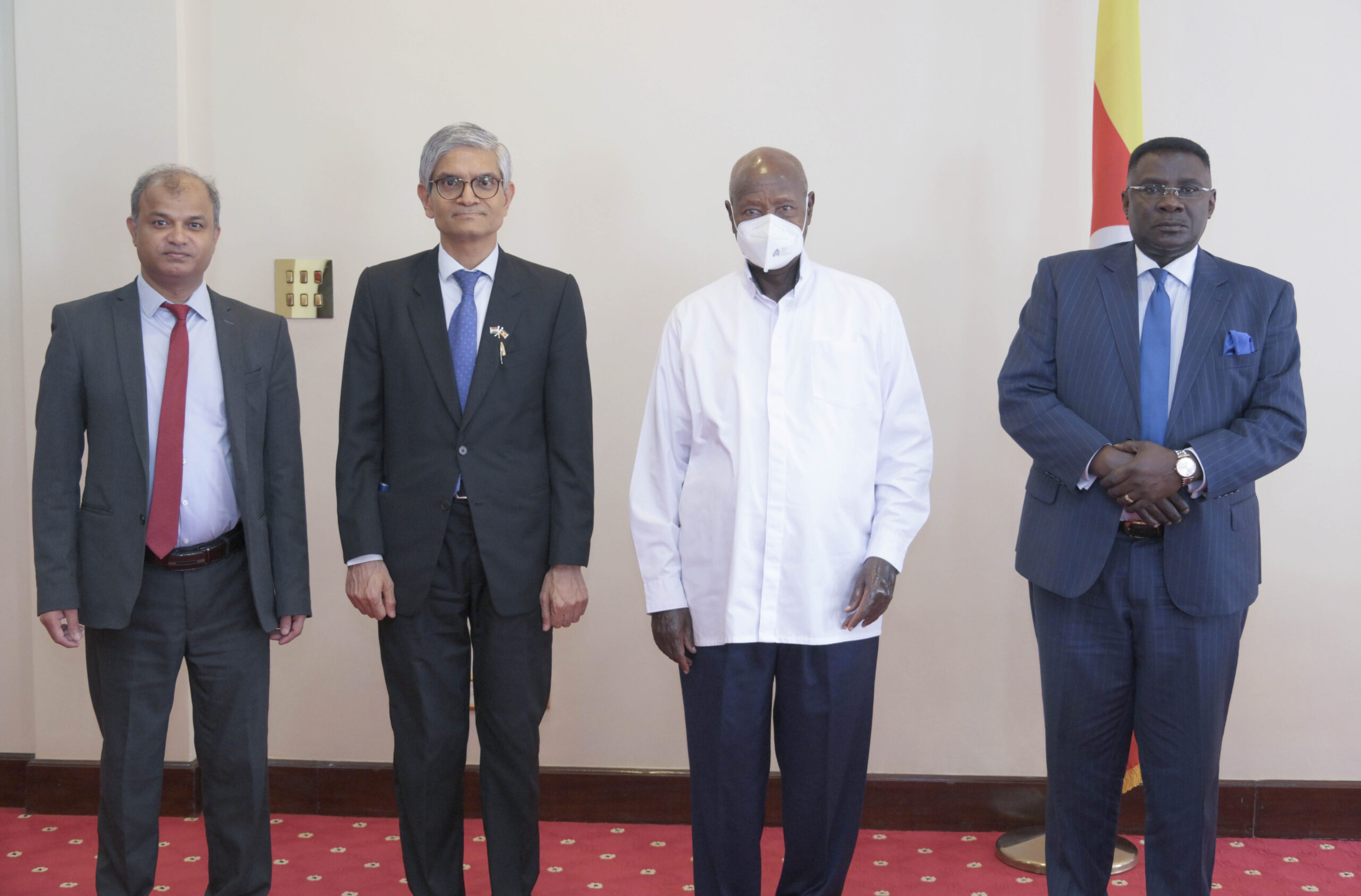
Entebbe— President Yoweri Kaguta Museveni has bid farewell to India’s outgoing High Commissioner to Uganda, H.E. Upender Singh Rawat, commending him for his contribution to the longstanding relations between Uganda and India.
President Museveni received H.E. Rawat during a farewell call at State House, Entebbe, where he thanked the outgoing envoy for his service to Uganda and wished him success in his next tour of duty. “Thank you for your service in Uganda, and I wish you good luck in your next tour of duty,” President Museveni told the outgoing High Commissioner.
Before meeting the President, H.E. Rawat held a farewell meeting with the Minister of State for Foreign Affairs (Regional Cooperation), Hon. Haruna Kasolo Kyeyune, at the Ministry of Foreign Affairs. The meeting provided an opportunity to reflect on the progress of Uganda–India relations and the continued importance of strengthening cooperation in trade, investment, education, health, technology and other areas of mutual interest.
H.E. Rawat served in Uganda for three years and three months, during which bilateral engagement continued across political, economic, technical and people-to-people spheres. His tenure also coincided with renewed efforts to expand economic diplomacy and identify opportunities for greater Ugandan participation in the Indian market.
Trade remained one of the most important dimensions of the Uganda–India relationship. According to an Economic Policy Research Centre (EPRC) study based on ITC Trade Map data, Uganda’s exports to India stood at approximately US$459 million in 2024, while imports from India were about US$1.3 billion. This placed total recorded merchandise trade at roughly US$1.76 billion, with Uganda recording a merchandise trade deficit of approximately US$841 million.
Uganda’s exports to India were heavily concentrated in commodities, particularly gold and coffee. Gold and other precious metals accounted for approximately US$353 million of exports in 2024, while coffee contributed about US$78.5 million. On the other side of the trading relationship, India supplied Uganda with a range of manufactured and value-added products, including pharmaceuticals, machinery, vehicles and other industrial goods.
The figures illustrate both the depth of commercial relations and the scope for further diversification. EPRC has identified agricultural products, coffee, gold and emerging commodities such as cashew among areas where Uganda has export potential, while pharmaceuticals, motorcycles and agro-industrial inputs remain among India’s areas of export strength to Uganda.
The two countries took steps to strengthen the institutional framework for addressing these opportunities. On 25–26 March 2025, Uganda and India convened the Third Meeting of the India–Uganda Joint Trade Committee in New Delhi, where the two sides discussed bilateral trade and investment and explored measures to enhance economic cooperation. The meeting was significant in reactivating a key bilateral mechanism after a long interval; it was the first JTC meeting since the earlier sessions held decades previously.
The engagement was followed by additional business and investment activities. In March 2025, the Indian High Commission organised an India Trade Show and Exhibition in Kampala involving Indian companies and Ugandan business institutions. Later that year, a policy dialogue on bilateral relations, trade, investment and collaboration was organised with EPRC and IBF Uganda, alongside business-to-business engagements involving Indian companies.
Beyond commerce, the relationship has increasingly included practical cooperation in education, science and security. A notable milestone was the establishment of the National Forensic Sciences University (NFSU) Uganda Campus in Jinja, inaugurated on 12 April 2023 by India’s External Affairs Minister, Dr. S. Jaishankar. It became NFSU’s first overseas campus and India’s first overseas campus for a public academic institution. The campus offers programmes and training in areas including forensic science, cyber security, digital forensics and police and security studies. The campus therefore represents a shift in bilateral cooperation from conventional diplomatic and commercial engagement towards specialised knowledge transfer and institutional capacity building.
India’s development partnership with Uganda has also included concessional financing and technical cooperation. During Prime Minister Narendra Modi’s 2018 visit to Uganda, India announced a US$141 million line of credit for electricity transmission and substations and a further US$64 million line of credit for agriculture and dairy production, alongside other development and capacity-building initiatives.
The institutional foundations of Uganda–India relations date back decades. The two countries signed an Agreement on Friendship and Technical, Economic and Scientific Cooperation in 1965, establishing a framework for technical exchange and cooperation in economic and scientific fields. More than six decades later, the relationship encompasses political consultations, trade and investment, development cooperation, education, health, pharmaceuticals, agriculture, technology, security and cultural and people-to-people exchanges.
As H.E. Rawat concluded his three-year-and-three-month tour in Uganda, his departure marked the end of one diplomatic assignment within a broader relationship that continues to evolve. The task ahead for both countries remains to translate the depth of their political and historical ties into increasingly diversified trade, investment, technology transfer, skills development and mutually beneficial economic partnerships.