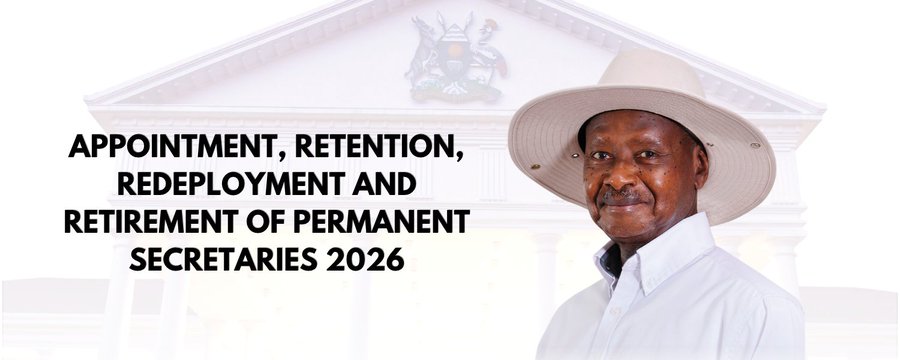
Uganda’s public service leadership is entering a new phase following President Yoweri Kaguta Museveni’s designation of 12 Permanent Secretary Nominees and a new Clerk to Parliament, in changes affecting 13 government offices. Announced on 8 November 2026 under Article 174(2) of the 1995 Constitution, the changes reach beyond administrative reshuffling. They touch institutions responsible for diplomacy, regional integration, agriculture, infrastructure, national security, science and technology, public accountability and parliamentary administration.

However, an important constitutional distinction must be made: these are designated officers whose suitability has been referred to the Public Service Commission for assessment and advice. The process must be completed before the Permanent Secretary appointments are finalised. The Constitution places the appointment of Permanent Secretaries in the hands of the President acting in accordance with the Commission’s advice.
The designated officers are Emmanuel Freddie Mugunga for the Office of the Prime Minister; Maureen Kasande for the Inspectorate of Government; Sheeba Kyobutungi Rujoki for the Office of the President’s Science, Technology and Innovation function; Kenneth Akiri for Water and Environment; Barbara Namugambe for Agriculture, Animal Industry and Fisheries; Charles Ssentongo for Foreign Affairs; Prof. Stephen Akandwanaho for ICT and National Guidance; Mark Sseremba for Public Service; Eng. Flavia Guto Bwire for Works and Transport; Edith Butuuro for Defence and Veteran Affairs; Aggrey Wunyi for East African Community Affairs; Betty Mutesa Cwinya-ai for the Public Service Commission; and Edward Sengonzi Damulira for Clerk to Parliament.
The significance lies in the responsibilities attached to these institutions. Agriculture, transport, water, technology and energy-related infrastructure are important to Uganda’s production capacity and regional competitiveness. Foreign Affairs and East African Community Affairs are central to international partnerships, market access and regional cooperation. The Office of the Prime Minister coordinates government programmes, while the Inspectorate of Government and Parliament have important accountability and oversight responsibilities. In practical terms, the effectiveness of these institutions will depend not only on who occupies the offices but also on how policies are translated into measurable public outcomes.
Among the changes, the designation of Amb. Charles Ssentongo for Permanent Secretary at the Ministry of Foreign Affairs deserves particular attention. Before this development, Ssentongo served as the Ministry’s Chief of Protocol, a position that placed him within the operational environment of Uganda’s diplomatic engagements and official relations with foreign missions.
His proposed transition from protocol leadership to Permanent Secretary is significant because the latter office carries a much wider administrative mandate. Under Article 174(3), a Permanent Secretary is responsible for organising and managing the Ministry, advising the responsible Minister, implementing government policy and ensuring proper expenditure of public funds.
This means the responsibility extends beyond managing diplomatic ceremonies and official engagements. It involves coordinating the administrative machinery that supports Uganda’s foreign policy, missions abroad, consular services, diplomatic relations and international cooperation.
The transition also comes as Uganda places increasing emphasis on economic and commercial diplomacy, public diplomacy, regional integration and international partnerships. The Ministry’s stated functions include promoting Uganda’s commercial interests abroad, advancing regional and continental integration, supporting international peace and security, and strengthening the country’s image through public diplomacy.
For Africa, these priorities matter. Uganda’s diplomatic engagement is not confined to bilateral relations; it contributes to wider conversations on African markets, infrastructure connectivity, peace and security, and the implementation of continental development frameworks. The new administrative leadership will therefore operate in a context where diplomacy must increasingly connect political relationships with trade, investment, technology, education and development cooperation.
Ssentongo’s experience in protocol offers institutional familiarity with diplomatic engagement. The next phase, if his appointment is confirmed, will require that experience to be complemented by the broader responsibilities of public administration, financial stewardship and policy implementation.
The designation of Aggrey Wunyi for the Ministry of East African Community Affairs is equally relevant to the regional integration agenda. The EAC’s ambitions require more than political commitments: they depend on effective coordination, implementation of agreed protocols, removal of non-tariff barriers and improved movement of goods, services, capital and people. Similarly, the proposed leadership changes in Agriculture, Works and Transport, Water and Environment, and ICT have implications for Uganda’s participation in regional value chains. Agricultural production requires reliable transport and markets; digital infrastructure supports cross-border commerce; and water and environmental management increasingly demand cooperation beyond national boundaries.
The scale of the administrative task should not be underestimated. The changes involve 12 Permanent Secretary Positions and the parliamentary Clerk’s office, with the Public Service Commission playing a constitutionally prescribed advisory role. The number is significant, but the real measure will be whether institutional transitions preserve continuity while improving implementation.
For Uganda and its African partners, the central question is what follows the announcement. Will the institutions improve programme coordination, budget execution, public accountability and service delivery? Will economic diplomacy generate stronger commercial connections? Will regional integration commitments translate into practical opportunities for businesses and citizens?These are the outcomes against which public administration should ultimately be assessed.
Uganda’s development ambitions require institutions capable of turning national priorities into results. As the Public Service Commission undertakes its assessment, attention will naturally turn to continuity, accountability and the capacity of the incoming leadership to support the country’s national and continental engagements. Leadership changes create an administrative transition. Their lasting significance, however, will be determined by what citizens, businesses and regional partners experience after the transition.