USA– For nearly a century, the FIFA World Cup final has been defined by football alone. The focus has traditionally remained on the 22 players chasing history over 90 minutes and sometimes beyond. But the 2026 FIFA World Cup introduced a new chapter in the tournament’s evolution, staging the first-ever halftime show in a World Cup final, transforming the interval into a global celebration of culture, creativity, and international unity. The first-ever FIFA World Cup final halftime show showcased global stars, orchestras, and cultural icons, with Uganda’s Ghetto Kids joining Shakira and Burna Boy in a landmark moment for African cultural diplomacy.
Far from being merely an entertainment spectacle, the halftime performance illustrated how sport has become one of the world’s most influential platforms for public and cultural diplomacy. It demonstrated that football is no longer just about competition; it is increasingly about storytelling, identity, and the projection of soft power.
The production brought together an extraordinary mix of global talent. Colombian superstar Shakira delivered one of the headline performances, joined by Canadian singer Justin Bieber, who appeared with an acoustic guitar. South Korean music phenomenon BTS energized audiences with their global hit Dynamite, while music icon Madonna added another layer of international appeal.
The show also crossed artistic boundaries, featuring Chris Martin, actors Jason Sudeikis and Brendan Hunt of Ted Lasso, the beloved Muppets, conductor Gustavo Dudamel, the New York Philharmonic, Venezuela’s Simón Bolívar Symphony Orchestra, and a moving performance by a choir of children, symbolizing hope, diversity, and the next generation. The result was a carefully curated production that celebrated music, sport, storytelling, and multiculturalism before a global television audience of billions.
The halftime show demonstrated the growing importance of cultural diplomacy in international sporting events. Traditionally associated with diplomacy through embassies, cultural exchanges, and artistic collaborations, cultural diplomacy now increasingly unfolds on sporting stages where audiences transcend borders, languages, and political differences.
The World Cup has long served as one of humanity’s few truly global gatherings. Introducing a halftime show reflects FIFA’s recognition that sport and culture are complementary instruments capable of fostering mutual understanding and strengthening international connections. Music, dance, theatre, and visual storytelling possess a unique ability to communicate shared human experiences, often where politics cannot.
Among the most meaningful moments for African audiences was the inclusion of Uganda’s internationally acclaimed Ghetto Kids, who joined Shakira and Nigerian Grammy Award-winning artist Burna Boy during the performance. Their appearance represented more than choreography, it symbolized the increasing visibility of African creative industries on the world’s biggest stages.
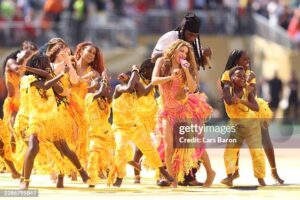
From humble beginnings in Kampala, the Ghetto Kids have become global ambassadors of resilience, talent, and youthful creativity. Their journey reflects the transformative power of arts and culture to transcend socioeconomic barriers while projecting positive narratives about Africa. Their participation also highlighted Uganda’s growing contribution to the global creative economy, reinforcing the country’s reputation as a source of artistic excellence capable of inspiring audiences far beyond its borders. For many young Africans, seeing performers from the continent share the stage with internationally celebrated artists served as a powerful reminder that global platforms are becoming increasingly inclusive.
The halftime spectacle illustrated how nations increasingly exercise influence through soft power rather than political or economic strength alone. Artists, athletes, filmmakers, musicians, and cultural ambassadors have become central to shaping how countries are perceived internationally. When audiences witness African performers captivating billions alongside some of the world’s biggest entertainers, perceptions shift. The narrative moves beyond stereotypes toward one centred on creativity, innovation, and cultural confidence. This is precisely where sport and diplomacy intersect, Major international tournaments increasingly function as platforms for nation branding, tourism promotion, cultural exchange, and international cooperation.
The introduction of a halftime show inevitably invites comparisons with the Super Bowl, whose entertainment segment has become a cultural institution in its own right. Yet the FIFA World Cup carries a different responsibility, unlike domestic sporting events, the World Cup belongs to every continent, every culture, and every footballing tradition. Its entertainment therefore must reflect global diversity rather than a single cultural perspective. The inaugural halftime show sought to achieve exactly that by blending Latin American rhythms, African artistry, Asian pop culture, classical orchestras, children’s voices, television icons, and popular entertainment into a single shared experience.
Whether this format becomes a permanent feature of future World Cup finals will depend on FIFA and its stakeholders. However, the debut demonstrated that carefully designed cultural programming can complement rather than overshadow the football itself. For African countries, the event offers an important lesson, Investment in sport should not end with stadiums and elite athletes. The creative economy including music, dance, film, fashion, and digital storytelling is becoming an equally important component of international influence.
Countries that strategically integrate sport with culture, tourism, education, and diplomacy are increasingly positioned to amplify their global visibility. Uganda’s representation through the Ghetto Kids serves as a reminder that cultural excellence can become one of a nation’s most valuable diplomatic assets.
Spain may have lifted the FIFA World Cup trophy, but the first-ever halftime show ensured that another victory was celebrated one belonging to culture itself. For a brief moment, the world’s biggest sporting stage became a meeting point of continents, traditions, languages, and generations. It was a reminder that while football crowns champions, culture builds bridges and in an increasingly interconnected world, those bridges may prove just as significant as the trophies themselves.