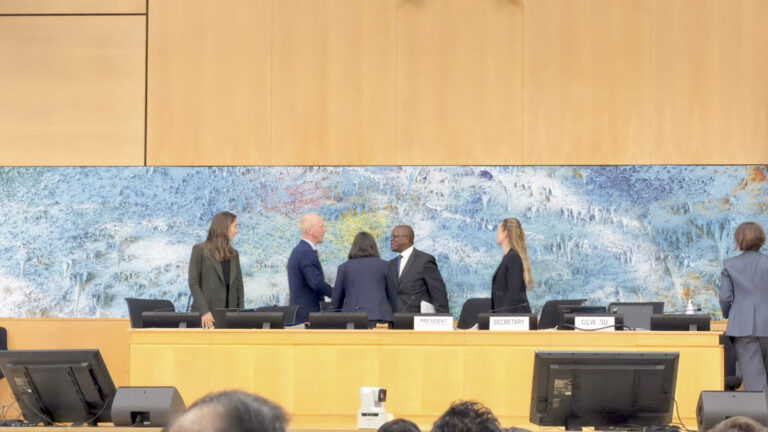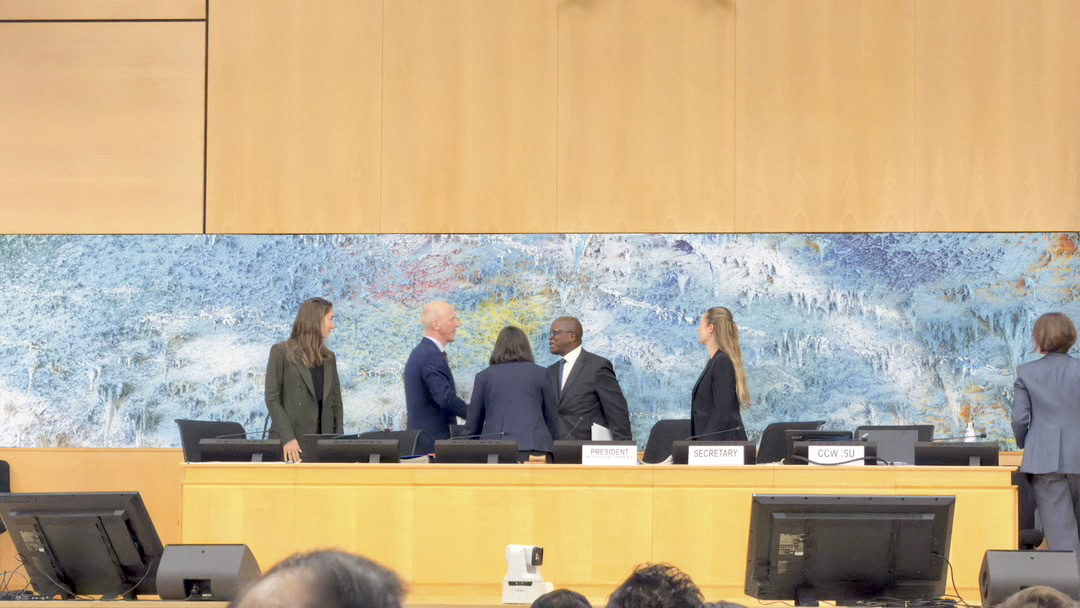
GENEVA— Uganda has concluded its chairmanship of the Convention on Certain Conventional Weapons (CCW), handing over responsibility to Switzerland at a critical moment in international efforts to strengthen the rules governing weapons used in armed conflict. The transition, marked by the opening of the Convention’s Seventh Review Conference at the Palais des Nations in Geneva, reflects Uganda’s contribution to multilateral diplomacy and the continuing importance of international humanitarian law in an era of rapidly changing military technology.

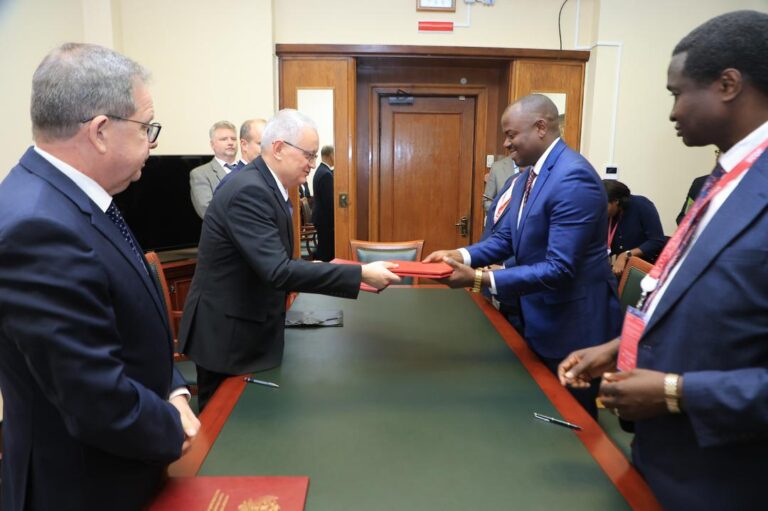
Ambassador Arthur Sewankambo Kafeero, Deputy Permanent Representative of Uganda to the United Nations Office and other international organisations in Geneva, formally handed over the chairmanship to Ambassador Julien Thöni, Permanent Representative of Switzerland to the Conference on Disarmament, who assumes the presidency of the Seventh Review Conference. The five-day conference runs from 16 to 20 November 2026.
Uganda’s role in the 2025–2026 cycle is significant against the wider history of the Convention. Adopted in Geneva on 10 October 1980 and entering into force on 2 December 1983, the CCW was established to prohibit or restrict conventional weapons considered excessively injurious or capable of producing indiscriminate effects. From its original 50 signatories, the Convention has grown to 128 High Contracting Parties, demonstrating the expanding international recognition of the need to regulate the humanitarian consequences of conventional warfare.
The Convention operates through five Protocols addressing specific categories of weapons: non-detectable fragments; mines, booby-traps and other devices; incendiary weapons; blinding laser weapons; and explosive remnants of war. Together, these instruments provide a framework for addressing weapons-related risks to civilians and combatants, while allowing States to respond to emerging developments in military technology.
Its evolution also illustrates how international humanitarian law adapts to changing patterns of conflict. The first Review Conference, held in 1995–1996, resulted in the adoption of Protocol IV on blinding laser weapons and amendments to Protocol II. Subsequent review conferences in 2001, 2006, 2011, 2016 and 2021 continued the process of examining the Convention’s implementation and responding to emerging humanitarian concerns. The current gathering is therefore the seventh major review conference in this institutional process.
Ambassador Kafeero chaired the 2025 Meeting of the High Contracting Parties, held in Geneva on 12 November 2025. The meeting addressed the Convention’s institutional continuity, reviewed developments under its framework and established arrangements for the 2026 programme, including the Preparatory Committee and Seventh Review Conference.
The official report of the 2025 meeting records Uganda’s nomination through the Non-Aligned Movement (NAM), followed by endorsement by the High Contracting Parties through a written silence procedure. The meeting brought together more than 80 participating High Contracting Parties, alongside observer States, international organisations and civil society representatives. Uganda’s chairmanship therefore placed the country in a position to facilitate dialogue among a broad range of States on issues central to humanitarian protection and arms regulation.
In his capacity as Chair of the 2025 meeting, Ambassador Kafeero also opened the Preparatory Committee on 7 September 2026. Ambassador Thöni was subsequently elected to guide preparations for the Seventh Review Conference, culminating in the formal transfer of leadership as the conference commenced.
This transition demonstrates an important feature of multilateral diplomacy: institutional leadership is not simply about presiding over meetings, but also about maintaining continuity, facilitating consensus and ensuring that negotiations remain anchored in agreed international commitments.
One of the most consequential issues before the Seventh Review Conference is the future of international work on lethal autonomous weapons systems (LAWS). These are weapon systems that can select and engage targets with varying degrees of autonomy, raising complex legal, ethical, military and technological questions.
The Group of Governmental Experts on emerging technologies in the area of LAWS was established under the CCW in 2016. A decade later, States are confronted with the task of determining how existing international humanitarian law should be applied to increasingly sophisticated military systems, and whether additional rules or measures are necessary.
The challenge is particularly important because the principles of distinction, proportionality and precautions in attack remain central to the conduct of hostilities. Technological advancement does not remove States’ obligations under international humanitarian law. Rather, it intensifies the need for clarity on human responsibility, accountability and meaningful human control over decisions involving the use of force.
The Review Conference will also consider the universalisation of the Convention, implementation of its five Protocols, the functioning of its compliance mechanism and the financial sustainability of its institutional work. With 128 High Contracting Parties, the Convention has achieved substantial international participation, but universal adherence and consistent implementation remain important objectives.
Uganda’s participation in the CCW process reflects its engagement in multilateral efforts to strengthen international peace, security and humanitarian protection. Through its Geneva Mission, Uganda has contributed to a process that requires negotiation across different geopolitical positions, legal traditions and national security interests.
The Permanent Mission of Uganda congratulated Ambassador Thöni on assuming the presidency and reaffirmed its readiness to cooperate with Switzerland and all High Contracting Parties throughout the conference. Uganda also reiterated its commitment to the object and purpose of the Convention and to practical, consensus-based outcomes that protect civilians and combatants from weapons that cause unnecessary suffering or have indiscriminate effects. The Mission further acknowledged the cooperation of the High Contracting Parties and the Convention’s Implementation Support Unit during the 2025 cycle.
As the Seventh Review Conference proceeds, Uganda’s handover should be understood not merely as the conclusion of a diplomatic assignment, but as part of the wider continuity of multilateral engagement. The measure of the process will ultimately lie in whether States can translate diplomatic consensus into stronger implementation, clearer safeguards and more effective protection for people affected by armed conflict.
For Uganda, the chairmanship offers an important contribution to the country’s profile in multilateral diplomacy. For the international community, the Geneva deliberations present another opportunity to ensure that the development and use of conventional weapons remain subject to humanitarian principles, legal responsibility and the shared obligation to preserve humanity during war.