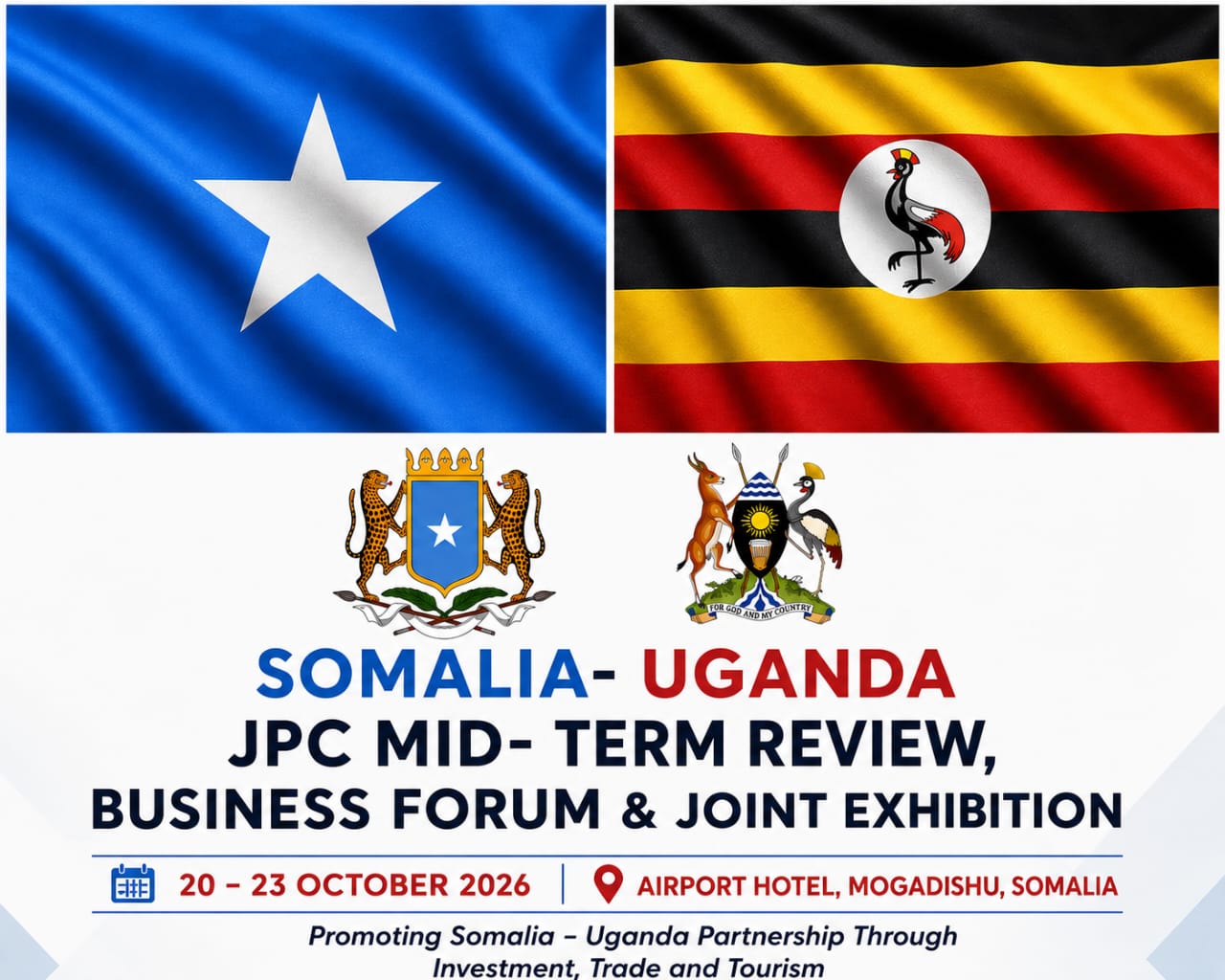
MOGADISHU, SOMALIA / KAMPALA, UGANDA | Uganda and Somalia are set to deepen economic cooperation through the Somalia–Uganda Business Forum and Joint Exhibition and the Joint Permanent Commission (JPC) Mid-Term Review, scheduled for 20–23 October 2026 in Mogadishu, subject to the confirmed official programme.

Held under the theme “Harnessing Trade, Tourism and Investment Opportunities between Both Countries and Beyond,” the engagements are intended to strengthen commercial links between government institutions, exporters, manufacturers, investors, tourism operators, educational institutions and other private-sector stakeholders. The agenda reflects a broader economic diplomacy objective: translating established diplomatic relations into market opportunities, investment partnerships, stronger business networks and practical cooperation that delivers measurable economic benefits.
Uganda’s national economic performance provides useful context for the discussions. Uganda recorded approximately US$3.30 billion in foreign direct investment inflows in 2024, compared with US$2.99 billion in 2023, according to figures cited in the event’s media working document.
The country also received 1,642,215 international visitors in 2025, generating approximately US$1.62 billion in tourism receipts, according to national tourism performance figures. These indicators demonstrate the scale of Uganda’s wider investment and tourism economy. They are national figures, however, and should not be interpreted as evidence of investment originating from Somalia or tourism receipts attributable to Somali visitors.
For businesses participating in the Mogadishu engagements, the opportunity lies in identifying areas where the two economies can complement one another through reliable supply chains, market access, investment and service-sector partnerships. Priority sectors include agriculture and agro-processing, coffee and tea, tourism and hospitality, healthcare supplies, manufacturing, industrial products, education and skills development, aviation and logistics.
The commercial value of these opportunities will depend on verified demand, competitive pricing, supplier capacity, applicable standards and the practical conditions governing cross-border transactions.
Diplomatic engagement can help businesses identify partners, understand market requirements and navigate institutional barriers that might otherwise discourage cross-border trade. For Uganda and Somalia, discussions on agricultural products, processed foods, medical supplies, tourism services, industrial goods and education could help identify potential areas for cooperation. Realising these opportunities will require more than expressions of interest. Businesses need dependable information on buyers and suppliers, product specifications, certification, customs requirements, transport arrangements, payment terms and distribution networks.
The forum provides an opportunity to identify these constraints and explore practical responses through relevant government agencies, business associations and private-sector participants. Investment discussions will similarly need to progress towards identifiable projects, transparent commercial terms, appropriate due diligence and clear implementation arrangements. The objective is to create conditions in which businesses can assess opportunities confidently and convert suitable engagements into sustainable commercial relationships.
Somalia’s membership of the East African Community adds a regional dimension to the bilateral engagement. Somalia became the EAC’s eighth Partner State on 4 March 2024, following the deposit of its instrument of ratification of the Treaty of Accession.
The development provides a framework for expanding regional cooperation, although the practical benefits for individual traders depend on the applicable treaty provisions, implementation arrangements, customs procedures, product standards and rules governing preferential market access. For Ugandan and Somali businesses, the priority is to understand which regional trade arrangements apply to their products and transactions, and what documentation and compliance requirements must be met.
The African Continental Free Trade Area also offers a broader framework for African economic integration. Its practical value depends on the implementation of relevant commitments and the ability of enterprises to navigate trade procedures and reach customers competitively. Effective regional integration is ultimately measured not only by membership in institutions, but also by whether businesses can access markets, move goods predictably and compete under clear and transparent rules.
The JPC Mid-Term Review provides a mechanism for the two governments to assess progress in bilateral cooperation, identify outstanding commitments and establish priorities for further engagement. Its economic significance lies in the potential to connect commercial opportunities with the institutions responsible for trade, investment, tourism, transport, education and other areas of cooperation. Where the review identifies policy or administrative barriers, follow-up arrangements can help clarify institutional responsibilities, establish implementation timelines and strengthen coordination between the relevant authorities.
The impact of the review will therefore depend on the clarity of any agreed actions and the consistency with which they are implemented. Any new agreements, decisions or commitments arising from the engagements should be reported once confirmed by the respective authorities.
Trade and investment are not the only areas in which Uganda and Somalia can explore cooperation. Tourism and hospitality offer opportunities for collaboration in destination promotion, travel services and business-to-business engagement. Education and skills development could support professional exchanges, institutional partnerships and training aligned with labour-market needs.
Healthcare supplies, aviation, logistics and other services may also provide opportunities where demand, regulation and commercial conditions support viable partnerships. Such cooperation requires careful assessment of market needs and the operating environment. Businesses must evaluate the relevant risks, costs and regulatory obligations before committing resources. For policymakers, the task is to facilitate lawful commercial engagement, provide reliable information and strengthen the institutional channels through which legitimate business concerns can be addressed.
The Somalia–Uganda Business Forum and Joint Exhibition and the JPC Mid-Term Review offer an opportunity to connect diplomatic engagement with practical economic outcomes. Progress should be assessed through tangible indicators, including business-to-business meetings held, qualified commercial leads generated, investment projects advanced, export orders secured, market-access barriers addressed and agreed government actions implemented. These indicators would provide a more meaningful assessment of impact than attendance figures or media visibility alone.
Uganda and Somalia have an opportunity to strengthen their economic relationship through structured engagement between their public institutions and private sectors. Sustained progress will depend on converting identified opportunities into commercially viable transactions and ensuring that policy commitments translate into practical improvements for businesses. As the engagements proceed in Mogadishu, the central task is to build stronger commercial connections, improve the conditions for lawful cross-border trade and identify partnerships capable of contributing to sustainable economic development in both countries.