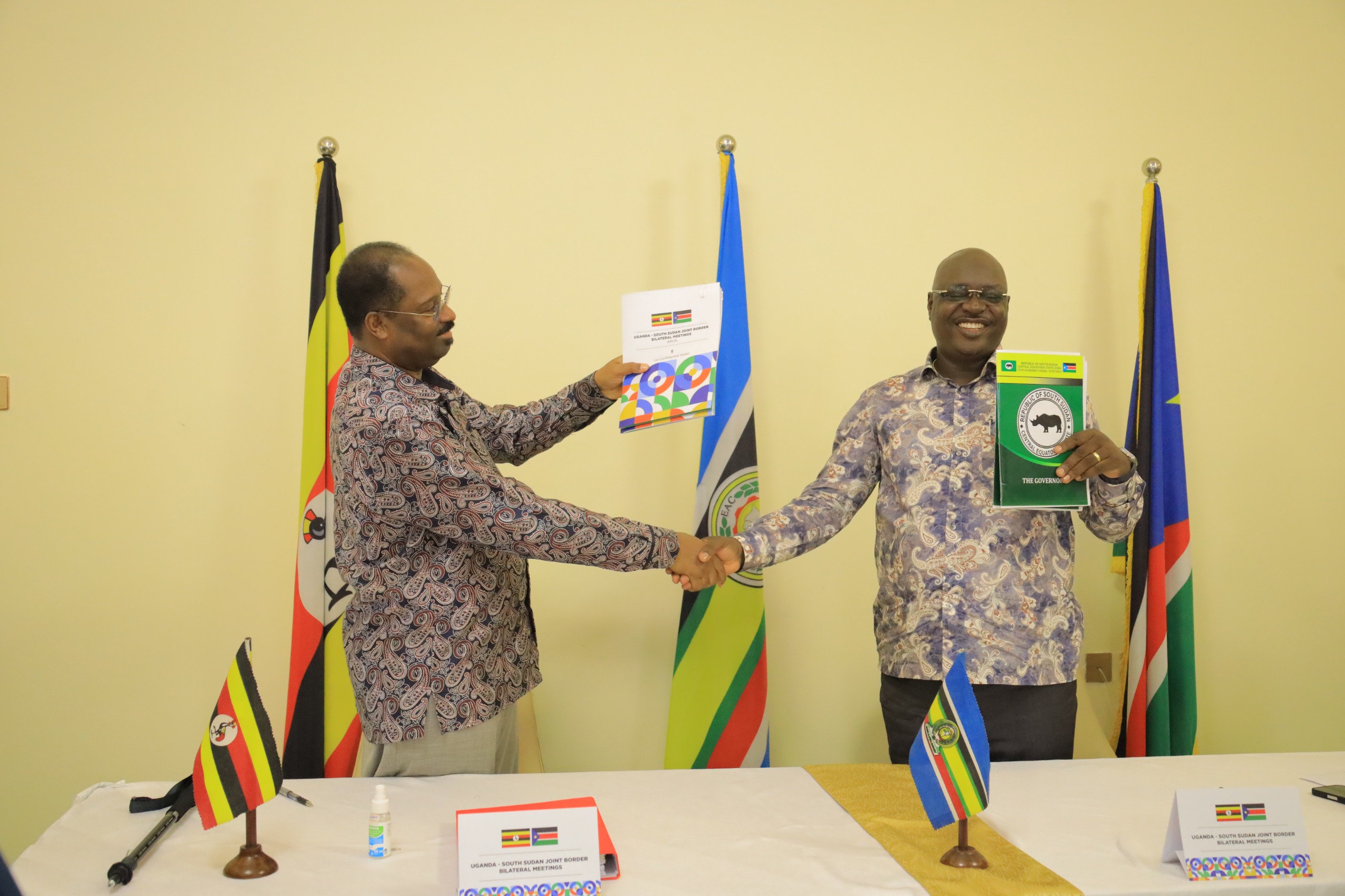
ARUA, Uganda — Uganda and South Sudan have reaffirmed their commitment to strengthening regional security, expanding cross-border trade, and accelerating economic integration following the successful conclusion of the 6th Uganda–South Sudan Joint Border Meeting on Economic and Security Cooperation held in Arua District from 23–24 July 2026.
The high-level bilateral engagement was convened pursuant to the strategic directives issued by President Yoweri Kaguta Museveni of Uganda and President Salva Kiir Mayardit of South Sudan during the Ugandan President’s State Visit to Juba in April 2025. The meeting reflects both governments’ continued commitment to transforming their shared border from a zone of vulnerability into a corridor of peace, commerce, and regional development.
Co-chaired by Uganda’s Ambassador to South Sudan, Ambassador Brig. Gen. Ronnie Balya, and the Governor of South Sudan’s Central Equatoria State, Emmanuel Adil Anthony Wani, the meeting brought together senior government officials, security agencies, technical experts, and border administrators to review progress and chart the next phase of bilateral cooperation.
Among the most consequential outcomes was the renewed commitment to resume the work of the Joint Technical Committee on Border Demarcation, tasked with reaffirming and re-marking the approximately 470-kilometre international boundary shared by the two countries. The delegations agreed to expedite the technical exercise with the objective of completing the process by 2027, a move expected to reduce recurring border disputes while improving governance, service delivery, and investment certainty in frontier communities.
For East Africa, clearly defined and jointly managed borders increasingly represent instruments of cooperation rather than division. Modern border management has become essential not only for national sovereignty but also for facilitating legitimate trade, combating transnational crime, and promoting regional integration under the East African Community (EAC) and the African Continental Free Trade Area (AfCFTA).
Security featured prominently during the deliberations, with both countries reaffirming their shared responsibility in addressing cross-border threats, including terrorism, violent extremism, organised crime, and illicit trafficking. Rather than focusing solely on military responses, the meeting adopted a broader understanding of border security one that incorporates regular joint patrols, intelligence sharing, continuous diplomatic consultations, and stronger engagement with traditional and community leaders.
The delegations also emphasized the importance of promoting accurate information and constructive public dialogue, recognising that misinformation and local tensions can undermine stability as much as physical insecurity. The outcome reflects an increasingly preventive approach to regional security, where trust-building and institutional coordination complement traditional defence cooperation.
Economic cooperation emerged as another central pillar of the meeting, Uganda and South Sudan committed to progressively eliminating both tariff and non-tariff barriers that continue to hinder cross-border commerce. The two sides also pledged to harmonise customs and immigration procedures while addressing bottlenecks affecting transport operators and private sector traders.
These reforms are expected to improve the movement of goods and people along the Central and West Nile transport corridors, routes that remain strategically important for regional supply chains linking Uganda with South Sudan and neighbouring markets. For Uganda, South Sudan remains one of its most significant regional export destinations. Facilitating smoother border operations has implications beyond bilateral commerce it supports food security, investment, logistics, and broader regional economic resilience.
Recognising that agreements require sustained implementation, both delegations adopted a comprehensive implementation matrix assigning responsibilities to government ministries, border authorities, security institutions, and private sector stakeholders. The immediate reactivation of Border Management Committees was also agreed upon to strengthen local coordination and ensure that policy commitments translate into practical improvements on the ground. Such institutional mechanisms are increasingly recognised as essential for sustaining peace in border regions, where local cooperation often determines the effectiveness of national policy.
The Arua meeting demonstrates how bilateral diplomacy can be used to address practical development challenges while reinforcing regional stability. At a time when many border regions across Africa continue to face pressures associated with insecurity, displacement, and informal trade, Uganda and South Sudan are pursuing a framework that combines diplomacy, security cooperation, economic integration, and community engagement.
The meeting concluded with expressions of appreciation from the South Sudanese delegation for Uganda’s hospitality, while both governments agreed that the 7th Uganda–South Sudan Joint Border Meeting will be hosted by the Republic of South Sudan on a mutually agreed date to be communicated through diplomatic channels. For the two neighbouring countries, the significance of the meeting extends beyond administrative coordination. It reflects a shared recognition that secure borders, efficient trade, and institutional cooperation are indispensable foundations for sustainable development and regional prosperity.
As East Africa advances its integration agenda, initiatives such as the Uganda–South Sudan Joint Border Meeting illustrate how diplomacy can move beyond declarations to deliver practical solutions that improve livelihoods, strengthen security, and reinforce confidence between neighbouring states.