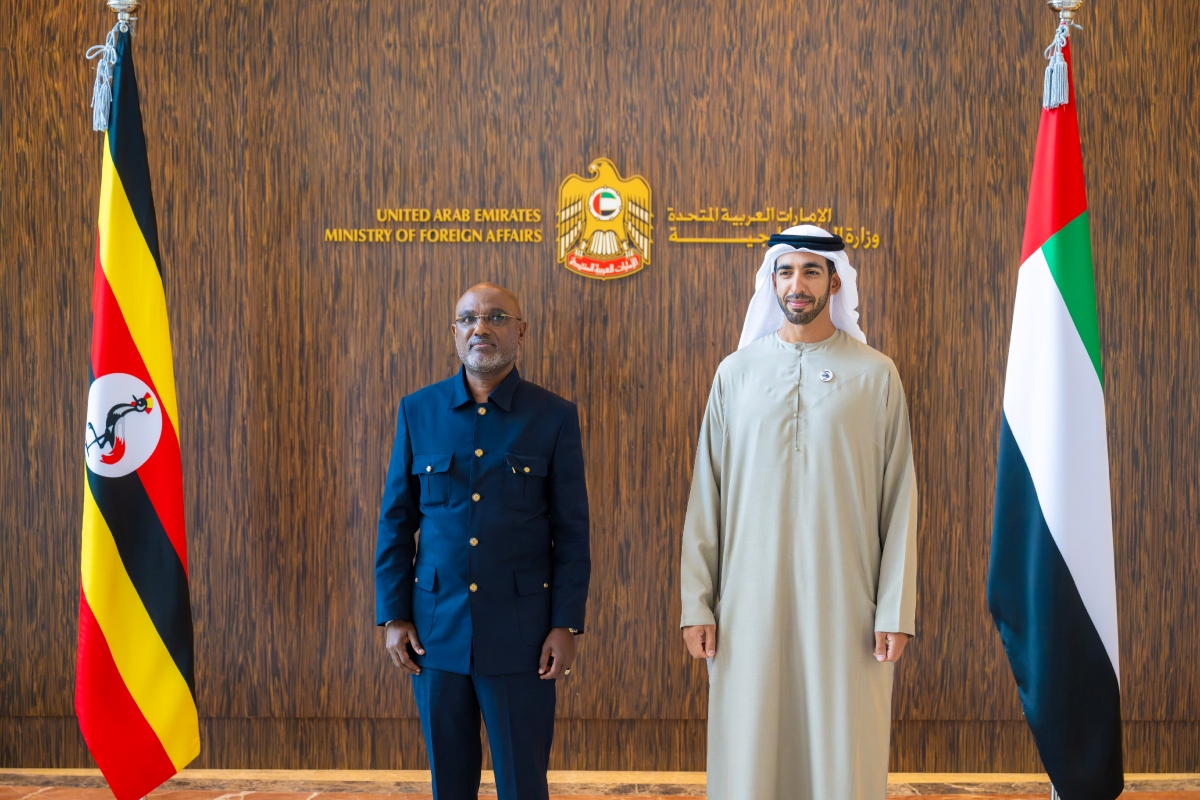
ABU DHABI / The meeting between Uganda’s Minister of Foreign Affairs, Hon. Adonia Ayebare, and the United Arab Emirates’ Minister of State, His Excellency Sheikh Shakhbout bin Nahyan Al Nahyan, at the UAE Ministry of Foreign Affairs in Abu Dhabi comes at a consequential moment for relations between the two countries. With substantial commercial interests connecting East Africa to the Gulf, the relationship offers opportunities for trade, investment and employment but also highlights the importance of predictable travel arrangements and effective diplomatic communication.

According to the official statement provided by the UAE side, the two officials discussed bilateral relations, opportunities to strengthen cooperation across multiple sectors, and regional and international developments of mutual concern. Sheikh Shakhbout reaffirmed the UAE’s commitment to expanding its partnership with Uganda for the benefit of both countries and their peoples. The meeting provides a diplomatic context for examining a broader question: how can Uganda and the UAE translate political goodwill into a more diversified, accessible and mutually beneficial economic partnership?
The timing is significant as the fifth Uganda–UAE Business Forum, initially scheduled for 26–29 October 2026 across Abu Dhabi, Dubai, Sharjah and Fujairah, has been postponed until further notice, according to the event’s official website. The forum had advertised participation by more than 500 business leaders and 100 investors, with discussions planned across ten priority sectors. The organisers have not established a new date in the information currently available. Diplomatic engagement, billions of dollars in reported trade and unresolved travel concerns place economic cooperation at the centre of the Uganda–United Arab Emirates partnership.
The economic relationship between Uganda and the UAE extends beyond diplomatic exchanges. It connects Uganda’s agricultural, mineral and other export sectors with one of the Gulf’s major commercial and logistics centres. United Nations international trade data compiled by Trading Economics indicate that Uganda’s reported merchandise exports to the UAE reached approximately US$5.18 billion in 2025, compared with approximately US$2.61 billion in 2024. These figures should be interpreted carefully: the value of gold and other precious metals dominates the reported export relationship, and trade figures can be affected by commodity prices, reporting methods and the classification of goods.
In 2025, the same dataset recorded approximately US$5.09 billion in exports under the category of pearls, precious stones, metals and coins. Coffee, tea and spices accounted for approximately US$30.9 million, while mineral fuels and oils contributed about US$20.5 million. Fish and aquatic products accounted for a further US$9.15 million. These figures illustrate both the scale of commercial engagement and a strategic challenge: the need to ensure that strong headline export values translate into broader domestic economic benefits.
Uganda’s economic diplomacy can use the UAE relationship to expand access for coffee, fish, fruits, vegetables, processed foods and other products, while encouraging investment in agro-processing, storage, logistics, manufacturing and export-oriented industries. For the UAE, Uganda offers an agricultural base, a strategic position within the East African Community and opportunities to participate in regional value chains. For Uganda, the UAE provides access to investors, commercial networks, international shipping connections and markets extending beyond the Gulf. The next phase of cooperation should therefore focus not only on the value of goods traded but also on value addition, market diversification, technology transfer, employment and the proportion of export earnings retained within Uganda’s economy.
One of the most sensitive issues affecting the relationship has been the travel and visa restrictions introduced in June 2026 in response to the Ebola outbreak in the region. On 26 September 2026, the UAE’s National Emergency Crisis and Disaster Management Authority, working with the Ministry of Health and Prevention and the Federal Authority for Identity, Citizenship, Customs and Port Security, announced that it was easing precautionary entry measures affecting Ugandan nationals. The announcement followed the conclusion of Uganda’s Ebola outbreak monitoring period.
The decision marked an important public-health and diplomatic development. However, the easing of precautionary entry measures should not automatically be interpreted as a guarantee that every visa application will be approved or that all individual entry requirements have been removed. Reports and concerns circulating among some Ugandan travellers and business stakeholders suggest uncertainty about whether the change has translated into predictable access in practice. As of the information available for this article, no independently verified official announcement establishes a blanket prohibition on Ugandan nationals travelling to the UAE after the easing of the Ebola-related measures.
Uganda’s Embassy in Abu Dhabi has previously addressed similar allegations. In a statement published on 20 September 2025, the mission said there was no official UAE communication announcing a general visa ban against Ugandans at that time. It explained that applications were assessed under UAE immigration regulations and encouraged travellers to use official information channels, submit complete documentation and avoid intermediaries promising expedited processing. That statement concerned the circumstances prevailing in 2025 and should not be treated as conclusive evidence of every applicant’s position in October 2026.
The distinction is important for responsible journalism and effective diplomacy. Unverified claims of a continuing blanket ban should not be presented as established fact. Equally, official announcements easing restrictions do not eliminate the need to address credible concerns from travellers whose applications remain unresolved. The policy challenge is to ensure that public-health precautions, immigration administration and commercial mobility operate through clear, consistent and accessible procedures.
For exporters, investors, conference delegates and service providers, uncertainty can have practical consequences. Delayed travel may disrupt negotiations, increase transaction costs, complicate contractual commitments and weaken confidence in business events designed to connect the two markets. A structured dialogue between the relevant diplomatic, immigration, public-health and business authorities could help clarify applicable procedures, identify recurring application difficulties and provide reliable information to travellers.
The fifth Uganda–UAE Business Forum was designed to connect government representatives, exporters, investors and business leaders across four emirates over four days. Its advertised programme covered agriculture and agro-processing, trade and exports, mining and minerals, tourism, infrastructure and energy, logistics and air cargo, manufacturing, financial services, technology, and health and pharmaceuticals.
The scale of the planned gathering more than 500 business leaders and 100 investors, according to the organisers demonstrated the ambitions attached to the bilateral commercial relationship. Its postponement, announced on the official event website, creates a practical gap in the calendar for businesses preparing to meet prospective partners. However, the available announcement does not identify the reason for the postponement. It would therefore be premature to attribute the decision to visa restrictions, diplomatic disagreements or any other specific factor without confirmation from the organisers.
The more consequential question is how both countries can preserve the momentum behind the initiative. A rescheduled forum could provide an opportunity to move from general investment promotion towards measurable commercial outcomes: signed purchase agreements, financing commitments, joint ventures, export contracts, technology partnerships and investment projects with defined implementation schedules.
Ugandan businesses would benefit from transparent information about participation, travel requirements, costs and revised dates. UAE investors, meanwhile, would benefit from clear project documentation, reliable data, predictable regulatory procedures and credible mechanisms for evaluating investment opportunities. The forum’s eventual success should be measured not by attendance alone, but by the quality and implementation of the business relationships it generates.
The concentration of reported exports in precious metals presents an important question for Uganda’s economic diplomacy. Gold is a significant contributor to Uganda’s export earnings, but high commodity values do not necessarily indicate that other productive sectors have reached their full export potential. A stronger commercial partnership would create opportunities for agricultural producers, processors, manufacturers, tourism operators, logistics companies and technology enterprises.
Coffee offers one example. Uganda has an established coffee-producing base and opportunities to expand the value captured through processing, branding, specialty products and direct commercial relationships. UAE-based distributors, hospitality businesses and retailers could become partners in developing higher-value market channels. Agricultural cooperation could also extend to fish, fresh produce, pulses, food processing, cold-chain infrastructure and standards compliance. These areas would require investment in quality assurance, traceability, storage, packaging and dependable transport.
Infrastructure and logistics are equally important. Improved cargo connections, efficient customs processes and stronger coordination between public agencies and private operators can reduce the costs of reaching international markets. Investment in manufacturing, renewable energy, digital services and health-related industries could further expand the relationship beyond the exchange of commodities.
For Uganda, the strategic objective is to attract investment that expands productive capacity, supports skills development, creates sustainable employment and strengthens domestic enterprises. For the UAE, a diversified partnership offers opportunities to build reliable supply relationships, invest in emerging markets and strengthen commercial links with East Africa.
The meeting between Sheikh Shakhbout and Ambassador Ayebare illustrates the continuing importance of diplomatic engagement in addressing issues that affect both political relations and everyday commercial activity. Diplomatic relationships are sustained not only through high-level meetings and public declarations but also through the effectiveness of the institutions responsible for implementing agreed decisions. Immigration authorities, public-health agencies, trade ministries, investment agencies, embassies and business associations all have roles in ensuring that cooperation delivers practical results.
Three priorities stand out.
- First, clarity on travel and visa procedures. Relevant authorities should communicate current requirements accurately and provide appropriate channels for applicants and businesses to seek clarification. Where individual cases encounter difficulties, established consular and administrative mechanisms can help identify the applicable rules.
- Second, renewed momentum for business engagement. Organisers should communicate the status of the postponed forum and provide a revised programme when confirmed. In the interim, chambers of commerce, trade agencies and diplomatic missions can continue facilitating sector-specific meetings and commercial partnerships.
- Third, a stronger focus on measurable economic outcomes. Bilateral cooperation should be assessed through transparent trade data, investment implementation, export diversification, employment creation and the development of sustainable commercial relationships. These priorities would strengthen confidence without requiring either government to prejudge individual visa cases or speculate about the reasons behind the forum’s postponement.
Uganda and the UAE have a clear basis for expanding cooperation. Their commercial relationship connects East African production and investment opportunities with Gulf-based capital, distribution networks and international business services. The challenge is to ensure that this potential is supported by predictable procedures, credible information and a diversified economic agenda.
The easing of Ebola-related precautionary entry measures was an important development, but sustained confidence will depend on how applicable rules are implemented and communicated. Similarly, the postponed business forum need not define the trajectory of the relationship. With clear communication and continued engagement, it can remain an opportunity to strengthen cooperation when a new date is confirmed.
For Uganda, the priority is to convert market access and investment interest into productive capacity, higher-value exports and employment. For the UAE, the opportunity lies in building durable commercial partnerships that support supply-chain resilience and mutually beneficial growth. Ultimately, the strength of Uganda–UAE relations will be measured not only by the frequency of diplomatic meetings or the value of headline trade figures, but by the extent to which cooperation creates tangible and sustainable benefits for businesses, workers and citizens in both countries.