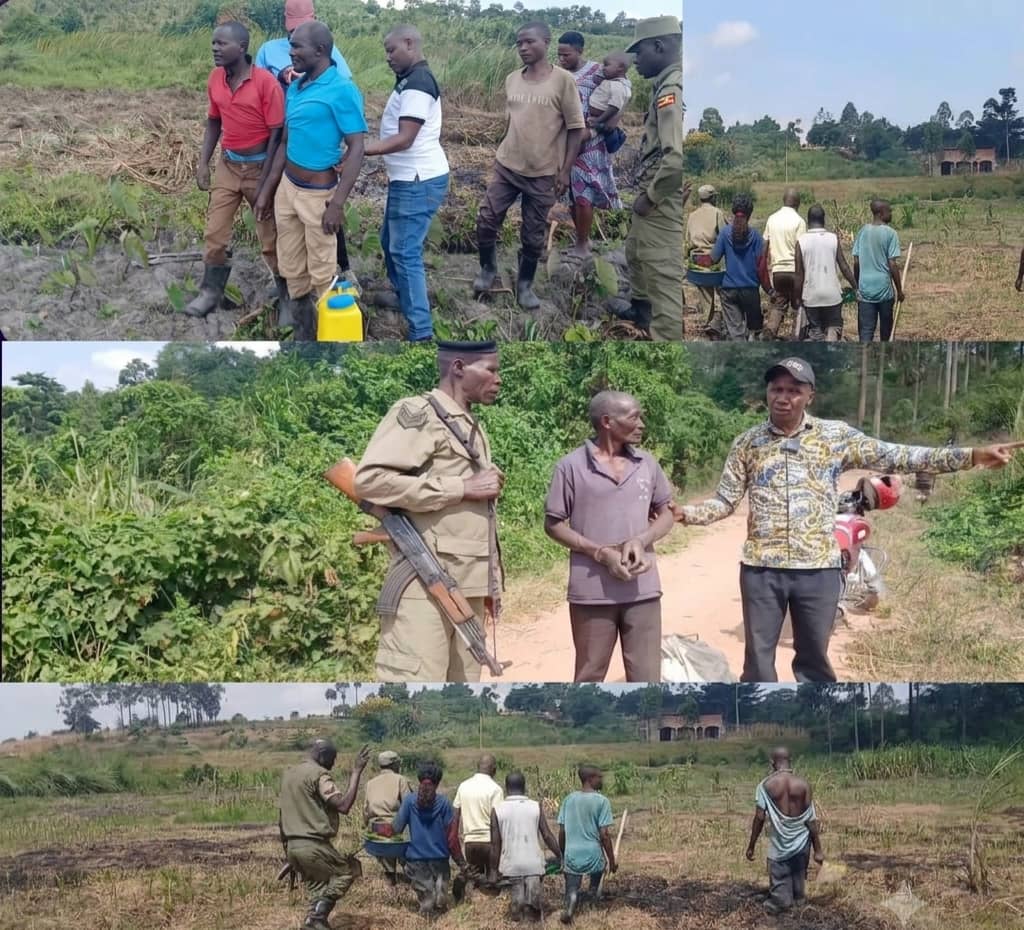
Mubende, Uganda — The arrest of 12 individuals accused of cultivating protected wetlands in Mubende District has reignited a long-standing national debate: Is environmental enforcement in Uganda being applied equally, or does it disproportionately affect the poor while influential actors remain untouched?
The arrests, carried out during a two-day operation led by Kassambya Assistant Resident District Commissioner (RDC) Andrew Solomon Musiindi alongside police and environmental officials, were presented as part of the government’s ongoing campaign to restore degraded wetlands following presidential directives against encroachment. Authorities maintain that the operation is intended to protect fragile ecosystems that are critical for water retention, flood control, biodiversity, and climate resilience. “Anyone found cultivating or carrying out activities in wetlands will be arrested and prosecuted,” Musiindi said during the operation. Among those arrested was a local village chairperson, Fred Kato, whom officials allege was involved in cultivation activities within a protected wetland. Kato has indicated his willingness to cooperate with investigators as inquiries continue while environmental conservation remains an important national objective, the operation has also exposed deeper questions about consistency in enforcement.
Who Bears the Weight of Environmental Law?
Across Uganda, wetland restoration campaigns have frequently resulted in arrests of small-scale farmers, many of whom argue that cultivation in these areas has historically been tied to survival, food security, and household income. In Mubende, several residents interviewed during the operation appealed for alternative livelihood programs, arguing that enforcement alone cannot address the economic realities driving encroachment. Yet critics argue that enforcement often appears more visible in rural communities than in cases involving powerful individuals, commercial interests, or large-scale developments.
This perception continues to fuel public skepticism with Several residents pointed to previous concerns regarding developments reportedly established in or near sensitive wetland areas within Mubende Municipality and surrounding locations. These concerns have circulated for years in public discussions, though questions remain regarding whether all allegations have been independently investigated or acted upon by relevant authorities. Environmental governance experts note that public confidence in conservation efforts depends not only on arrests but also on demonstrating that laws apply equally to all actors regardless of wealth, political affiliation, or social status.
Development Versus Conservation
The debate becomes even more complex when viewed against Mubende’s ongoing urban transformation. Over the past decade, the municipality has benefited significantly from the Uganda Support to Municipal Infrastructure Development (USMID) programme, funded through the World Bank and the Government of Uganda. Road upgrades, drainage systems, public spaces, market infrastructure, and beautification projects have altered the municipality’s landscape. However, questions are increasingly being raised about the sustainability of these investments.
Residents and observers point to visible signs of deterioration in some public infrastructure even before certain projects have reached full maturity. Such concerns have generated calls for stronger oversight, maintenance planning, and value-for-money assessments. Particularly notable is the condition of some public spaces developed under urban renewal programmes, including facilities intended to improve environmental protection and urban aesthetics. If wetlands continue to be degraded while public funds and donor resources are simultaneously invested in environmental restoration and climate-resilient infrastructure, experts warn that municipalities risk undermining the very objectives those projects were designed to achieve.
The wider conversation also intersects with questions of local government accountability. Financial reports from Mubende Municipal Council have shown substantial funding inflows, including support through the USMID programme. While infrastructure development has remained highly visible, residents continue to raise concerns regarding service delivery gaps in sectors such as waste management, healthcare, education, and urban maintenance. These concerns are not unique to Mubende, Across Uganda, municipalities are increasingly being challenged to demonstrate how locally generated revenue is being utilized alongside donor-supported investments. For taxpayers, the central question remains straightforward: If external partners are financing major infrastructure projects, how effectively are local resources being deployed to improve everyday services? Transparency advocates argue that public trust is strengthened when governments openly communicate expenditure priorities, procurement decisions, project performance, and maintenance strategies.
The latest wetland operation now presents a defining test for authorities, will environmental enforcement remain focused on subsistence cultivators and local community members, or will investigations extend equally to all alleged forms of wetland degradation, including those linked to influential individuals, commercial developments, and large-scale investments? The answer may determine whether the public views the campaign as genuine environmental protection or selective enforcement.
For Uganda, where wetlands continue to disappear under pressure from urbanization, agriculture, and commercial development, conservation efforts will only achieve lasting legitimacy if they are seen to be fair, transparent, and impartial. Protecting wetlands is undoubtedly a national responsibility. But so too is ensuring that environmental justice is applied without fear, favour, or exception. As enforcement operations continue across Mubende and beyond, citizens will be watching closely not simply to see who gets arrested, but to see whether the law reaches every corner of the wetland, regardless of who occupies it. Allegations concerning specific developments or individuals referenced by community members require verification through relevant government agencies, environmental regulators, and official investigations. Daily Thinkers remains committed to factual reporting, evidence-based analysis, and the principles of fairness and responsible journalism.