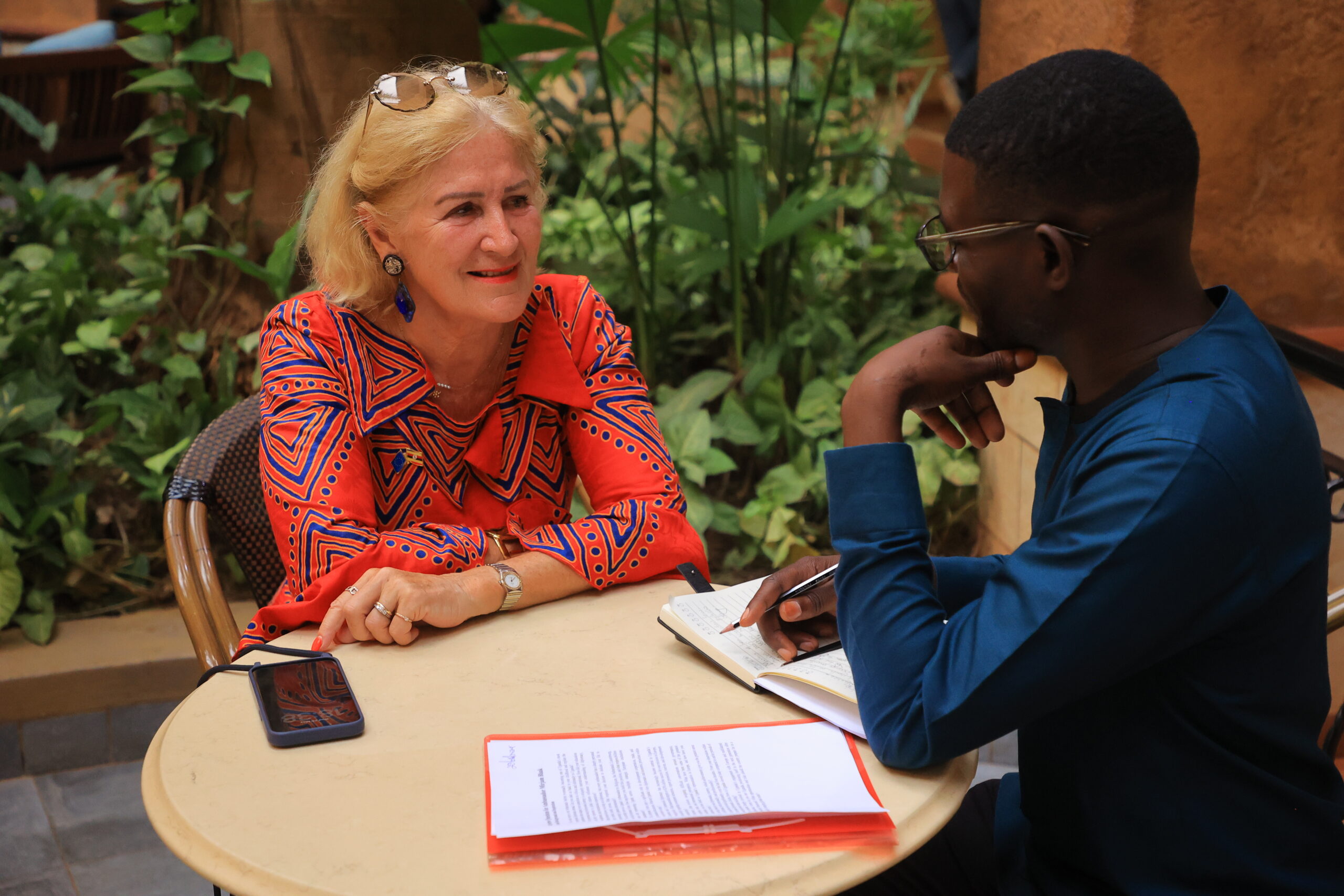
L-R Amb. Mirjam Blaak and Our Editor During the Interview
Kampala, Uganda — For more than three decades, Ambassador Mirjam Blaak has occupied a distinctive place within Uganda’s diplomatic history. Born in the Netherlands and trained in international law, her journey into African diplomacy did not begin through politics, but through curiosity, travel, and humanitarian service. Today, as Uganda’s Ambassador to Belgium, the Netherlands, Luxembourg and the European Union, she stands among the country’s longest-serving and most recognisable diplomatic figures in Europe. Yet behind the official titles lies a story deeply intertwined with Uganda’s liberation history, refugee protection during East Africa’s political turbulence, the reconstruction of Uganda’s economy after 1986, and the evolution of Economic and Commercial Diplomacy as a defining pillar of modern foreign policy.
In this exclusive conversation with Daily Thinkers, Ambassador Blaak reflects on the experiences that shaped her worldview, Uganda’s transformation over four decades, relations with the European Union, and Africa’s place within a rapidly changing global order. Born and raised in the Netherlands, Ambassador Blaak describes her childhood as one shaped by international curiosity. Her father, who directed a shipping and transport company operating across Africa, Asia and the Middle East, frequently returned home with stories about different cultures and societies. Those early influences, she explains, awakened a fascination with the wider world long before diplomacy became part of her life. While studying law and later specialising in international law, she worked for KLM as an air hostess for nearly five years, an experience she describes as formative in understanding cultures beyond Europe. “I often say I was being paid to discover the world,” she remarked with a reflective smile. “Africa particularly touched me the openness of the people, the beauty of nature, the sense of freedom. Over time, the continent stopped feeling distant. It became emotionally part of my life.”
Her professional transition into humanitarian and diplomatic work emerged during the politically volatile years of East Africa in the early 1980s. Assigned by the Dutch Ministry of Foreign Affairs to work with the United Nations High Commissioner for Refugees (UNHCR) in Kenya as a Protection Officer, she encountered refugees fleeing instability and political violence across the region, including many Ugandans escaping the turbulence of the pre-1986 period. Among those she encountered were individuals who would later occupy influential positions within Uganda’s political establishment. For Ambassador Blaak, those experiences transformed diplomacy from academic theory into a deeply human responsibility. “Diplomacy stopped being abstract,” she explained. “It became about survival, dignity, and protecting people during moments of uncertainty.”
Her connection to Uganda deepened further during the liberation struggle. Following the 1985 coup, she became involved in facilitating communication between National Resistance Army representatives and diplomatic actors in Nairobi. When Kampala was captured in January 1986, she travelled to Uganda alongside returning Ugandan exiles and leaders preparing to form the new government. What she encountered upon arrival left a lasting impression. “The country had been devastated economically,” she recalled. “Factories were idle, infrastructure had collapsed, and institutions barely functioned. But there was also extraordinary determination to rebuild.”
That rebuilding process, she says, became inseparable from her own personal journey. Uganda would later become her home, where she started a family with her late husband, Dr Ronald Batta, a historical freedom fighter and surgeon who joined the NRA struggle. Today, after nearly fourteen years as Head of Mission in Brussels, Ambassador Blaak oversees one of Uganda’s most strategically important diplomatic postings. Her responsibilities span bilateral relations with Belgium, the Netherlands and Luxembourg, while simultaneously engaging European Union institutions on trade, development cooperation, political dialogue, regional security and investment promotion. According to Ambassador Blaak, modern diplomacy has evolved far beyond ceremonial representation. “Success today is measured through practical outcomes,” she explained. “How much investment are you attracting? How many jobs are created? How much market access are you opening for your country?”
Her mission has increasingly focused on Economic and Commercial Diplomacy attracting European investment into Uganda’s agriculture, fisheries, manufacturing, tourism and infrastructure sectors. She points to Uganda’s progress in meeting European phytosanitary standards for fisheries exports as one example of how patient diplomacy can generate long-term economic gains. At the same time, she acknowledges that diplomacy often requires navigating sensitive conversations around governance, migration, international perception and geopolitical interests. “The challenge is frequently perception management,” she observed. “International narratives about African countries are not always balanced or contextualised.” Rather than confrontation, she believes diplomacy requires sustained engagement, patience, and mutual respect. “Real diplomacy is not emotional activism,” she said. “It is consistent dialogue built on facts, relationships and understanding.”
Reflecting on Uganda’s trajectory since 1986, Ambassador Blaak argues that the country’s transformation remains significant within regional and international circles. From economic collapse and institutional breakdown, Uganda has gradually repositioned itself as a regional security actor, an emerging investment destination, and a country of growing geopolitical relevance within East Africa. Looking ahead, she believes Uganda possesses substantial long-term potential, particularly through industrialisation, agriculture, regional trade, tourism, and value addition. “The opportunities are enormous,” she noted. “But so are the risks if issues like corruption, youth unemployment and complacency are not addressed strategically.”
As global power dynamics continue shifting, Ambassador Blaak believes Africa’s future will increasingly depend on how effectively its countries position themselves within emerging economic and diplomatic frameworks rather than remaining peripheral actors within global affairs.
Before concluding the interview, she offered a final reflection directed toward Uganda’s next generation of diplomats. “Diplomacy is not social media performance,” she said. “It is human engagement, listening, patience, understanding people, and negotiation. Representing your country is both a responsibility and an honour.”