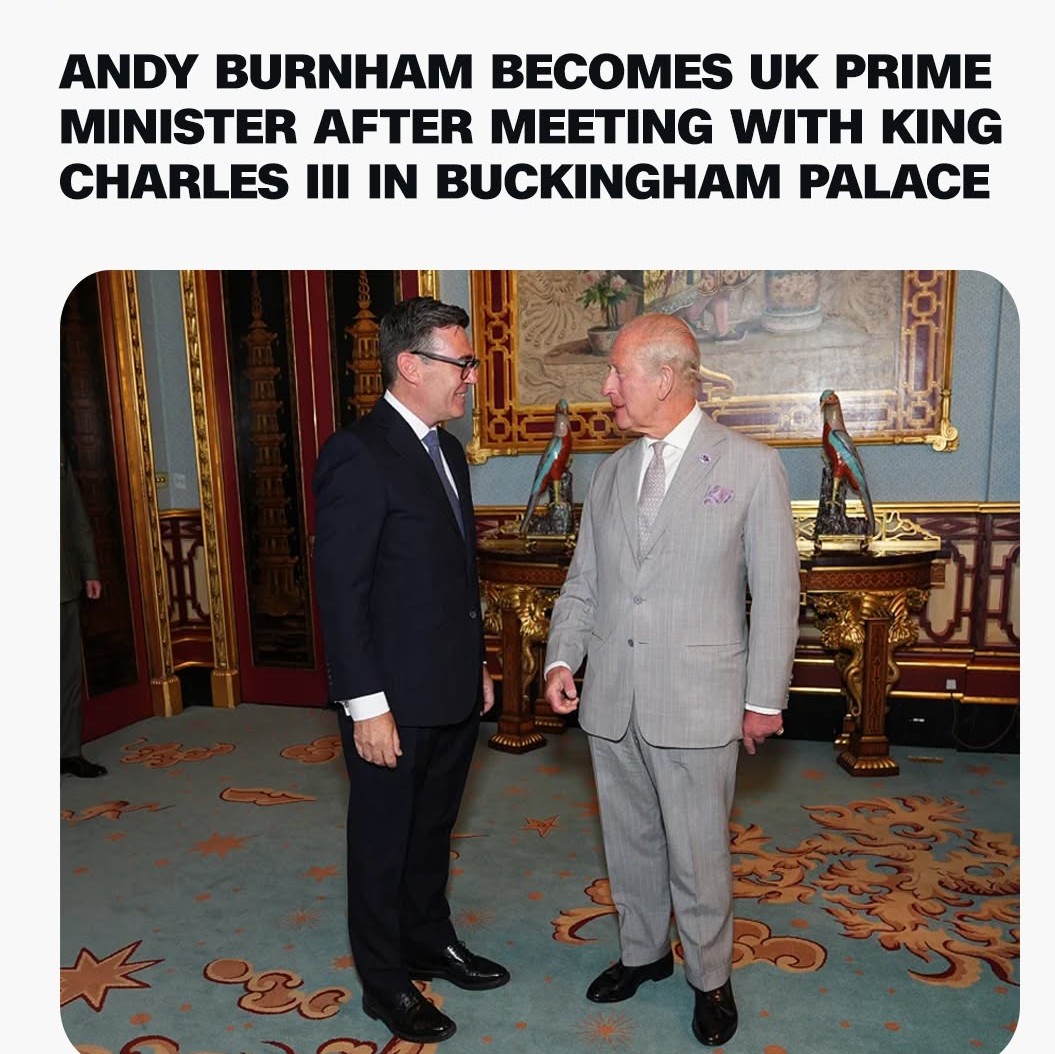
LONDON, United Kingdom — Andy Burnham has officially become the United Kingdom’s new Prime Minister after King Charles III invited him to form a government at Buckingham Palace, marking another significant chapter in British politics following the resignation of Sir Keir Starmer. Burnham’s appointment makes him the country’s seventh prime minister in just over a decade, underscoring a period of sustained political transition in Westminster.
The constitutional ceremony followed long-established British tradition. Earlier in the day, Sir Keir Starmer formally tendered his resignation to the King before Burnham was received at Buckingham Palace, where the monarch requested that he form a new administration. Under the UK’s constitutional monarchy, the sovereign appoints the individual most likely to command the confidence of the House of Commons to serve as Prime Minister.
Burnham assumes office after securing the Labour Party leadership unopposed following Starmer’s resignation, which came amid mounting political pressure despite Labour’s decisive general election victory in 2024. The leadership transition occurred without a general election, a process that is constitutionally permitted under the UK’s parliamentary system when the governing party changes its leader while retaining a majority in Parliament.
A familiar figure in British politics, Burnham brings decades of experience to Downing Street. He previously served as a Cabinet minister under Labour governments before spending nearly a decade as Mayor of Greater Manchester, where he gained national recognition for championing regional devolution, public transport reforms, and local economic development. More recently, he returned to Westminster as Member of Parliament for Makerfield before successfully contesting the Labour leadership.
Addressing the nation outside 10 Downing Street, Burnham pledged to restore confidence in government while acknowledging the scale of the challenges facing the country. He called for a more constructive political culture, promising to improve living standards, strengthen economic growth, and build upon the foundations laid by his predecessor. His remarks combined realism with optimism, stressing the need for long-term planning and national unity.
Among Burnham’s immediate priorities are tackling the cost-of-living pressures affecting households, stimulating economic growth, expanding regional devolution, and delivering reforms to public services. His incoming administration is also expected to announce a reshaped Cabinet as it begins implementing its legislative and economic agenda. Financial markets and international partners will be closely watching the new government’s policy direction, particularly on taxation, investment, energy, and public spending.
The leadership transition is also being closely followed internationally. As one of the world’s leading economies and a permanent member of the United Nations Security Council, the United Kingdom plays a significant role in global diplomacy, security, trade, climate policy, and development cooperation. Burnham’s foreign policy decisions will therefore have implications extending beyond Britain, particularly in relations with Europe, the Commonwealth, the United States, and emerging economies across Africa and Asia.
For African countries, including Uganda, the change in leadership presents an opportunity to strengthen bilateral engagement across trade, investment, education, climate resilience, security cooperation, and sustainable development. The United Kingdom remains an important development and commercial partner for many African nations, making the priorities of the new government relevant to policymakers across the continent.
Burnham’s appointment closes one chapter in British politics while opening another. Whether his government succeeds in restoring political stability and delivering economic renewal will be closely scrutinised both at home and abroad. As he begins assembling his Cabinet and outlining his legislative programme, attention now turns to how his administration will translate campaign promises into governance and navigate the domestic and international challenges ahead.
SEO Keywords: Andy Burnham Prime Minister, UK Prime Minister 2026, King Charles III, Buckingham Palace, Keir Starmer resignation, UK politics, Labour Party, British government, Downing Street, United Kingdom leadership, UK foreign policy, Daily Thinkers.