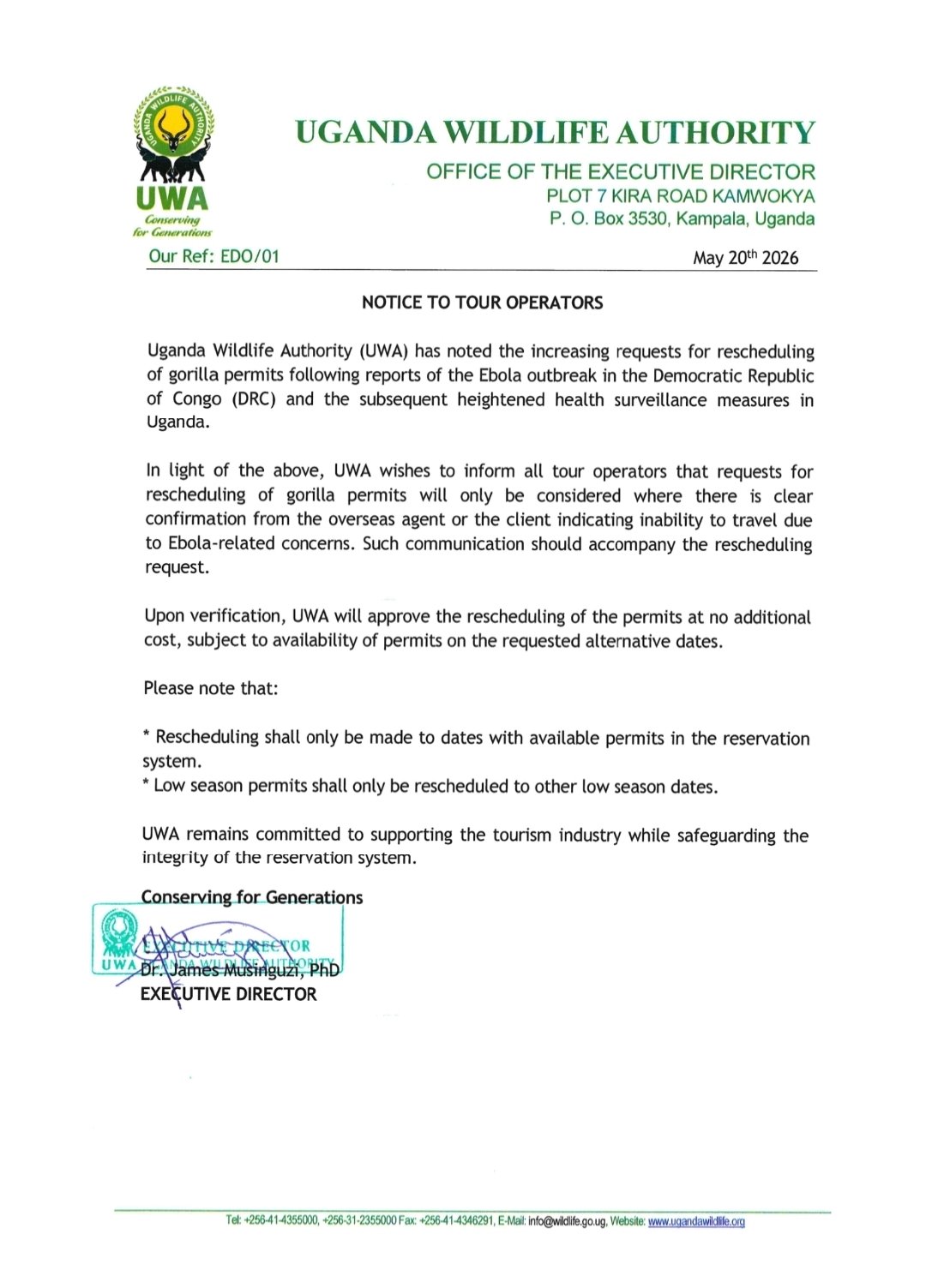
Kampala, Uganda — The Uganda Wildlife Authority has issued a notice allowing rescheduling of gorilla permits following Ebola-related concerns linked to the Democratic Republic of Congo (DRC) reflects the growing pressure East African tourism economies face whenever regional health outbreaks emerge near shared borders. While Uganda has not declared an Ebola outbreak within its key tourism destinations, international perception, amplified by global media coverage, often moves faster than geographic realities.
Once reports of Ebola cases in eastern DRC surfaced, international headlines quickly framed the outbreak within the wider East African region. For many overseas travelers unfamiliar with regional border dynamics, distinctions between outbreak zones and tourism circuits become blurred. The result has been growing concern among tourists and international travel agents, particularly regarding gorilla trekking experiences in southwestern Uganda due to their proximity to the DRC border. The Uganda Wildlife Authority (UWA), through its latest communication to tour operators, acknowledged the increasing number of requests for gorilla permit rescheduling amid Ebola fears. The notice outlines a flexible approach allowing tourists unable to travel due to outbreak-related concerns to reschedule permits at no additional cost, subject to availability and verification from overseas agents or clients.
From a tourism management perspective, the move signals an attempt to preserve confidence within Uganda’s high-value conservation tourism sector while balancing public health sensitivity and operational continuity. Gorilla tourism remains one of Uganda’s most important foreign exchange earnings and a cornerstone of its international destination branding. Any prolonged disruption within this segment carries implications not only for tourism revenues, but also for conservation financing, community livelihoods, and investor confidence across the hospitality sector. However, the situation also raises broader questions about crisis communication and regional tourism resilience within East Africa. In today’s global information environment, outbreaks, insecurity, or conflict occurring near borders can rapidly affect entire regional tourism ecosystems regardless of whether destinations themselves remain operationally safe.
Uganda now finds itself confronting a familiar challenge faced by many tourism-dependent economies: how to manage international perception during external crises largely beyond direct national control. Health outbreaks, much like security incidents, often produce fear-driven reactions among travelers, insurers, and international operators long before official risk assessments are fully understood. The challenge becomes even more significant given Uganda’s tourism recovery cycle. The country has been operating within a relatively slower tourism season, and industry stakeholders were anticipating improved arrivals as peak travel months approached. The emergence of Ebola concerns linked to neighboring DRC therefore arrives at a particularly sensitive moment for tour operators, hotels, transport providers, and conservation agencies hoping to stabilize post-pandemic growth momentum.
Industry observers increasingly argue that East African tourism resilience now depends not only on destination attractiveness, but also on how governments and institutions communicate during crises. Travelers today respond as much to perception management as to the actual risk environment. This is where comparisons with Rwanda’s tourism crisis management model frequently emerge within regional conversations. Rwanda has over the years built a reputation for disciplined crisis communication, rapid international engagement, and centralized narrative management during periods of regional insecurity or external concern. Even amid occasional rebel activity near border regions, Rwanda’s tourism sector has often succeeded in maintaining global confidence through coordinated messaging, diplomatic reassurance, aggressive destination branding, and visible institutional response systems.
The lesson for Uganda may not necessarily lie in replicating Rwanda’s model entirely, but in strengthening institutional coordination between tourism authorities, public health agencies, foreign missions, airlines, tour operators, and international media engagement teams during periods of regional uncertainty. Tourism crises today are rarely resolved through silence alone. In many cases, absence of coordinated communication allows speculation and international anxiety to dominate narratives. Proactive visibility, transparent updates, health preparedness briefings, and targeted reassurance campaigns increasingly form part of modern tourism diplomacy. Equally important is the role of regional cooperation. Because East Africa’s tourism ecosystem is interconnected, outbreaks or security incidents affecting one country often influence neighboring destinations. This creates a growing need for coordinated regional response mechanisms capable of distinguishing isolated risk zones from unaffected tourism corridors.
Uganda’s conservation assets remain globally competitive. Bwindi Impenetrable National Park, community tourism initiatives, cultural heritage sites, and biodiversity experiences continue to attract significant international interest. Yet protecting these gains increasingly requires investment not only in wildlife conservation, but also in strategic communication infrastructure capable of managing perception during unpredictable crises. The UWA notice therefore represents more than an administrative adjustment for tourists. It reflects the delicate balancing act confronting African tourism economies operating within complex regional realities where public health, geopolitics, media narratives, and economic survival intersect. As East Africa continues navigating cross-border health and security uncertainties, the broader challenge will not simply be responding to outbreaks after they occur. It will be building tourism systems resilient enough to sustain confidence even during periods of regional instability. In global tourism, perception can influence economies almost as powerfully as reality itself.